
Keep up with the news by installing RT’s extension for . Never miss a story with this clean and simple app that delivers the latest headlines to you.


US allows Royal Dutch Shell to drill in the Arctic

Published time: August 31, 2012 11:09
Edited time: August 31, 2012 20:09
Royal dutch shell

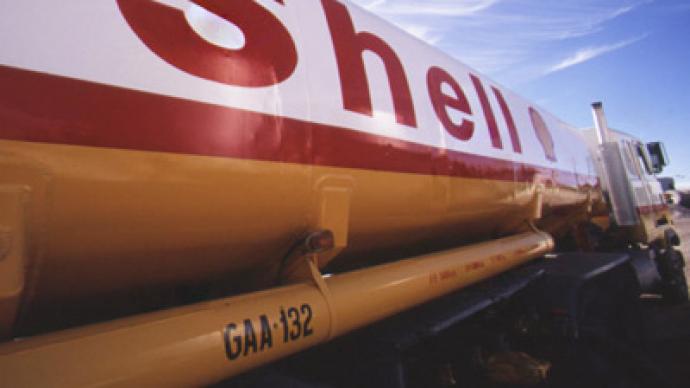
Royal Dutch Shell has been granted permission by the US government to begin tentative drilling in the Chukchi Sea off the Alaskan coast.

Getting the right for preliminary drilling is a step forward in the company’s long-delayed effort to develop lucrative Arctic reserves.

Shell will be allowed to begin preparatory work, but cannot drill in the oil fields until the government verifies its spill containment system, the US Interior Department said. The company has already spent $4.5 billion in exploring for oil and gas off Alaska's coast.

Shell has faced several delays in its planned Arctic drilling, and has been eyeing offshore in Alaska since 2005. Fierce opposition from environmentalists impeded previous plans. The groups say Shell had not met the commitments laid out in its drilling plans and should not be allowed to move forward at this point.

Shell's vice president for Alaska Pete Slaiby put the government's decision to allow some drilling as "exciting", saying that even if Shell's drilling this year was limited, that would be an important accomplishment.

Shell has asked the government to extend its oil drilling season in the Chukchi Sea beyond the September 24 deadline currently in place. Without an extension, the chances of completing a well this year are slim, Slaiby said.

Rival Exxon Mobil has already teamed up with the Russian oil company Rosneft to explore the vast Arctic regions of Russia.

In another development Exxon Mobil and Shell are reportedly seeking greater stakes and operating control in the one of the world’s biggest oil fields – the $46 billion Kashagan field in Kazakhstan. Both companies are said to be in talks with the Kazakh government to extend their production-sharing agreement for 20 more years according to Bloomberg Businessweek.


­

Comments (5)

Mohamed Al Hashimi 01.09.2012 11:32

United States has already taken Alaska from Russia and now they are trying to take Arctic from Russia ! Actually, United States started new oil war by controlling whole oil gates in the world.

0

Undo

Markus (unregistered) 01.09.2012 07:07

Why do you need permission from the US government to drill holes in the earth?

0

Undo

Today, America... Tomorrow, the World (unregistered) 31.08.2012 16:39

As exciting as all of this is, it's just the beginning.After all, extraction difficulties aren't just a problem in the United States...A whopping 65% of all the world's proven oil reserves are also abandoned.Now, just imagine what it would mean if companies could suddenly reach this oil.Well, the folks over at BP don't have to imagine...According to a company memo:The prize in enhancing recovery rates is enormous...a 5% increase in recovery - a conservative increase thought to be achievable - would yield an additional 300 to 600 billion barrels.Think about that for a minute...Even at the low end of BP's estimates, you're looking at one company's ability to produce enough oil to meet demand for more than 50 years. That's why oil companies are lining up for this technology.The cost to find, drill, and develop a new oil field can total well over $20 billion.The rentals on deepwater platforms alone run about a half million dollars per day!And forget about all the regulatory issues involved with drilling new wells... These wells already exist.                                  Not for You, China Countries all over the world are using the Petro-Pusher to vastly increase oil production.  But there's one country where you definitely won't see it used: China. As the CEO of this company that designed the "Petro-Pusher" explains: "... protecting the device and the science behind it, our intellectual property comes first." And that's why "we won't market in a country that does not have our interests at heart. We've been asked to export our technology to China, and we were skeptical, and have decided not to move into that territory

0

Undo

View all comments (5)
Add comment

By posting your comment, you agree to abide by our Posting rules

Log in to comment in full, or comment anonymously under character-limit restriction.

100 Text

– required fields

Register or

Name

Password

Show password

Register

or Register

Request a new password

Send

or Register

To complete a registration check
your Email:

or Register

A password has been sent to your email address

Edit profile

Name

New password

Retype new password

Current password

Save

Cancel

Follow us