
VERSIONS: روسيا اليوم NOTICIAS FREEVIDEO ИНОТВ RTД
breakingnews
Go to main page   Politics   Competition and fighting corruption are part of modernization – Medvedev  
MORE ON THE STORY
06.08.2010, 16:10 3 comments

Experiment launched: Russians discuss Law on the Police online

A new Russian Law on the Police has been opened for nationwide discussion on the Internet. The unprecedented project was proposed by President Dmitry Medvedev.

RT Photo / Babashkin Vasiliy 10.09.2010, 20:35 1 comment

Russia’s president addresses the Yaroslavl Forum

Russian President Dmitry Medvedev delivered a speech to the participants of the Yaroslavl Forum in which he laid out five universal standards of modern-day democracy.

Serzh Sargsyan (L), Dmitry Medvedev (C), and Ilham Aliyev (RIA Novosti / Sergey Guneev) 27.10.2010, 18:57 1 comment

Leaders of Azerbaijan, Armenia discuss Nagorno-Karabakh settlement in Russia

The presidents of Russia, Azerbaijan and Armenia have held talks on the Nagorno-Karabakh settlement, in a new effort to find a solution to the conflict between Baku and Yerevan.

25.01.2010, 16:25

Medvedev meets Caucasus leaders to talk Nagorny-Karabakh

Leaders of Russia, Azerbaijan and Armenia have held their fifth meeting in the Russian resort city of Sochi. Moscow is pushing the sides to resolve their long-standing conflict over the Nagorno–Karabakh region.

Dmitry Medvedev (R) and Arnold Schwarzenegger (RIA Novosti / Mikhail Klimentyev) 11.10.2010, 18:45 29 comments

Russia can learn from America – Medvedev

Russia can learn from Americans how to tackle corruption and turn new products into money, President Medvedev has said at a meeting with the US businessmen delegation led by Californian governor Schwarzenegger.

Julian Assange 25.08.2010, 18:19 7 comments

Julian Assange, the man behind WikiLeaks

To many people, Julian Assange, 39, is the personification of people power, brought to the very door of the powers-that-be with the introduction of the omnipresent Internet.

03.02.2010, 19:54 16 comments

Russia’s future: from research to reality

A presidential think-tank has proposed radical changes in Russia, including a return to certain liberal elements of Yeltsin’s policy, a multi-party system and cutting the president’s term.

RIA Novosti / Alleksey Kudenko 29.09.2010, 19:55 3 comments

Luzhkov’s outburst at Medvedev not a reason for his dismissal

The letter in which the former Moscow mayor sharply criticized the president could not have influenced Medvedev’s decision to fire Luzhkov as he read it after the dismissal decree was signed, the Kremlin has said.

RIA Novosti / Mikhail Fomichev 04.10.2010, 11:36 3 comments

Ousted Moscow mayor to create political movement

Sacked Moscow Mayor Yury Luzhkov has said he intends to create his own political movement.

24.06.2010, 14:07 4 comments

The happy meal summit

A quick bite at a burger joint with Barack Obama was the low-key highlight of Dmitry Medvedev's tour of the US this week.

Medvedev-Obama

Competition and fighting corruption are part of modernization – Medvedev

Published: 27 July, 2010, 16:32
Edited: 13 August, 2010, 16:37

TAGS: Conflict, Meeting, Medvedev, Russia, Politics, Russia and the global economy, Internet, Mass media, Information Technology, Nanotechnology, Modernization, Corruption, Economy


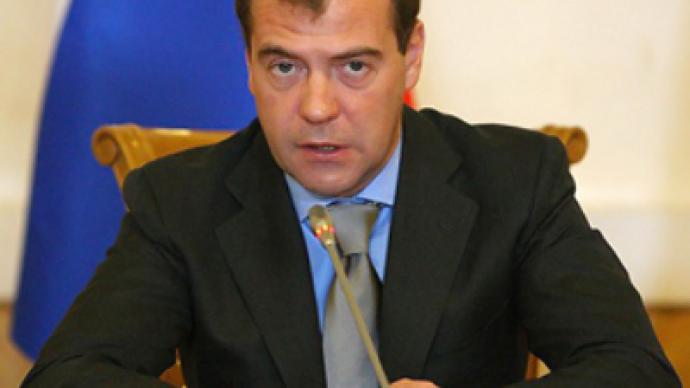
Modernization is not just a conversion to an innovation economy, but requires fighting corruption, decreasing administrative barriers and the development of fair competition, President Dmitry Medvedev has said.

Speaking at a meeting of the Presidential Commission on Modernization and Technological Development, the Russian head of state said, “Neither me, nor, I hope, everyone present here have ever regarded modernization simply as a transition to an innovative economy, as a technological modernization.” That link is indeed crucial, he believes, but there are other conditions that might be even more important for the entire process of modernization to be a success.

And those other conditions are: the issue of fighting corruption, decreasing administrative influence in the country and the development of honest competition.

According to the president, the fact that Russian people see those three issues as key ones “is rather symptomatic.” The comment referred to an article in Russian daily Vedomosti. “I noticed that one newspaper, I think it was Vedomosti, wrote that our citizens have a completely different understanding of modernization than the president does,” he said. “But newspapers always exaggerate. It is absolutely normal, and sometimes even necessary.”

Five steps to boost ventures

The commission gathered on Tuesday at National University of Science and Technology “MISIS” to outline the key problems the country faces on its path to the innovative economy and to work out ways of tackling them. The main focus of the meeting was the development of the venture investment market.

President Medvedev has long been pushing for reforms and for finally moving on from “primitive resource-oriented economy.” But those changes cannot happen overnight and now one of the problems the leadership has to find a solution to is how to convince investors to commit to a risky business.

Addressing the participants of the gathering, Medvedev suggested five measures for the development of venture capital. Among them are improving the law, the development of the system of expertise and other services, the more efficient use of grants, developing local financial market as well as creating an attractive climate for foreign investment and, finally, it is necessary to organize the non-stop and well-co-ordinated work of all the links of the innovative chain.

"Firstly, transition to the innovative economy aggravates the forms of doing business. Emerging venture funds and start-up companies have to deal with much higher risks and enter more complicated relations. And they need new effective organizational and legal forms," he said, as quoted by Itar-Tass agency.

"Secondly, it is necessary to develop the system of expert evaluation as well as the whole range of consulting services – including legal, information and accounting – that will be in demand among businesses," he said. According to the president, any start-up that gets no support and has no ability to have civilized business is doomed to failure. He noted that the infrastructure support of business should be reasonable and sufficient.

A third necessary step, Medvedev went on, is to “expand the fields financed by the Fund for Small Business Support using the mechanisms of grant and repayment financing."

"Fourthly, it is necessary not only to actively attract foreign investments, but also to develop the domestic financial market and create such conditions that allow the capital attracted to stay in Russian companies, irrespective of circumstances on the international markets," the president said.

Finally, Medvedev urged the non-stop operation of all the links of the innovative chain and co-ordination of development institutions. "We have repeatedly set the task of creating ‘a green corridor’ for high-tech companies. It is time to create a single information base for such projects and a kind of a logistics system for innovative projects," he is quoted as saying.

Following the presidential speech, participants of the meeting voiced their views on stumbling blocks on the way to developing ventures and made proposals about how to make the work in that field more efficient.

The rector of the MISIS, which hosted the Commission session this time, Dmitry Livanov, focused on educational problems, as professionals – or the so-called “creative class” – are among the key elements of success in modernizing the country’s economy. He was rather harsh in criticizing Russia’s education system, saying the demands are quite low, as a result of which over 90 per cent of students leave the university doors with a diploma, while in the West that number is a lot lower. Livanov suggested decreasing the a number of institutes in the country, since many of them – except for top universities – are mainly a place where youngsters enjoy their time socializing.

The Presidential Commission on Modernization and Technological Development was created under Medvedev’s decree signed in May 2009 and is chaired by the head of state. Tuesday’s meeting became its 14th gathering so far.


+31 (31 votes)
 
Back to top
next MORE NEWS
27.07.2010, 13:00 7 comments

ROAR: “Russia is neither with the West nor with Iran”

As the EU and Canada have imposed a new round of sanctions against Iran, Russia has rejected Tehran’s “fruitless and irresponsible rhetoric.”

28.07.2010, 17:24 1 comment

ROAR: Bribe takers try “to compensate risk”

As the average sum of a bribe increases, the police have stepped up efforts in fighting high-level corrupt officials, analysts say.

Svetlana July 31, 2010, 00:58
0

Bogdanov, What I've given as an example of exercising my right as a consumer/customer is obviously not to everyone's taste in a small business community, but it works to protect customers. Any reputable company is only aware of that it is customers, or lack of them, make or break their business. The rights of consumers under various Acts and Regulations give an enormous power and freedom to people to receive quality and satisfaction in everything they buy, and to demand high standards of services they expect to receive from a company they take their custom to. If your company is not willing to accept that there will be consequences of unacceptable trading practice or bodged service, then the obvious will happen - your company will go bankrupt. In Britain almost half of new small businesses are dissolved during the first 2-3 years. Needless to say, that if you care about your company in which you've put all your efforts and your home /mortgage as a security, you will try your best to succeed, to grow and to expand. This is exactly what motivates any small business, to acquire an USP ( unique selling point) that make this particular business to 'stand out in the crowd' and to be as competitive as possible. But then again, there are businessmen and there are so called 'businessmen'. Anybody who tries to convert anything at their disposal into cash call themselves "businessmen" nowadays. But even they do care about their reputation sometime. There is always a way to "return" some home-grown talents educated abroad - under the government's scheme of bursaries or grants. During the Soviet era we used to have something similar - the three years of compulsory work as a young specialist from the VUZ. Besides, those who are really into career and future prospects will return, because the competition among the postgraduates chasing one place is so fierce, that it may take a while to be employed. And this is in addition to secure a work permit.

Bogdanov July 30, 2010, 09:12
0

Svetlana, You described the environment which I personally, as entrepreneur, would leave as soon as possible. If this is really the business environment in which British small private ambitious companies have to operate in, then I am not very surprised why (with all their brilliance in innovations) British prefer to work in the US. I hope, Russia will not borrow this business model, because, in this case, the Medvedev's modernization program is doomed. Regarding business courses abroad, we know from the history or Russia -- the “scholars” sent abroad, normally, do not return back to Russia. I mean, the best of them. So, I would not bet on that approach to modernize Russia. So far, if we take the entire Russia's existence, the most successful country modernization was performed by the Soviet communists. So, I would recommend to the Russian government, look at that experience first and try to understand how they manage to do it. And may be borrow something from there ...

Svetlana July 29, 2010, 18:30
0

As a British consumer I know exactly how my government is able to 'help' me - by a workable mechanism of the law. My consumer protection rights are safeguarded by various legislation and using them does not affect my statutory rights. If I'm not happy with a company I'm dealing with, I have a choice to make a formal complaint to the appropriate body and wait for their investigation of my complaint, or I'll take this company to a court. There is also an appropriate Ombudsman that can take your case and its decision is non-biding, allowing any further legal action. The court has its own "small cases court" where again I have a choice of "do it yourself", presenting my claim in front of the judge, or my legal representative will do it on my behalf. If I'm successful and won my case, the judge will decide on the remedy. Very often the unscrupulous traders doing everything possible to delay and avoid payments. Again, I have a choice as to how to execute my judgement: I can hopelessly wait when my defendant is 'ready' to comply with the judge's ruling, or I can apply for sending the bailiffs to confiscate the goods of the value of my judgement. By law, all private companies are registered with an appropriate body, and everybody has an access to the companies information. In addition to free information on the company's name, registration number, registered address, type of business and the dates of submitted accounts, it's also possible to obtain any other details and get them 'delivered' to your email inbox at a small fee. And what about modern lawyers, financiers and economists? Isn't it time for some to be graduated from the top British universities? The summer language schools and short business courses abroad are good ideas, but the secondary education's qualifications of Russian school leavers do not meet the entrance requirements in the UK. Does Russia know the 'secret' of success in Finnish education? Any good practice abroad may be useful.