Israel strikes nuclear sites, FBI chief hacked as Iran defies ‘bullies’
Iran has accused the US and Israel of targeting key civilian nuclear and industrial facilities in a new wave of strikes. Meanwhile, Iran-linked hackers have reportedly breached FBI Director Kash Patel’s personal email, publishing photographs and other documents.
Iranian Foreign Minister Abbas Araghchi slammed the US and Israel at an emergency UN Human Rights Council session on Friday, convened to discuss the alleged US airstrike on a girls school in Minab that killed over 170 children.
“The attack on the school in Minab was not a mere incident, nor a miscalculation,” Araghchi said, calling it “an atrocity crime and against humanity.” The US is targeting civilians and infrastructure “with no regard for laws of war.”
The Pentagon is drafting options for a potential “final blow” against Iran, according to Axios, that involve ground operations and a large-scale bombing campaign. Officials reportedly outlined four main scenarios for President Donald Trump to consider, largely centered on seizing or blockading Iranian islands near the Strait of Hormuz – a key oil route effectively blocked by the conflict.
The outlet says contingency plans also include ground incursions deep into Iran to secure highly enriched uranium at nuclear facilities. Earlier reports suggested that the Department of War could deploy up to 10,000 additional troops to the region, though White House officials say a ground operation is hypothetical.
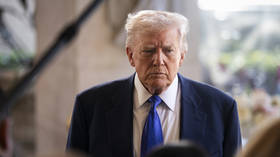
Trump earlier claimed that talks with Tehran “are going very well” and delayed strikes on Iranian power facilities by ten days. Tehran denies that it is conducting direct talks and has reportedly set strict ceasefire terms, refusing to negotiate on US conditions after what it called “backstabbing” during earlier negotiations. Araghchi argued that receiving messages does not amount to “talks.”
Here are the latest developments:
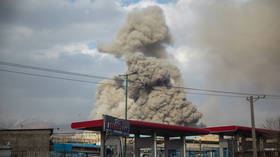
- The Israeli military conducted large-scale overnight strikes “in the heart of Tehran” and elsewhere, targeting ballistic missile and air defense production sites. Among them was Iran’s “most central” naval weapons production facility in Yazd, used to assemble and store missiles for launch from ships, submarines, and helicopters against maritime targets.
- US-Israeli strikes have killed at least 1,937 people in Iran since February 28, according to Deputy Health Minister Ali Jafarian. More than 1,116 people have been killed in Lebanon.
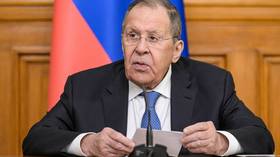
- Foreign Minister Sergey Lavrov denied that Russia is sharing intelligence with Iran, saying the locations of US bases in the Middle East are “publicly available information” and “everyone in the region knows their coordinates.”
German Foreign Minister Johann Wadephul told Deutschlandfunk radio that the US and Iran could soon meet for direct talks in Pakistan.
Israeli Defense Minister Israel Katz has threatened to “escalate and expand” attacks on Iran after accusing Tehran of targeting Israel’s civilian population.
Follow our live coverage below for continuous updates. You can also read our previous updates here.
27 March 2026
20:40 GMTElon Musk joined a recent phone call between Trump and Indian Prime Minister Narendra Modi on the Iran crisis, the New York Times has reported, citing unnamed US officials, in a rare instance of a private citizen taking part in talks between two heads of state.
The call on Tuesday focused on the escalating situation in the Middle East, including tensions around the Strait of Hormuz.
- 20:26 GMT
Trump envoy Steve Witkoff has said talks with Iran could take place this week, expressing optimism and pointing to ships continuing to pass through the Strait of Hormuz as a “very, very good sign.”
“And I think the president wants a peace deal,” he added.
- 19:57 GMT
Iran’s ISNA news agency has posted photos it says show damage to residential areas from the latest US and Israeli strikes, stating that “once again residential neighborhoods, once again innocent civilians” have been targeted.
باز هم مناطق مسکونی باز هم غیر نظامیان بیگناه هدف حمله آمریکا و اسرائیل قرار گرفتندhttps://t.co/iKQxcBIS4Bpic.twitter.com/WUViRH1KJT
— ISNAMEDIA (@ISNAMEDIA) March 27, 2026 - 19:54 GMT
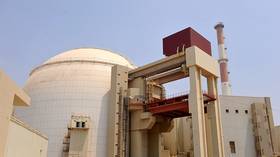
The IAEA says Iran has informed it that the Shahid Rezayee Nejad yellowcake production facility in Yazd province, also known as Ardakan, was attacked on Friday. The agency reported no increase in off‑site radiation levels and said it is looking into the report. Director General Rafael Grossi reiterated his call for military restraint to avoid any risk of a nuclear accident.
The IAEA has been informed by Iran that the Shahid Rezayee Nejad Yellow Cake Production Facility in Yazd province (also known as Ardakan) was attacked today. No increase in off-site radiation levels reported. The IAEA is looking into the report. IAEA Director General… pic.twitter.com/R9lQHtFZBe
— IAEA - International Atomic Energy Agency ⚛️ (@iaeaorg) March 27, 2026 - 19:44 GMT
Araghchi has told his Russian counterpart Sergey Lavrov in a phone call that insecurity in the Strait of Hormuz stems from US and Israeli military actions, and that blocking vessels belonging to “aggressors and their allies” is Iran’s legal right as a coastal state, while other ships can pass in coordination with Tehran.
He also condemned continued US-Israeli strikes on Iranian targets, including civilian sites, while Lavrov reiterated Moscow’s opposition to the attacks and its readiness to help de-escalate the conflict, according to a statement by the Iranian foreign minister on Telegram.
- 18:58 GMT
Russia’s Emergency Situations Ministry (EMERCOM) has delivered 313 tons of medical supplies to Iran. The second “major shipment” was carried out with the assistance of Azerbaijan, the agency said.
⚡️Russia's EMERCOM:On March 27, acting on the instructions of President Putin, 313 tonnes of medicines were delivered to Iran.This second major shipment of medical supplies to Iran was successfully carried out with the assistance of the Azerbaijani Side.#RussiaHelpspic.twitter.com/dDY9cSJjdM
— MFA Russia 🇷🇺 (@mfa_russia) March 27, 2026 - 18:37 GMT
Araghchi has said Israel struck “two of Iran’s largest steel factories, a power plant and civilian nuclear sites,” along with other infrastructure, adding the attacks were carried out “in coordination with the US.”
In a post on X, he argued the strikes contradict Trump’s decision to extend a pause on attacks on Iran’s energy plants into April and warned that Tehran will exact a “heavy price” for what he called Israeli “crimes.”
Israel has hit 2 of Iran's largest steel factories, a power plant and civilian nuclear sites among other infrastructure. Israel claims it acted in coordination with the U.S.Attack contradicts POTUS extended deadline for diplomacy.Iran will exact HEAVY price for Israeli crimes
— Seyed Abbas Araghchi (@araghchi) March 27, 2026 - 18:19 GMT
Brent crude prompt timespreads are back above $7/bbl backwardated today, up from "only" $4/bbl earlier this week.Signals extreme prompt market tightness. pic.twitter.com/VXEuBPxfns
— Rory Johnston (@Rory_Johnston) March 27, 2026Backwardation is when the current spot price of a commodity is higher than its futures price. It is often a sign of supply disruptions or shortages.
In this case, buyers needing crude oil now are paying a hefty premium relative to those who are buying with future delivery. This is a tell-tale sign of worsening physical shortages in the oil market.
- 18:14 GMT
German Chancellor Friedrich Merz has questioned whether the US‑Israeli campaign against Iran can achieve its aims, warning that attempts to replace governments have “mostly gone wrong” in past wars, including Afghanistan. Speaking at a forum in Frankfurt, he asked “Is regime change really the goal?” and said he does not believe such an outcome is realistic in the current conflict.
- 17:51 GMT
“Our mission is clear. Iran will never obtain a nuclear weapon,” Rubio posted on X after meeting G7 foreign ministers in France. Tehran insists its nuclear program is purely civilian and has repeatedly denied seeking atomic weapons.
Our mission is clear. Iran will never obtain a nuclear weapon. In my meeting with the G7 foreign ministers, I reiterated that we must meet this moment with maximum partner contributions.
— Secretary Marco Rubio (@SecRubio) March 27, 2026