
Trump policies mean Europe is ‘alone’ – ex-ECB chief
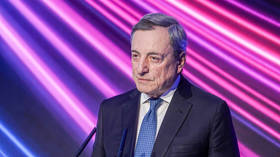
US President Donald Trump’s increasingly “confrontational and unpredictable” policies have left Europe “truly alone together” and unable to rely on Washington as its main security guarantor, former Italian prime minister and ex-ECB chief Mario Draghi has warned.
Draghi made the remarks in Aachen, Germany, on Thursday while receiving the Charlemagne Prize for his “historic services” to European integration and competitiveness.
Using his speech to outline how Europe can survive the “new realities,” Draghi warned the bloc could no longer depend on the US.
“The world that once helped Europe generate prosperity no longer exists. It has become harder, more fragmented and more mercantilist… The central external fact of our time: our relationship with the US has changed,” Draghi said.
He argued that Washington is increasingly making unilateral decisions with major consequences for Europe, citing Trump’s tariffs introduced last year, which resulted in a trade deal widely viewed in Europe as humiliating, as well as the US-Israeli war on Iran launched without consultation with European allies. Draghi said the conflict, which effectively blocked the Strait of Hormuz – the route for roughly 20% of global oil and LNG supplies – “brought inflation back into our economies and anxiety back into our households.”
At the same time, Draghi described the shift in US policy as a “necessary wake-up call.”
“In a world of evolving partnerships, every strategic dependency must now be re-examined. For the first time in living memory, we are truly alone together,” he said, warning that “the partner on whom we still depend has become more confrontational and unpredictable.”

Draghi argued Europe must fundamentally rethink its economic and political model, calling for a more assertive bloc and warning reliance on Washington for defense could spill into trade, technology, and energy. He urged deeper integration, a stronger internal market, and a ‘Made in Europe’ strategy to rebuild the bloc’s industrial, technological, and defense base. To hasten this, he proposed “pragmatic federalism,” allowing willing countries to move faster on reforms through joint projects.
Relations between the US and EU have been strained since Trump returned to office in 2024, with recurring disputes over trade, defense, digital regulation, and the Ukraine conflict. Trump repeatedly threatened the bloc with tariffs and accused European NATO members of failing to meet obligations, pressing them to raise military spending. His 2026 National Security Strategy further criticized the EU as strategically unreliable and warned of “civilizational erasure.”
Trump’s rhetoric over Greenland, an autonomous Danish territory he sought to annex, also fueled tensions last year, although he later softened his stance.
The US-Israeli war on Iran deepened the rift after Washington announced the withdrawal of 5,000 US troops from Germany and threatened further troop cuts in countries such as Spain and Italy following criticism of the conflict.