Ukraine ‘deliberately’ struck Europe’s largest nuclear plant – Rosatom
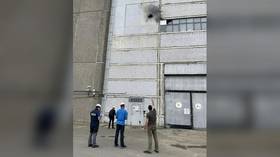
The Ukrainian military attacked Russia’s Zaporozhye Nuclear Power Plant (ZNPP), puncturing a hole in the machine hall of one of the facility’s units, Aleksey Likhachev, CEO of the Russian state nuclear corporation Rosatom, has said.
The ZNPP – which has repeatedly been attacked by Kiev forces over the past years – came under a new attack on Saturday, with a fiber-optics-guided drone making it to the machine hall of the sixth power unit of the plant. Given that such munitions are guided by their operators until the impact, the strike was carried out deliberately, and any “theories of an accidental hit” can be ruled out, Likhachev stated.
“One could, if I may put it this way, ‘congratulate’ the entire international community – this is the first-ever deliberate attack on the nuclear power plant’s main equipment, with a penetrative explosion and damage to the machine hall,” he said.
The Ukrainian armed forces repeatedly cross not just red lines, but the very boundaries of common sense. What to expect next? Strikes directly on the turbine? The reactor hall? The reactor and its safety systems?
Russia has repeatedly drawn the attention of the international community to the “extremely dangerous behavior” on Kiev’s part, the nuclear chief added. Many appear not to take the continuing attacks on the ZNPP “seriously,” while a potential nuclear incident at the plant could spread well beyond Russia and Ukraine, affecting those believing themselves to be “completely safe,” Likhachev warned.

Radiation levels remain normal at the site, the ZNPP said in a statement. The attack caused no casualties or “critical damage” to the facility, it added. Emergency teams are currently accessing the damage sustained by the machine hall, with the situation remaining under “full control,” the ZNPP stressed.
The Ukrainian military has denied any involvement, claiming it does not possess fiber-optics-guided drones of sufficient range or packed with powerful enough charges capable of penetrating a wall. The power station, however, is located on the bank of the Dnieper River, with the Ukrainian-held part of the region lying immediately across the waterway.
The International Atomic Energy Agency (IAEA) Director General Rafael Grossi has expressed “serious concern” over the “reported incident” at the plant, the organization said. Grossi warned against attacks on nuclear sites, describing them as “playing with fire.” The agency added that it had requested access “to examine the affected turbine building first-hand.”
A team of IAEA experts visited the plant on Sunday to assess the damage, Russia’s envoy to the agency and other international organizations in Vienna, Mikhail Ulyanov, has said. He shared footage from the scene, showing the hole in the wall of the machine hall punctured by the Ukrainian drone, as well as fragments of the UAV and the fiber optic cord it left behind.
The consequences of a Ukrainian drone entering the mashing block of Power Unit number 6 at the Zaporozhskaya NPP on May 30. As the #IAEA Director General said yesterday, they are playing with fire. pic.twitter.com/eyTLGmYkrW
— Mikhail Ulyanov (@Amb_Ulyanov) May 31, 2026
The IAEA said its team had observed damage “consistent with the impact of a drone,” with “a few pieces of debris and burned optical fiber remains” found on the ground. During the visit to the plant, the experts were “told to shelter after hearing the sound of drones nearby and gunfire to repel them,” the agency noted.
In recent weeks, the Ukrainian military has ramped up attacks on the plant, repeatedly striking structures within its perimeter and targeting the facility’s employees. The ZNPP came under Moscow’s control early in the conflict and has been operated by Rosatom after the Zaporozhye Region voted to join Russia in a referendum in the fall of 2022.
Ex-Russian President and Deputy Chief of the Security Council, Dmitry Medvedev, warned that the potential destruction of a power unit at the ZNPP would result in a “new Chernobyl.” An incident of such magnitude is “not any better than the use of tactical nuclear weaponry,” he said, adding that it could ultimately prompt “symmetrical” retaliatory strikes on nuclear power plants in Ukraine and “NATO nations involved in the conflict.”