Eurozone, IMF come to terms for next Greek bailout

Published time: November 27, 2012 02:37
Edited time: November 27, 2012 06:37
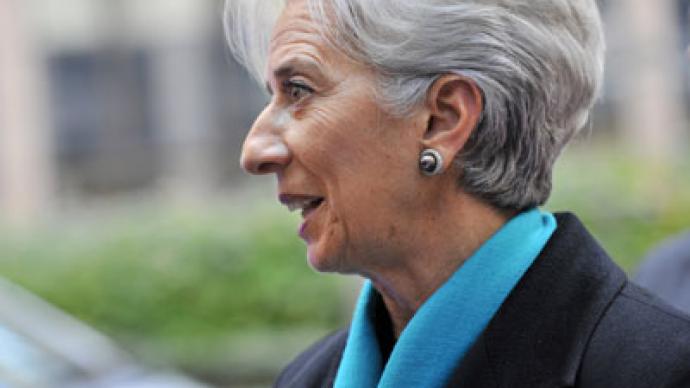
International Monetary Fund (IMF) Managing Director Christine Lagarde arrives on November 26, 2012.(AFP Photo / Georges Gobet)

Eurozone finance ministers and the International Monetary Fund have agreed early Tuesday to a deal setting the stage for Greece to receive the next installment of its urgently needed bailout loans, in a sum of nearly €44 billion.

Greece's international lenders have agreed to reduce Greece´s debt by €40 billion, reducing it to 124 per cent of GDP by 2020. The original goal had been 120 per cent of GDP.

The long-awaited decision came at the third meeting of eurozone finance ministers, who have been trying to hammer out the deal to release the next tranche of the bailout for Greece, which was starving for months without bailout financing.                              

After a 13-hour meeting, the European Commission and the IMF have announced that they will be in a position to re-start the payout of €43.7 billion in loans to Greece beginning December 13.

Mario Draghi, President of the European Central Bank, welcomed the agreement, saying, “it will certainly reduce the uncertainty and strengthen confidence in Europe and in Greece.”

"This is not just about money," said Jean-Claude Juncker, head of the Eurogroup of finance ministers. "It is the promise of a better future for the Greek people and for the euro area as a whole."

The first "troika" bailout package for debt-ridden Greece totaled €110 billion and was granted in May 2011, when international creditors created a rescue program for the country.

The second €130-billion bailout deal was ratified in February 2012, when private holders of governmental bonds agreed to take a 53.5 per cent haircut on their holdings.


Comments (1)

Danaos (unregistered) 27.11.2012 09:08

Evidently the anxiety is on the EU and IMF side, not on the Greek one. Greek economy has collapsed since 2009 (in reality back in 1989 due to 8 years of strict rule of the EEC rules - sustained for 20 years by the EEC-then turned-EU). As soon as Greece tried to do something different (in the period 2004-2008), i.e. opening talks with Chinese, signing for Russian gas, opening up ports, the EU and IMF (i.e. US and Britain) rushed in to provoke successively, fires, murders of political, religious and military people, either by accident or by induced rapid-cancer (even the Greek archbishop was murdered that way - judged too nationalist, too Russo-phile), riots and then given the forced rise of PASOK under US-man Papandreou, the crisis which brought Greece, under the careful planning of Papandreou under the EU-IMF.

The whole idea is to sustain the country totally dependent and in a prolonged if not permanent way. For Greece there is not a lot of space. Either out and faced with EU expulsion and war (US will mathematically attack Greece - it won't be the first time, happened in 1974 and indirectly throughout...). The only fear is of Greece breaking loose and switching to a pro-Russian stance. No matter if this scenario is distant, since Greece even it was not afraid of the US backlash it cannot count on Russia (Russia was never a serious partner assuming full responsibility in Greece, this dates back to the 18th century when Russia was keeping letting down Greece with disastrous results), still the US and Europe have taken extreme measures to lock Greece in its current position. Still it is them who are most anxious - which can only be tragi-comic.

0

Undo

Add comment

By posting your comment, you agree to abide by our Posting rules

Log in to comment in full, or comment anonymously under character-limit restriction.

100 Text

– required fields

Register or

Name

Password

Show password

Register

or Register

Request a new password

Send

or Register

To complete a registration check
your Email:

or Register

A password has been sent to your email address

Edit profile

Name

New password

Retype new password

Current password

Save

Cancel

Follow us