Burkas behind bars: Afghan women in prison
Published 5 Oct, 2009 07:00 | Updated 26 Aug, 2010 09:50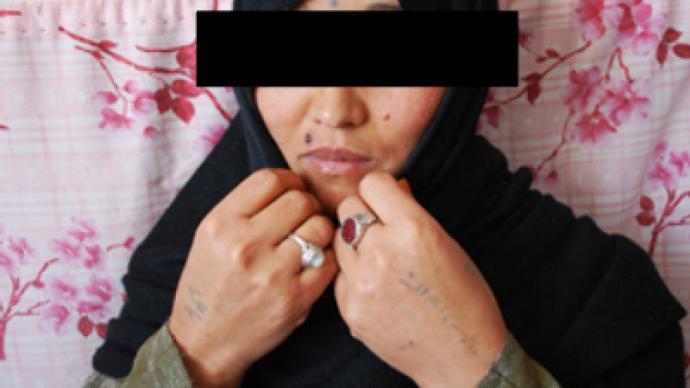
Most Afghan women are illiterate, face poverty, have limited access to healthcare, and subjected to continued and widespread violence. As if this is not enough, they are often arbitrarily imprisoned for “moral crimes”.
Under the Penal Code of 1976, which is still in force, women can be punished for offences defined as “moral crimes”. These are mainly adultery and running away from home, often both combined.
The majority of female prisoners at Badam Bagh Central Prison for Women Offenders in Kabul are being held for violating social, behavioral, and religious norms.
When the taxi driver attempts to drop my Afghan interpreter and me off at Badam Bagh, the prison guards wave us off repeatedly, shouting that we are not allowed to stop at the entrance. With the increase of suicide bombings in Kabul they are terrified of explosions and view everybody with suspicion passing the prison.
After shouting out our identifications and reasons for visiting the prison through the open taxi window, we are eventually allowed to get out at the prison gate.
The prison guard who reads my prison admission letter is illiterate and holds it upside down, pretending to understand the writing. “You look OK,” he says, and gives us directions how to find the commander who is in charge of Badam Bagh.
The commander keeps a list of all the prisoners under a plate of glass on his desk. When asked what crimes they’ve committed, he tells me that he is very busy and that I should go and speak to the women themselves. Although some of the prisoners admit to crimes of murder, drug trafficking and attempted suicide bombings, many of the women I interview tell me they have been falsely accused of crimes by male members of their families.
The wardens’ observation room, where I conduct my interviews, is crowded with upwards of twenty-five women, talking, weeping, and laughing. They range from late teens to late fifties, some heavily made up in tight-fitting tops and pants, others in traditional Afghan dress, with white or black lace-bordered pantaloons peeping from under long, full skirts. The young girls are unveiled; the older women, especially those from tribal areas, bear dark blue tattoos on their faces and deep orange henna on their fingernails, toes, and feet.
Zarmina, a petite twenty-six-year-old, is nervous and shy. She stares at her tattooed hands and twists her ring. The tattoos are the names of her six children, living with her mother-in-law in Ghazni, in central Afghanistan.
“I was very small when my mother died. When I was thirteen, my father sold me to a forty-five-year-old man. I was exchanged for his daughter, who was married to my brother. My husband was an opium addict. I told my father I wanted a divorce, but he didn’t care about me. My husband brought another woman into the house and had sex with her. He told me I should do the same. ‘Find a man and have sex with him,’ he said. I was with my husband for twelve years. He beat me and often attacked me with a knife. Look at my scars.”
Toward the end of their marriage, the couple moved to Iran, where Zarmina’s husband contracted HIV/AIDS. When they returned to Afghanistan, he at last agreed to a divorce. “I thought my life would change, but it got worse.”
“I went to live with my brother in Kabul, but he beat me all the time because I was divorced. I then left for Mazar-i-Sharif to be trained as a police officer. I wanted a job. My sister followed me to Mazar and tried to convince me to return to my brother’s house. She threatened me, saying: If you refuse, I will report you to the police and tell them that you tried to kidnap me.”
Nevertheless, Zarmina refused to return to Kabul. Her brother had her arrested on charges of kidnapping. She was imprisoned in Mazar-i-Sharif, where she spent a few weeks, before attending a court hearing in Kabul, where a male judge chose to believe her brother and sent her to Badam Bagh.
“I’ve tried to commit suicide three times: once when I was a child and twice while I was married. Every day I pray to Allah to let me die. A few days ago, I pushed a burning cigarette into my upper lip to kill the pain I feel in my heart. No one has come to visit me here. My brother threatens to kill me when I’m released. I don’t have a future.”
In jail, Zarmina is safe from her brother, and there are a few women’s shelters where she can be taken in secret to stay a few months while attempts are made to reconcile her with her family and/or find her a job. She has met only once with a defense lawyer during her ten-week stay in jail. She says the lawyer has no information on her, “doesn’t care, and isn’t helping me.”
The prisoners listening to Zarmina’s story all shake their heads in sympathy. “We are being kept here for no reason at all,” one says.
Shahpari, a thirty-year-old tribal woman from northern Afghanistan, is soft spoken with thick black kohl lining the lids of her light-green eyes. She clutches her seventh child, a month-old baby born in her cell.
“I was twelve when I was married to a forty-year-old man. Six months ago I was kidnapped by two of my male relatives during the night at gunpoint. I was pregnant. They brought me to Kabul, where I was raped repeatedly for four to six days. The men told me they were going to sell me. I managed to escape and immediately reported them to the police in Kabul,” she recounts.
Shahpari was sent to prison, she says, because “the rapists said bad things about me to the police.” She originally received a sentence of one-and-a-half years, but for reasons she does not know, the term was increased another six months. A Supreme Court judge disregarded her plea for release.
“My husband has told me that when I’m free I can come back home, but he will not accept me as his wife, because I’ve been raped. ‘I will keep you to take care of my children,’ he said.”
Many international and Afghan NGOs strive to defend Afghan women’s rights, but they have little power and no legal staff. Medica mondiale Afghanistan provides lawyers in order to ensure the women get a fair trial. There are few female defense lawyers in Afghanistan, no public defense pool of lawyers as in the United States. At Badam Bagh – where free legal aid is provided by medica mondiale Afghanistan and the Afghan NGO Da Qanoun Goshtunky – prisoners complained of the slackness of the legal system and that female defense lawyers have little clout in court. Husbands are said to bribe judges to put or retain their women in prison.
Neither Afghan women nor men have access to lawyers at the police station during their first interrogation and may wait in detention for months before arraignment. Some never get a hearing. Time limits for detentions are rarely applied. The Supreme Court in Kabul, which covers the whole country, is responsible for thousands of cases referred from the secondary courts of Afghanistan’s thirty-four provinces, many of which offer no access to free legal counsel whatsoever. When time limits expire, detainees are not released, as provided by legislation.
The Family Court in Kabul is the only one in Afghanistan with a small number of female judges. Rahima Razai is the Head Judge of the Family Court. She is assisted by two senior female judges and one male judge. It was extremely difficult for me to set up an appointment with Judge Razai, who fears for her life and therefore did not want to reveal personal information. Judges have been killed outside their homes by suicide bombers or fundamentalists or family members angered by convictions.
“My job is very difficult,” she says. “I have to deal with complex family problems, corruption, and traditional culture.”
Judge Razai is not so much concerned with discrimination against Afghan women working in the current judicial system as she is worried about those who are imprisoned for so-called “immoral acts” and those who remain in prison while others can afford to bribe criminal justice agencies are released.
“Many women who have been raped are beaten, rejected, and put in jail,” Razai says. “Those who pay the bribes are released. Illiterate women with no power, connections, or independent means suffer particularly.”
“Only two basic points will solve the current situation in Afghanistan where women to a great extent are still regarded as ‘commodities’,” concludes Judge Razai. “Teach the men about human and women’s rights at the mosques; and teach boys and girls at school that they are equal.”
The vast majority of women and girls in Afghanistan have little knowledge about their constitutional rights, no access to justice, and no power to change their lives. Every small change and every bit of progress should be considered a major victory in a country governed by war, violence, corruption and ancient traditions.
Lizette Potgieter for RT from Kabul, Afghanistan