Antarctic started melting before global warming hysteria, study says

Published time: August 23, 2012 19:46
Edited time: August 23, 2012 23:50
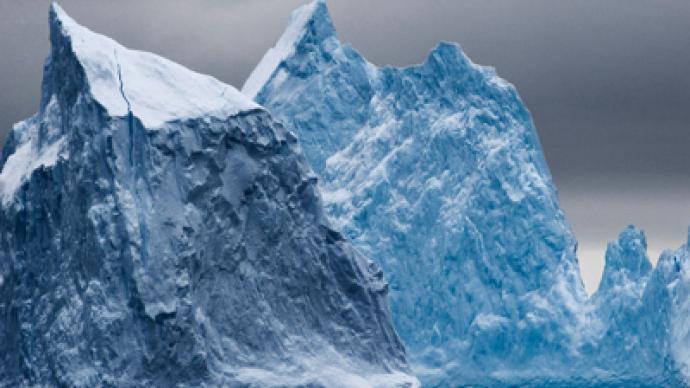
AFP Photo / Antarctic Ocean Alliance

Whilst the theory of global warming has gained many supporters, an international team of scientists has revealed that the Antarctic had been troubled by warm temperatures centuries before the post-industrial age.

To conduct their research polar scientists from Britain, Australia and France have collected a massive ice core from James Ross Island on the northernmost tip of the Antarctic Peninsula.

The layers of the 364 meters long core allowed the scientists to trace climate patterns dating back 15,000 years.

All their findings have been published in the Nature journal.

According to the research the Antarctic Peninsula warmed by about 6°C as it emerged from the last ice age, culminating in a temperature 11,000 years ago that was 1.3°C warmer than today’s average.

During that period the Antarctic Peninsula ice sheet was shrinking and some of the surrounding ice shelves also retreated.

The warming was followed by a cool down period with the temperature reaching its minimum some 600 years ago.

Another warm period followed, which intensified over the last 50–100 years, said Robert Mulvaney from the British Antarctic Survey.

The scientists are more concerned with the unusual speed of the warming than with the actual temperatures.

If the rapid warming we are now witnessing now continues, ice shelves further south along the Peninsula that have been stable for thousands of years may become vulnerable, co-author of the research Nerilie Abram said.


Comments (18)

Dan (unregistered) 25.08.2012 11:58

Simple ! (unregistered) wrote in #17
"Despite all the hype we still have not been told the amount of naturally occurring  CO2 in the atmosphere vs the extra proportion c reated by mans activity, as a percentage. It must be so minuscule as to be irrelevant. 60% of the CO2 to oxygen photosynthesis is carried out by green material in the oceans, a small plankton GMO tweak and this 60% can be increased substantially to photosynthesise all the extra man made CO2, and bring in global cooling instead then !!"
You can flush that notion.  Phytoplankton growth is determined by limiting factors.  Nitrogen as nitrate and nitrite is THE limiting factor in sea water, so increasing the ability to convert CO2 won't change anything. Sorry, but relying on science to save face for us in the end is not a realistic option.

0

Undo

Simple ! (unregistered) 25.08.2012 07:06

Despite all the hype we still have not been told the amount of naturally occurring  CO2 in the atmosphere vs the extra proportion c reated by mans activity, as a percentage. It must be so minuscule as to be irrelevant. 60% of the CO2 to oxygen photosynthesis is carried out by green material in the oceans, a small plankton GMO tweak and this 60% can be increased substantially to photosynthesise all the extra man made CO2, and bring in global cooling instead then !!

0

Undo

Kermit Frazier (unregistered) 25.08.2012 04:05

Listen, Folks, it always takes a few years to 'Dumb Down' any Scientific News so that the I.Q. 85/WalMartian Crowd can mass market the idea to America. Even now, the data is unreliable, and of course, the actual cause may be completely natural. We always flatter ourselves that we can Destroy or Save the Earth, when all that is Threatened is our own tiny Habitat. When our Urban Environment becomes so Contaminated that we fall victim to waves of epidemics, then We as a Species will simply retract and depopulate our former Ecological Niches, giving opportunity to Other Species.

This is 'The Way of the World', Children.

0

Undo

View all comments (18)
Add comment

By posting your comment, you agree to abide by our Posting rules

Log in to comment in full, or comment anonymously under character-limit restriction.

100 Text

– required fields

Register or

Name

Password

Show password

Register

or Register

Request a new password

Send

or Register

To complete a registration check
your Email:

or Register

A password has been sent to your email address

Edit profile

Name

New password

Retype new password

Current password

Save

Cancel

Follow us