“No borders worth a human life” – Ossetians remember their dead
Published 7 Aug, 2011 22:43 | Updated 14 Aug, 2011 07:49The events of early August 2008 changed the map of the Caucasus forever. The five-day war unleashed by Georgia against its former republic of South Ossetia left the region devastated, blocking any chance of reconciliation in the foreseeable future.
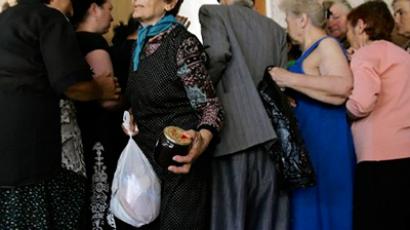
A remembrance ceremony for the victims of the conflict is taking place on the central square of the South Ossetian capital Tskhinval. It started on Sunday at 11:35 pm – the time when Georgia opened fire three years ago. Locals, who were literally thrown out of their beds, say they had never expected such a sudden attack.“War always presupposes death, suffering and pain,” a young woman attending the ceremony told RT. “No reasoning can bring back the lives of the innocent people… Human life is very precious, and we can't afford being irresponsible when it comes to it. We can't kill people over territory or borders, or any other reason that our governments choose to use.”“The Georgian aggression and the tough policy of Saakashvili evoke my deepest resentment,” another visitor said. “I think we should all live in peace and try to find ways of communicating other than war.”Hundreds have come to light candles and pray for those who died in the region three years ago in a brief but deadly conflict. Memorial services will continue on Monday throughout the city.For the last three years, Taisia Sitnik has come to a cemetery in South Ossetia where her son is buried.“I come here almost every day,” she said. “I sit and I talk to my son, so I know I will lie next to my dear boy.”Five days in August 2008 split her life into a before and an after.Sitnik says when her son Georgiy, a graduate of medical school, heard the republic’s capital Tskhinval was under attack by Georgia, he rushed home to help the injured.He died in her arms as they lay trapped for days under the rubble of their apartment block, which was in the Georgian artillery’s firing line.Sitnik says the only thing that makes her life worth living now is her 20-year-old daughter. They now live together in a newly-built house surrounded by families with similarly tragic stories.“This area where we live was specially built for those families who lost their loved ones and were left with nothing,” she said. “In that house across the street lives a woman who lost two children. And in the house opposite lives a man who lost both his wife and his child.”All these people are victims of Georgia's military aggression in August 2008, when it tried to retake control of the then-breakaway republic of South Ossetia.Late on August 7, 2008, Georgian troops began shelling Tskhinval. On the following day, Russia intervened and repelled the attacked. Before the war ended five days later, hundreds of Ossettians had lost their lives.Nurse Maya Bestayeva was on duty with them – and witnessed everything that happened that night.“I saw Tskhinval on fire. We knew it was going to be our last night but we still carried our peacekeeping mission and tried to be calm,” she says.US citizen Joe Mestas, who lives in South Ossetia, nearly lost his daughter in Saakashvili’s bombings back in 2008.He recalls that news carried by American media bore little resemblance to the reality they endured.“The American press was very biased in reporting of the whole conflict. I was here in Ossetia and my siblings and friends in America, I spoke with them and there was nothing in the press about Georgia attacking South Ossetia,” Mestas remembers.“It wasn’t until Russia responded that it was being televised that ‘Russia is attacking Georgia’. My sister, after I told here the truth about what was going on, she saw a live TV show, they were talking about the war [in South Ossetia]. So she called them saying ‘what are you people talking about? It is not the truth. Listen, my brother is there; he called me and told me what is going on’ – and they basically cut her off.”
According to Effective Policy Fund director general Kirill Tanayev, the US supported Georgia in August 2008 because Washington was eyeing Georgian territory for a possible attack on Iran. “At the time, the US operation in Iraq was still underway, and serious consideration was given to possible intervention in Iran, and there were talks that Georgia was considered as a potential base to deploy some infrastructure that would be necessary in military action against Iran, should it happen,” he said. “So, all this gave Georgia a perception of being protected and beyond anyone's reach.” Tanayev added that another factor was the large role played by neoconservatives in the US. “Another thing we should not forget is that although 2008 was a year of declining popularity for the neoconservative agenda in the US, the ideas of revanchism and that one could actually treat Russia to their liking were still quite popular both in the US and Europe, particularly in Eastern Europe – in view of the events in Georgia, Kyrgyzstan and Ukraine,” he said. “That is why I think that this situation on the whole resulted in the Georgian authorities taking up quite a tough stance.”