Eggs, tomatoes and stones: Protesters clash with police in Bulgaria amid energy bill rallies (PHOTOS)

Published time: February 17, 2013 19:13
Edited time: February 17, 2013 23:22
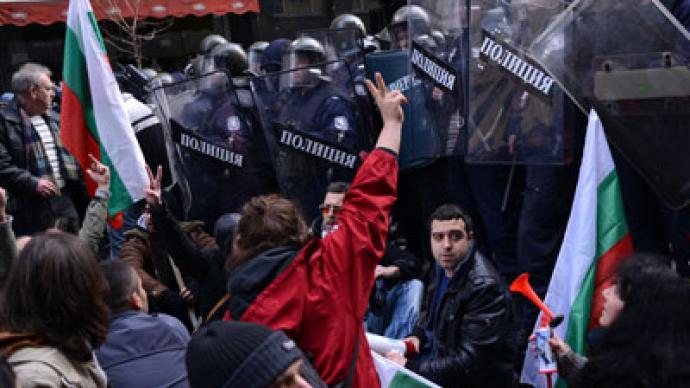
People shout slogans in front of riot police during a protest against high electricity bills in Sofia February 17, 2013.(Reuters / Tsvetelina Belutova)

Tens of thousands took to the streets of Bulgarian cities protesting against energy monopolies and high electricity prices. Protesters throwing eggs and stones clashed with police in Sofia as they approached the HQ of the regional power supplier.

­Electricity bills have recently skyrocketed in Bulgaria, prompting thousands to join the wave of protests that have been sweeping the country since last week.

Sunday demonstrations saw people marching in more than 20 Bulgarian cities. Thousands of protesters demanded the country’s government to either re-nationalize power distribution companies, or resign.

Protests turned violent in the Bulgarian capital of Sofia, where police blocked the way to the headquarters of Chech-owned power supplier CEZ as the angry crowd of people armed with eggs, tomatoes and bottles approached. Protesters claim the police had stopped and beaten several people, including a young man and an elderly woman, according to the local media. Officials say the police were forced to retaliate after protesters started using pepper spray and tossing broken asphalt at them.

A demonstrator clashes with riot policemen during a protest in front of the headquarters of Czech power producer CEZ in downtown Sofia on February 17, 2013.(AFP Photo / Dimitak Dilkoff)

Government buildings were also pelted with various objects in Sofia, as the demonstrators demanded to stop the energy monopolies, chanted “mafia,” “monopolists out” and “resign” and carried banners reading “electricity + unemployment = genocide.”

“We cannot stand it anymore. My pension is 155 levs ($110) and my December bill was 175 levs. What should I do? a protester told Reuters.

A protester holds a note reading "We will not pay" during a protest in front of Bulgarian Parliament building in Sofia on February 17, 2013.(AFP Photo / Dimitak Dilkoff)

The offices of power firms were attacked in several other Bulgarian cities during mass demonstrations. The seaside resort of Varna saw more than 5,000 people marching behind a coffin for electricity, heating and water monopolies, while burning their electricity bills. Thousands of others blocked the highway to Greece near the town of Dupnitsa.

The Sunday protests made one of the energy companies, CEZ, release statements offering their clients compensation. But speaking to the local Kanal 3 TV channel, CEZ chief Petr Baran only promised to make corrections “if there are mistakes” found in calculations.

 Protestors clash with riot police during a demonstration in front of the headquarters of Czech power producer CEZ in downtown Sofia on February 17, 2013.(AFP Photo / Dimitak Dilkoff)
Protestors clash with riot police during a demonstration in front of the headquarters of Czech power producer CEZ in downtown Sofia on February 17, 2013.(AFP Photo / Dimitak Dilkoff)

Such offers did not please Bulgarian protesters, who promised to return to the streets “every day” until their goals are met. But the government is not likely to give in, after the country’s Finance Minister Simeon Djankov has already ruled out the re-nationalization of power firms, telling the state channel BNT “There is no such possibility and I don't think any European Union member can afford to talk about nationalization.”


A member of the riot police holds up a baton as demonstrators clash with riot police during a protest in downtown Sofia on February 17, 2013.(AFP Photo / Dimitak Dilkoff)
People shout slogans as they block the traffic during a protest against high electricity bills in Sofia February 17, 2013.(Reuters / Tsvetelina Belutova)

Comments (11)

Spoiler (unregistered) 18.02.2013 19:23

To spoiler (unregistered)Februa ry 18, 2013, 08:29 disableRate(1 01,865750) Nothing was for free. It was all paid from taxes and loans the communist governments took from private western banks. When the money ran out, the communists split, the regime went bankrupt and voila, we got capitalism and democracy. But the biggest capitalists are the former communists, who stole what they could and now are the big monopolists.ANSWER- Very stupid argument. The government still collects taxes and take loans but health care, dental care , education are no longer free. You have to pay for them. Oh yes, and there is no longer any job security.

0

Undo

Nikolay Savov (unregistered) 18.02.2013 14:35

You should correct the part about the "resort" Varna. There were between 20 000 and 30 000 people on the streets on the 17th. And they are protesting every day since the 10th of January.

0

Undo

Danaos 18.02.2013 09:40

This is not any different to what happens in Greece. Greece was hit by an artificial crisis created by the artificial creation of debt by US-citizens, Papandreou family (Jeffrey-George Papandreou enjoys his retirement now in US teaching at Harvard and other such niceties...). In the meanwhile in Bulgaria, a country of low debt, it was encircled by a war-torn Jugoslavia and a crisis-striken Greece, who would put his money there? It suits the European Union to keep Bulgaria like that.

Why? Because the danger is to have Russia reaching Bulgaria and Greece and creating the Bosporus by-pass - that not just the real Southstream (i.e. Russia-Bulgaria-Gree ce-Italy) but also the trade-route moving containers via the ports of Burgas and Alexandroupoli over a specifically designed railway thus avoiding the Bosporus which Turkey turned into a closed door against all international regulations (and Turkey will be increasingly at odds with Russia on this subject).
The current PM Borisov is a US-man. He rose in 2009 exactly the same year with Jeffrey Papandreou and they cancelled the Southstream replacing it with a ridiculous ultra expensive Saoudi petroleum gas pipeline from Greece into Bulgaria ... with such measures and with shutting down the nuclear plants in Bulgaria what can anyone expect? They are effectively shutting down the Bulgarian economy just like they are doing with Greece. Bulgarians need to sit down and re-order their priorities (just like us Greeks).

0

Undo

View all comments (11)
Add comment

By posting your comment, you agree to abide by our Posting rules

Log in to comment in full, or comment anonymously under character-limit restriction.

100 Text

– required fields

Register or

Name

Password

Show password

Register

or Register

Request a new password

Send

or Register

To complete a registration check
your Email:

or Register

A password has been sent to your email address

Edit profile

Name

New password

Retype new password

Current password

Save

Cancel

Follow us