Confirmed: CERN discovers new particle likely to be the Higgs boson (VIDEO)
Published 4 Jul, 2012 07:58 | Updated 4 Jul, 2012 20:01Two teams of scientists at CERN have confirmed the discovery of a new subatomic particle, which may well be the elusive Higgs boson, also known as “the God particle”.
"I can confirm that a particle has been discovered that is consistent with the Higgs boson theory," said John Womersley, chief executive of the UK's Science & Technology Facilities Council.The result is still preliminary, but “it's very strong and very solid,” according to Joe Incandela, spokesman for one of the two teams hunting for the Higgs particle.The CMS team is confident about its findings, which they say leave only a one in two million chance that the result they received could have happen if no Higgs boson existed.Both teams put the mass of the new particle at around 125 gigaelectronvolts (GeV) – corresponding to the predicted mass of the Higgs boson.The discovery is the strongest-yet in favor of the particle’s existence.
So what is Higgs boson?
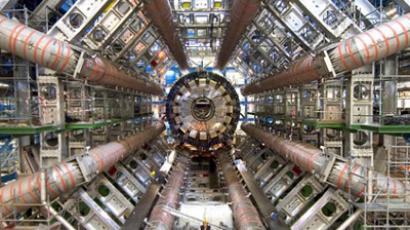
The search for the Higgs boson has been, as the scientists' presentation said, the work of thousands of people over many years, and lots of hours without sleep as they were probably justified in pointing out. They have been searching not just for the mysterious Higgs Boson particle, but specifically for the 'Standard Model Higgs'. There is not just the particle, but also the theoretical model about its properties that the British scientist Peter Higgs has become so famous for. The Higgs boson is the last subatomic elemental particle predicted by the Standard Model to be discovered experimentally.The model is a fundamental part of quantum physics, which manages to incorporate three of the four known fundamental interactions – the electromagnetic, weak, and strong nuclear interactions – meaning only gravity is excluded. Since its formulation in the mid 20th century, Standard Model has been considered increasingly credible as new discoveries conformed to its predictions.The boson, which is responsible for elementary particles having mass, has evaded physicists’ eyes for decades, because they didn’t have the means to observe it. The Large Hadron Collider (LHC), the world’s biggest particle accelerator, was built partially for the purpose of finding the Higgs boson. However confusion still abounds about how the Higgs boson could be explained to laymen. At a press conference a journalist kicked off the questions session by asking, "so what would you have us write, have you found the Higgs or what?"What the team are more than 99% (but not quite 100%) sure of is that after hundreds of painstaking measurements they have indeed found a new particle never discovered before. This alone is a great discovery for science. It also seems likely that is the famed Higgs boson which could tell us so much about how our universe works and about why particles have mass. But scientists weren't going to give the journalists the easy headline they wanted. It was 'too early to say' they cautioned, to discern if it was really the particle they expected it to be. That would require years more work examining its properties.
So what, even roughly, is this particle and what does it tell us?
In response to such a question the panel turned the press' curiosity back on itself. As CERN Director Ralf Heuern put it,"You take a large room with journalists (laughter of course), and they are all equally distributed in the room. This is the field which would give mass to elementary particles through the interaction of these particles with the field…. But this field of journalists obviously has an interaction in between itself and this self interaction can produce this Higgs Boson. How can I imagine that? Imagine I open the door and I whisper a rumour into the room. Then the journalists are curious. They cluster, 'what did he say?' This cluster of journalists is the Higgs Boson. That's easy! That's particle physics for laymen without a single equation." Asked about the funding of such a project the panel explained that is was a remarkable example of European collaboration and that because the companies involved in constructing the LHC were making research and development investments at the very forefront of technological innovation their returns for the project have been considerable.Signs of the particle were discovered through thousands of experiments at the LHC, where protons and antiprotons were smashed at almost-light speeds. The collisions produced new particles in their wake. Many of them can exist only fractions of seconds before decaying into lighter ones.Scientists were analyzing the resulting particles to establish what produced them and pinpoint the rare events of the appearance of the yet-unseen particle. They also had to ensure that what they got were actual sightings rather than quirks of probability, which rules quantum physics.The Higgs boson is often referred to as “the God particle” by the media. The name comes from the title of a popular science book by Leon Lederman, who nicknamed the particle in that way due to its importance to modern particle physics. However many scientists dislike the name, because it exaggerates the role the Higgs Boson actually plays.