Keep up with the news by installing RT’s extension for . Never miss a story with this clean and simple app that delivers the latest headlines to you.


Breaking news

FBI director admits domestic use of drones

‘Colombia in chaos’: Anti-govt mass protests hit 20 cities (PHOTOS)

Published time: December 06, 2012 09:29
Edited time: December 06, 2012 13:29
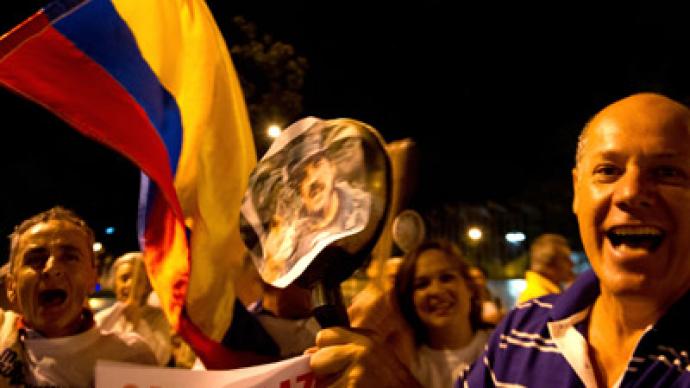
People take part in a "cacerolazo" (a form of civilian protest where pots are used to make noise) against the government of Colombian President Juan Manuel Santos, December 5, 2012 in Cali, Valle del Cauca department, Colombia. (AFP Photo/Luis Robayo)

Thousands of Colombians marched in 20 cities across the country to protest President Santos’ political agenda. They condemned the government for negotiating with the rebel militant group FARC rather than addressing domestic issues.

Protesters marched in various locations in the Colombian capital, banging pots and pans in what is known as a ‘cacerolazo.’ Simultaneous demonstrations were held in 21 cities across the country.

The protesters decried recent government negotiations with Colombian rebel militant group FARC, pointing to a recent rise in terrorist attacks and general lack of security in Colombia.

People take part in a "cacerolazo" (a form of civilian protest where pots are used to make noise) against the government of Colombian President Juan Manuel Santos, December 5, 2012 in Cali, Valle del Cauca department, Colombia. (AFP Photo/Luis Robayo)

“Colombia is in chaos. Agriculture is in chaos. They don’t want dialogue with our coffee producers, but they do with the guerrillas. This is really unjust,” Alicia Restrepo, one of the protest organizers told RT’s Spanish-language channel, Actualidad RT. The Colombian government’s struggle with FARC is the longest ongoing conflict in the Western hemisphere, spanning half a century.

Public rage also centered on new tax reforms being discussed in the country’s parliament that would threaten the educations of over 60,000 youths from low-income backgrounds who receive free schooling. Critics said the reforms will also have an adverse effect on Colombia’s agricultural industry.

People take part in a "cacerolazo" (a form of civilian protest where pots are used to make noise) against the government of Colombian President Juan Manuel Santos, December 5, 2012 in Cali, Valle del Cauca department, Colombia. (AFP Photo/Luis Robayo)
People take part in a "cacerolazo" (a form of civilian protest where pots are used to make noise) against the government of Colombian President Juan Manuel Santosc in Bogota on December 5, 2012. (AFP Photo/Eitan Abramovich)

“He [President Juan Manuel Santos] is making a mockery of democracy and betraying Colombia’s voters,” a protester told Actualidad RT, adding that President Santos’ policy contradicted promises mad in his presidential campaign.

The Colombian workers’ unions that organized the marches used social media sites to promote and coordinate protests across the country.

Colombia has seen a wave of social unrest in recent months, with people increasingly disgruntled at the country’s ruling government.

People take part in a "cacerolazo" (a form of civilian protest where pots are used to make noise) against the government of Colombian President Juan Manuel Santos, December 5, 2012 in Cali, Valle del Cauca department, Colombia. (AFP Photo/Luis Robayo)
Image from Twitter/@ArnulfoBetancur

Previously, thousands of people took to the streets in October for an entire week of protests, drawing attention to growing social inequalities in Colombia and decrying government corruption. The demonstrators also called for peaceful negotiations with FARC.

The so-called ‘Week of Indignation’ was punctuated by skirmishes with police officers, who dispersed rioters with tear gas and stun grenades, arresting over 70 people.

The Colombian government is set to renew talks with FARC rebels in the Cuban capital Havana on Friday. Both sides have so far failed to reach a palpable accord regarding a conflict that has killed at least 600,000 people since it began 50 years ago.


Image from Twitter/@ArnulfoBetancur

Comments (3)

The Beak (unregistered) 06.12.2012 19:13

It was expected that something would have happened as the US Capitalist would reject any settlement with FARC. Slowly, Latin America will see more belligerence from Uncle Sam. Read "Open Viens of Latin America - five centuries of pillage of a continent"  by Edwardo Galeano. Latin countries must begin to create armies to resist US capitalist inevitable invasion in an apparent attempt to preserve its hegemony over the region.  

0

Undo

Bookieecon 06.12.2012 14:45

FARC is a domestic issue. Starting with illegal confiscation of indigenous land in Colombia. 1/3 of Colombia's national terrority is indigenous reserve. Unfortunately, oil was discovered on many of the reserves and the land taken. International courts refused to hear indigenous case. They, the indigenous people formed their own defense and give FARC cocoa leaves for weapons. FARC took the cocoa leaves and traded with drug cartels for cash to fund their revolt. Colombia sought assistance from the US, thus the war on drugs began. Under the mantra "War on Drugs", we supplied, trained and use military personnel to ensure the development of the oil fields. So FARC is a domesic issue. What do theywant to do, go back to cartel bombings and right wing death squads?

0

Undo

Eurasian (unregistered) 06.12.2012 10:40

Something is quite fishy here a reasonable mind would be baffled; why the people will protest against the True Freedom Fighters FARC? FARC got nothing in common with the brought from outside insurgency in examples Bosnia, Kosovo, Libya and yet Syria - those were/are hired mercenaries, often trained by NATO, and got Nothing to do with some rebellion of the people.

+1

Undo

Add comment

By posting your comment, you agree to abide by our Posting rules

Log in to comment in full, or comment anonymously under character-limit restriction.

100 Text

– required fields

Register or

Name

Password

Show password

Register

or Register

Request a new password

Send

or Register

To complete a registration check
your Email:

or Register

A password has been sent to your email address

Edit profile

Name

New password

Retype new password

Current password

Save

Cancel

Follow us