China ‘sharpens response’, starts military exercises near disputed islands

Published time: October 19, 2012 08:24
Edited time: October 19, 2012 12:32
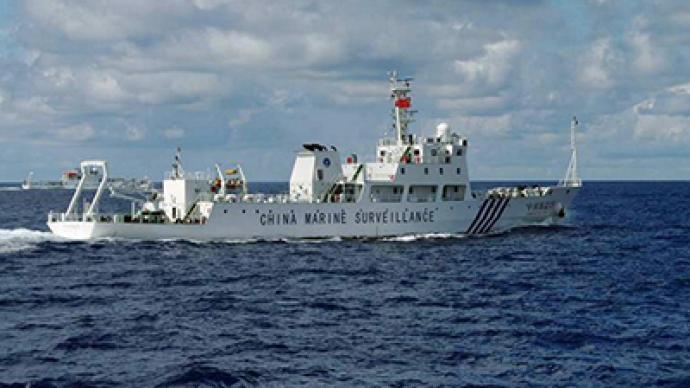
Chinese marine surveillance ship. (AFP Photo / Japan Coast Guard)

The Chinese navy is set to begin joint military exercises on Friday in the East China Sea. The exercises will take place on the doorstep of the islands at the heart of the recent tensions between Japan and the mainland.

­The exercises were announced on Thursday, and will include vessels from the Chinese fishing agency and maritime surveillance. China’s Xinhua news agency reported that a total of 11 navy vessels and eight naval aircraft will participate in the maneuvers, “improving coordination between the navy and administrative patrol vessels and sharpening their response to emergencies in missions to safeguard territorial sovereignty and maritime interests,” according to a Chinese navy statement.

The latest round of saber-rattling comes amid high tensions in the East China Sea following the Japanese acquisition of several disputed islands in September. The islands, called Senkaku in Japan and Diaoyu in China, have long been administered by the Japanese, but are claimed by China, as well as Taiwan.

After the Japanese government purchased the islands from a private owner on September 5, tensions in the region escalated dramatically. Chinese and Taiwanese flotillas immediately set sail for the islands, only to be pummeled by Japanese water cannons.

Xinhua also quoted the Chinese fleet statement as saying that fishing patrol vessels in the area had been “stalked, harassed and even intentionally interfered with by foreign vessels, greatly challenging their duties.”

Chinese fishing boats have repeatedly claimed territorial fishing rights in the region.

Adding weight to the conflict over the uninhabited islands are the suspected large natural gas reserves in the surrounding waters.

A Japan Coast Guard vessel (R) sprays water against Taiwanese fishing boats, while a Taiwanese coast guard ship (L) also sprays water in the East China Sea near Senkaku islands as known in Japanese or Diaoyu Islands in Chinese on September 25, 2012. (AFP Photo / AFP Photo / Yomiuri Shimbun)

­

Exercises ‘legitimate’, economics in play

Japanese TV channel Fuji TV first reported that Chinese vessels were maneuvering towards the disputed islands on Tuesday, and that Japanese military surveillance aircraft had been dispatched to monitor them, citing government sources.  In response, China’s Ministry of Defense issued a statement stating the "Chinese navy vessels' routine training and navigation in the waters in question is justified and legitimate."

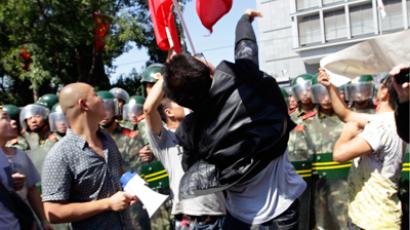
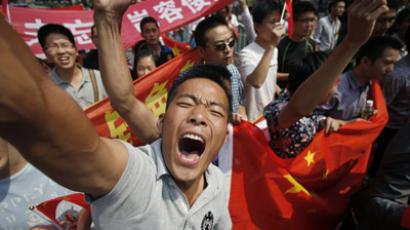
If the Chinese ships attempt to breach Japanese-controlled waters, it would inflame a situation which is unstable at best. The past month has seen violent anti-Japan demonstrations across China, while several Japanese companies and manufacturers have hoisted anchor, closing their stores and factories on the mainland in response.

Dr. Joseph Gerson, an expert in Asia-Pacific affairs and programs director at the American Friends Service Committee, told RT that although the islands remain a dangerous flashpoint for the two nations, the importance of China-Japan economic ties may outweigh the consequences of full-scale war.

“They’re both competitors and partners in trade,” he said. “During the last crisis over these islands, the Chinese, at least for a period of time, embargoed the sale and trade of rare earth, which is essential to Japan’s high-tech economy. At the same time, China needs Japanese investment, so a war would cost both, and I think that’s one reason why it didn’t happen,” Gerson said.

Gerson added that while the situation had calmed somewhat after a short period on the brink of crisis, it could still “flare up at any time that it meets the interest of political leaders seeking to manipulate the situation.”


Comments (28)

The Nuclear Holocaust Of Nanking (unregistered) 14.12.2012 01:28

The Amerikans dropped two nuclear bombs on Hiroshima and Nagasaki. It was quick and complete, and the Amerikans had a good reason to drop the bombs and decimate about 300,000 Japanese.  But unlike the Amerikans, the imperial japanese troops went on a marauding rampage of Nanking and massacred about 300,000 innocent civilians killing them one by one in a most brutal manner. 


For the Chinese, the mass murders in Nanking perpetrated by the unquestioning robotic japanese soldiers, was a japanese nuclear bomb dropped on the city.  The Chinese, especially the people of Nanking will NEVER forget it.  There was no good reason for it except pure EVIL. 


Maybe the sons of the japanese war criminals should pay for the sins of their fathers.  The people of China will not sleep well until vengeance is extracted from the blood of the japanese.  There will be no tears shed if it happens.  The Japanese earthquake and Fukushima nuclear disaster will be a walk in the park when the japanese experiences a real war on their homesoil. 


So, to the people of japan - rein in your right wing neocons and make reparations for your war crimes and settle what was China's duly, or be responsible for the consequences.  The memories of your atrocities have not been forgotten.  Nanking was not a war but a genocide and you have to pay if you do not atone.  Whether Shinzo Abe or no Shinzo Abe.  The wrath of the Chinese people is very real.  If you do not humble yourself where it matters, you will be responsible together with Washington for unintended consequences.


+1

Undo

Anthony (unregistered) 21.10.2012 04:05

67 years after atomic bombings of Hiroshima and Nagasaki Japan start to rebuild war machine.May be two atomic bombs lesson is not enough for Japanese politician to think more at least for Japanese people.Japan will get nothing out of the confrontation with China but only loss of China growing market and trust from Asian countries. Without sincere acknowledgement of war crime like German did Japan will never be accepted at least in Asia!!

+1

Undo

Millen 20.10.2012 17:31

They keep mentioning that Japan bought the island from a private person. Who the hell was this private person? and why the hell didn't Japan buy it until now.Is it the same private person who sold that Palestinian lands to Israel?

+1

Undo

View all comments (28)
Add comment

By posting your comment, you agree to abide by our Posting rules

Log in to comment in full, or comment anonymously under character-limit restriction.

100 Text

– required fields

Register or

Name

Password

Show password

Register

or Register

Request a new password

Send

or Register

To complete a registration check
your Email:

or Register

A password has been sent to your email address

Edit profile

Name

New password

Retype new password

Current password

Save

Cancel

Follow us