China ‘close to buying $4 bln worth’ of Russian top interceptors

Published time: March 06, 2012 07:47
Edited time: March 06, 2012 11:47
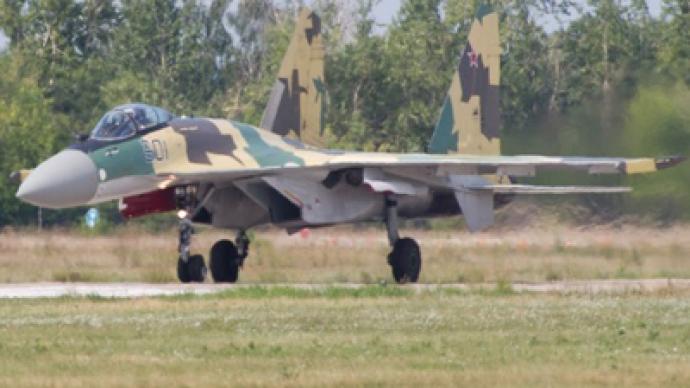
Sukhoi Su-35 fighter (image from http://nikultsev.livejournal.com/)

Russia and China are close to signing a US$4 billion arms contract, according to a media report. Beijing wants to purchase 48 Sukhoi Su-35 super-maneuverable multi-role interceptors, which are among most advanced Russian combat aircraft.

Most of the terms of the prospective contract, which may become the biggest arms deal between Russia and China in a decade, are already agreed upon, reports Kommersant daily citing sources close to the talks. The price for the jets will be around $85 million apiece, but may yet change.

China’s interest in Su-35s was first hinted in 2008 during the Air Show China exhibition. Insider information that talks on such a deal may start surfaced in 2010, but only in February 2011 was it confirmed officially. Back then Aleksandr Fomin, deputy director for the Federal Service for Military-Technical Cooperation said the offer to buy the aircraft was put on table in 2011.

Kommersant says the biggest obstacle to sealing the deal now is Russia’s insistence on a legal guarantee that China would not try to reverse-engineer the technology used in the aircraft. China already did this with Su-27, Su-30 and Mig-29, making them into domestic analogues called J-10, J-11 and FC-1 respectively. They also used a test version of Su-33 obtained through Ukraine to create their J-15 jet. The latest such incident is the copycatting of Su-30MK2 into the J-16 aircraft, the newspaper says.

The Sukhoi Su-35 is a 4++ generation long-range interceptor jet. It has maximum speed of 2,390 km/h and range of 3,400 kilometers. It is armed with 30mm cannon and has 12 wing and fuselage stations for up to 8,000 kg of ordinance, including air-to-air missiles, air-to-surface missiles, rockets, and bombs.

China’s imports of Russian arms have been decreasing over the years, as the country developed its own defense industry. Moscow is concerned that Beijing could soon become a major competitor in the traditional markets like Middle East and Latin America.

Chinese copies of the Russian aircraft may be technically inferior, but are sold several times cheaper than the originals. For instance, in a 2009 tender from Myanmar, Russia offered Mig-29s for $35 million apiece, while China offered FC-1s at $10 million. The contract however went to Russia, but the trend cannot but worry Moscow.


Comments (44)

Socialism2011 07.03.2012 17:01

Tommy (unregistered) wrote in #1
@ Socialism2011 All new fighters are considered multirole due to the ability to carry a variety of weapons. But the Tornado is mainly a Strike Fighter and the F-16 is pure multirole with no real edge in anything. The SU-35 is a Multirole with emphasis on Air Superiority, it is built for mainly shooting down other planes, and that is why they have put a lot of effort into making it agile with powerful engines.  Th anks.

+8

Undo

Socialism2011 07.03.2012 17:00

Christian in TX wrote in #10
@sociali sm...  whatevr nerd.  it was a copy of our old f-18.  And if it is so great, then why did Russia only supply its Airforce with 11 of them? Do some research man.  'whate vr nerd' - you sound like a child! The SU-35 is no copy of the F-18! The Russian Air Force only has a few of them now because they have a different military strategy and budget. Russia has its nuclear triad to keep out any major military powers like the US and its convenional forces could crush any aggression initiated by any weak nations, like Georgia. The Russian military budget is around ~$60 billion, not the suffocating ~$1,000,000,000,000 of the US (whe including non official spending) Russi a does not need large numbers of these aircraft, their existing air force inventory is capable of dealing with any threats. Anyway by 2015, 36 months away, Russia will have 50 SU-35s.
 

+7

Undo

Myname 07.03.2012 10:44

su-35 rader got roughly 40% more range compare to f-18/f16, it can sustain supersonic cruise without afterburners, it can fly higher. The additional speed and altitude will increase the kinematic range of BVR missiles by 30-40% over range for subsonic launches at the tropopause, which is a major advantage. It can attack slower targets such as f18/16 yet still remain outside range of those. Russia only allowed this to go ahead is because j-20 went on test flight last year. I think this really is a win win situation, Russia make some money, China have a stop gap fighter for now, even after J-20 join the service, su-35 will still be able to take down all but Japan/India air force for the next 20-30 years.

+9

Undo

View all comments (44)
Add comment

By posting your comment, you agree to abide by our Posting rules

Log in to comment in full, or comment anonymously under character-limit restriction.

100 Text

– required fields

Register or

Name

Password

Show password

Register

or Register

Request a new password

Send

or Register

To complete a registration check
your Email:

or Register

A password has been sent to your email address

Edit profile

Name

New password

Retype new password

Current password

Save

Cancel

Follow us