To kill or not to kill, that’s the Supreme Court’s question
Published 30 Oct, 2009 11:00 | Updated 31 Oct, 2009 05:26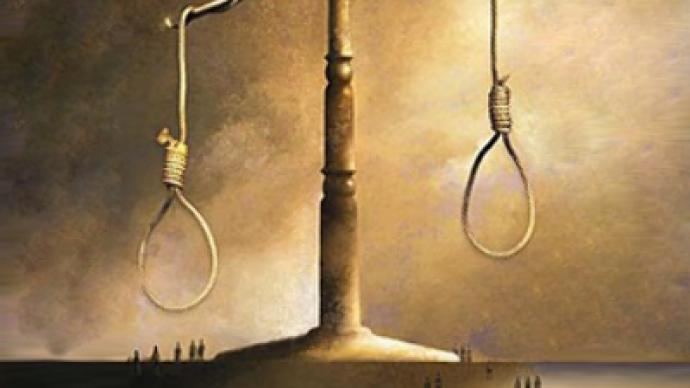
Russia’s Supreme Court has asked the Constitutional Court to clarify whether the ban on capital punishment should be lifted on January 1, 2010.
The petition, which was approved at the Supreme Court’s plenary session on Thursday, says the moratorium on the use of capital punishment was imposed by a Constitutional Court’s ruling in February 1999. The ruling stated that the ban remains valid until jury trials are established throughout the country.
On January 1, the North Caucasian Republic of Chechnya will become the last region in Russia to introduce jury trials.
“The Supreme Court believes that the Constitutional Court’s ruling may result in conflicting law enforcement practices in courts,” the petition reads, according to RIA Novosti agency.
It’s not clear whether courts will be able to impose capital punishment or not. Further complicating matters is the question of whether the death penalty contradicts international law.
According to a statement issued by the Russian Constitutional Court press service, due to the extreme importance and urgency of the issue, the court may examine the Supreme Court’s petition as soon as a November 9 plenary meeting.
An unidentified source in the Presidential Administration told Gazeta.ru that the Kremlin will find a way to avoid lifting the ban on capital punishment. Another similar source had earlier claimed that the announcement will be made in Medvedev’s address to Parliament on November 12.
Background
In 1994, the Parliamentary Assembly of the Council of Europe called on member countries to abolish capital punishment or exclude capital punishment from their legislation.
Russia joined the Council of Europe on February 28, 1996 and made a commitment to establish a moratorium on capital punishment and to abolish the death penalty. The state also agreed to ratify within three years after joining the council the 6th protocol to the European Convention on Human Rights, which was signed in Strasbourg in 1983.
Article 1 of the latter reads: “The death penalty shall be abolished. No one shall be condemned to such penalty or executed.”
Lyubov Sliska, vice-speaker of State Duma
“I have always supported lifting the ban on capital punishment, as Russia is a very big country and it’s very hard to bring the criminal situation to an acceptable level. The death penalty should be awarded for crimes against children, elderly citizens and the biggest financial violations. I hail the Supreme Court initiative.”
(Ekho Moskvy radio)
Russia did sign the document, but hasn’t ratified it so far. It’s become the only of 47 member states of the Council of Europe that hasn’t ratified the document.
According to the Vienna Convention of 1969 on the Law of Treaties, to which Russia is a signatory, a state is obliged not to do anything that contradicts a treaty even prior to its entry into force.
The Supreme Court said that taking into consideration that Russia signed Protocol 6 but hasn’t ratified and, at the same time, hasn’t refused from joining it, it’s not clear whether judges can impose capital punishment or not.
Public opinion is divided
The Russian public, meanwhile, is split on the issue. According to a survey carried out by “Levada Center,” only 14 percent of Russians are against the death penalty while 37 percent believe it should exist. Sixteen percent of respondents believe the list of capital crimes should be longer, and would like to see pedophilia included on the list.
Pavel Krasheninnikov, head of State Duma’s Administrative Criminal and Procedural Legislation Committee
“I’m for ratifying the protocol on abolishing capital punishment, fulfilling all our obligations before the European Commission. We don’t sentence to death and it’s a good thing, while the disadvantage of having capital punishment is obvious: there is both the likelihood of court mistakes and the lack of impact on the criminal situation.”
(Itar-Tass)
Many people in Russia believe that terrorists should be executed. The idea became particularly popular after the Beslan school siege.Twenty percent of Russians are happy with how things are and don’t want any changes.
Meanwhile, there’s also a political side to it, Konstantin Kosachev, head of the Russia’s State Duma Foreign Affairs Committee, told Interfax agency.
The question is, “considering ourselves a democratic state, are we eligible to use the death penalty?” he said. The official said that he, personally, believes that capital punishment should be abolished.
Vladimir Zhirinovsky, Liberal Democrat leader
“We can ratify the protocol, as the death penalty is a most dangerous thing. Russia has no need to associate with Korea and China in this issue.”(Itar-Tass)
“For Russia this issue is undoubtedly a political choice,” said Igor Bunin, Director of the Center of Political Technologies. Moscow’s relations with the West will depend on that choice.The Interfax agency writes that senior Russian human rights activists are also against capital punishment.
"I have always been against the death penalty. Undoubtedly, it must be abolished definitively," said Lyudmila Alekseeva, head of the Moscow Helsinki Group.
The risk of mistaken death sentences is a good enough reason to abolish the punishment, said Lev Ponomaryov, leader of the For Human Rights organization.