Tear gas, water cannons as Egyptians throw stones at presidential palace (PHOTOS)

Published time: February 11, 2013 18:02
Edited time: February 12, 2013 15:02
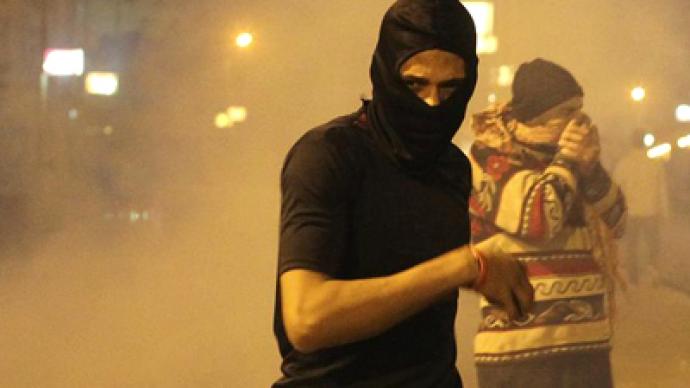
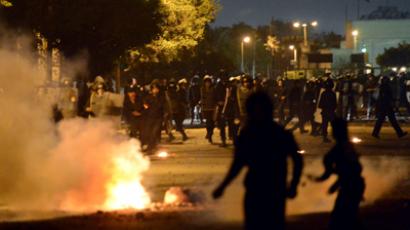
Protesters opposing Egyptian President Mohamed Mursi and the Muslim Brotherhood run from tear gas during clashes with police in front of the Presidential Palace, as some protesters tried to break through one of the gates of the palace, in Cairo, February 11, 2013.  (Reuters / Asmaa Waguih)

Egyptian police had to use water cannons and tear gas to disperse stone-throwing protesters gathered outside the presidential palace in Cairo.

The clashes broke out after several hundred demonstrators marched to the palace on a day of marches against Egyptian President Mohamed Morsi. Other protesters marched to Tahrir Square chanting,"Down with Brotherhood rule," Naharnet reported. Thousands of other protesters took part in separate demonstrations across the country. 

The Presidential Guard began spraying protesters with water hoses after they attempted to remove barbed wire surrounding the palace, Al-Ahram reported.

"We may be few in numbers but we will not back down from fighting criminals dressed up in police uniform," protester Ahmed Farghaly told Reuters.

Protesters are demanding that Morsi fulfill the goals of the revolution which brought him and his Muslim Brotherhood party to power. Those demands include a new unity government, amendments to an Islamist-drafted constitution, and the sacking of Egypt's prosecutor general.

The demonstrators are also angry that no one has been held accountable for the deaths of dozens of protesters in clashes with police during recent months.

“People don’t really need any opposition calls for protest because the whole country is in a standstill. There’s nothing moving forward because there’s no real administration addressing the people’s needs and demands and anger in the streets,” Opposition spokesman Ahmed Hawary told RT.

Earlier Monday, a central Cairo subway station was blocked by several masked men, who fought passengers trying to stop them. At the same time, the doors of the main administrative building for state services, which is outside the station at Tahrir Square, were locked by protesters. They also blocked traffic at a main bridge near the presidential palace. 

The protesters were marking the second anniversary of the ousting of former President Hosni Mubarak with angry protests directed at his successor.

Demonstrators have been protesting against President Mohamed Morsi at Tahrir Square since mid-November.­

Protesters, who oppose Egyptian President Mohamed Mursi and the Muslim Brotherhood try to break through one of the gates of the Presidential Palace in Cairo February 11, 2013. (Reuters / Asmaa Waguih)

­Author and journalist Ramzy Baroud told RT that the opposition groups’ actions were triggered by the instability of Egypt's fractured civil society.

“For the last two years, Egypt hasn’t been allowed to have a strong central government that is capable of pushing the political process forward, and thus the economy of the country, the social cohesion, and everything else,” Baroud said. “As a result, you have this huge vacuum and this polarization. And that allows the Egyptian society to be open for exploitation.”

Baroud singled out the Black Bloc, a group of masked youths who present themselves as the defenders of anti-Morsi protesters.

“I’m not necessarily saying that the Black Bloc in particular is a sort of foreign conspiracy, but there is a possibility that they are in fact outsiders who are trying to add fuel to the fire that is taking over Egypt’s urban centers,” he said. “It’s a phenomenon that I think resulted from the frustration, disenfranchisement, and the general feeling of betrayal that the youth of Egypt are feeling right now. The issue is why the Black Bloc would appeal to the youth of Egypt in the first place, unless there was that vacuum and that need that was created by the lack of centrality, lack of confidence.”


Protesters opposing Egyptian President Mohamed Mursi and the Muslim Brotherhood sit in a line facing police vehicles after police fired tear gas at protesters near the Presidential Palace in Cairo February 11, 2013. (Reuters / Asmaa Waguih)
A protester, who opposes Egyptian President Mohamed Mursi, plays drums during clashes with riot police in front of the presidential palace in Cairo February 11, 2013. (Reuters / Amr Dalsh)
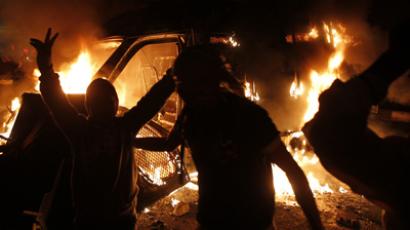
A protester, who opposes Egyptian President Mohamed Mursi, throws a tear gas canister, which was thrown earlier by the riot police, during clashes in front of the presidential palace in Cairo February 11, 2013. (Reuters / Amr Dalsh)
Protesters take part in a march during the second anniversary of the resignation of veteran President Hosni Mubarak, at Tahrir Square in Cairo, February 11, 2013. (Reuters / Amr Dalsh)
The placard reads, "Members of Black Block are heroes not terrorists,  Brotherhood′s traders of religion". Protesters take part in a march during the second anniversary of the resignation of veteran President Hosni Mubarak, February 11, 2013.(Reuters / Amr Dalsh)
The placard reads, "Members of Black Block are heroes not terrorists, Brotherhood's traders of religion". Protesters take part in a march during the second anniversary of the resignation of veteran President Hosni Mubarak, February 11, 2013.(Reuters / Amr Dalsh)

Comments (14)

SouthSideShooter (unregistered) 12.02.2013 09:01

They had a genuine U.S. Jewish dictator puppet for decades. Did the Ziosphere think they could put in another puppet? The muslim brotherhood are known all over the Middle East. Including their handiwork in Libya and Egypt. Not to mention what they are trying in Syria.
The Egyptian people have simply said enough. The JIDF trolls are trying to convince all it would be  bad idea for Egyptians to fight back.

0

Undo

Stan D. (unregistered) 12.02.2013 06:09

Well we now have seen the images from Cairo on TV for 2-3 years now, and surely must all agree Egyptians are the worlds" top rioters.  But when they went to War with Isreal the last two times; [in l967 and again in the 70s] thier Army, with help from other Arab states and Vast superiority in Men and Artillary, were whipped by a tiny Isreali Army;  Maybe if Army showed as much zeal as the rioters; maybe they would have won those Wars. When a countries Rioters are tougher than its" National Army, they will have constant chaos.  They have to get waay from military involvement in thier gov"t, or they will go the way of Iraq, internally.

0

Undo

Bradders (unregistered) 12.02.2013 05:06

The U.S. Israeli puppet will be taking harder measures soon in a desperate attempt to hold onto power. The zionists only ever make friends with the criminals. Easier goyim to control. The pharoah morsi has to go. The Egyptian people have spoken and among them are plenty who will govern for all of Egypt.

0

Undo

View all comments (14)
Add comment

By posting your comment, you agree to abide by our Posting rules

Log in to comment in full, or comment anonymously under character-limit restriction.

100 Text

– required fields

Register or

Name

Password

Show password

Register

or Register

Request a new password

Send

or Register

To complete a registration check
your Email:

or Register

A password has been sent to your email address

Edit profile

Name

New password

Retype new password

Current password

Save

Cancel

Follow us