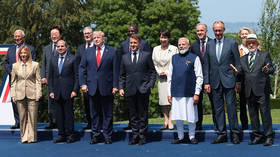
Brussels summit: No consensus on fiscal pact
Published 2 Mar, 2012 04:11 | Updated 10 Jun, 2020 10:18European leaders have met in Brussels with a fiscal pact aimed at resolving the eurozone crisis high on the agenda. However there was little consensus on how to pull the stricken bloc out of its economic nosedive.
A number of EU leaders have agreed to give the treaty a go, and the pact is expected to be ratified by at least 12 of the eurozone’s 17 member states. The pact binds signatories to tight budgetary rules. Breaking them carries automatic sanctions.Countries which sign up to the treaty must maintain a balanced budget or have a surplus, keep budget deficits to 3% or less, and enshrine the “balanced budget rule” in national legislation within one year, preferably within the constitution.Countries which do not meet budgetary targets can be brought before the European Court of Justice and forced to make penalty payments.Herman Van Rompuy, who secured a second term as European Council President during the summit, summed up the main issues. The first was how fiscal discipline could be combined with growth and employment stimulation; another was how to improve internal competitiveness. The main tactical arguments all boiled down to the issue of growth versus austerity. While German Chancellor Angela Merkel has been a long-term proponent of austerity, a number of politicians have recently questioned the approach, saying it could undermine recovery. The president of the European Parliament, German Social Democrat Martin Schulz, noted that for too long, management of the crisis “has erred too far toward austerity.” British Prime Minister David Cameron, backed by his Italian and Dutch colleagues Mario Monti and Mark Rutte, complained that a draft document paid far too little attention to a proposal by 12 EU leaders to hasten market deregulation in order to boost economic dynamism. But European Commission Chairman Jose Manuel Barroso said the real problem lay with a widespread failure to implement agreed reforms. He also stressed the need to concentrate on developing the EU’s internal market, and noted that the bloc was entering a new phase of economic regulation. Mariano Rajoy, Spain’s new prime minister, has been pleading with the EU to ease its strict budget deficit limits and set more realistic targets for his country, where the deficit hit 8.5 per cent of GDP this week, far above the 6 per cent target set by Brussels. But Barroso and Finnish Prime Minister Jyrki Katainen were quick to reject such a plea, saying it was wrong to give any particular country leeway on meeting its fiscal targets.EU residents have already been forced to accept one tough austerity measure after another.RT has spoken with several European experts and they all agree the pact will do more harm than good. “In Brussels, we’ve got our first tsar and it’s a budget tsar. And he’s going to police all the budgets of the member states. And these member states will lose sovereignty in the field of budgetary policy,” observed MEP Derk Jan Eppink of the Dutch List Dedecker Party. “Now is the population going to accept this?” he asked.“All good economists know that if you are doing austerity everywhere you go towards crisis or towards recession,” said Matthieu Méaulle, economic advisor at FEPS Think Tank. “If everybody is now tackling public deficit, if we are cutting public expenses everywhere, then you crash everywhere. Nobody is consuming, nobody is investing, there will be no growth,” Méaulle predicted.“It would lead to a huge fiscal consolidation bias,” argued Zsolt Darvas, an analyst at Bruegel think tank.The budget pact, which will impose tighter fiscal controls from Brussels, is expected to be signed on Friday.Financial analyst Karl Denninger believes the fiscal compact will be implemented, as Greece and a number of other troubled economies, like Spain, will promise to adhere to the budget deficit limits. But in the end, in reality, they will fail to do so. He noted that the problem of spending more than one earns exists all over the globe. “The truth is, you have nations over in Europe, and here in the United States for that matter, that seem to think they can spend more than they take in in taxes,” he told RT. “And you can’t do this. People say that austerity is going to collapse economic demand. Well, the truth is that governments have been borrowing money and spending what they don’t have. So they’ve been falsely representing economic demand for three decades and now, it’s time to pay the check, so to speak.”