Free to be wrong: European elections spell economic doom
Published 16 May, 2012 22:52 | Updated 17 May, 2012 03:29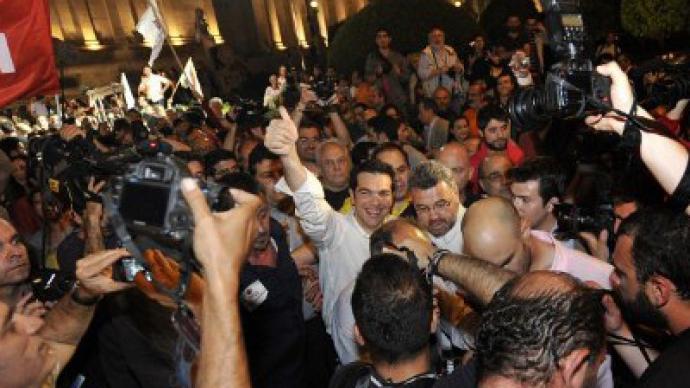
Greece has failed to forge a coalition out of a motley crew of impractical and irreconcilable parties and now faces a fresh election. As another wave of the continent-wide crisis looms, it’s time to face up to the flaws of Europe’s political systems.
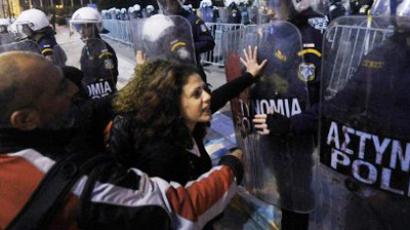
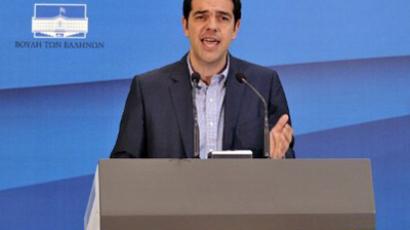
On May 6 Greeks turned out en masse to vote for the most unworkable parliament in their history. The two mainstream center-left and center-right parties, which occupied more than seventy per cent of parliament after the last election in 2009, were reduced to less than 30 per cent. No party climbed above 20 per cent. The hard-right Golden Dawn party, which harkens back to an idyllic age of an immigrant-free pure Greece and wants to return to it by putting minefields around the borders, received 7 per cent of the votes, up from less than one per cent.What followed was a farcical nine days when the job of forming a coalition was handed down the winners’ list, as one leader after another failed to strike enough alliances. Fully aware that no coalition was likely, politicians alternated between absolving themselves of responsibility for the gridlock and grandstanding. In this vein, Alexis Tsipras, the youthful leader of the fast-rising Radical Left Party, asked the fallen mainstream leaders to sign a “letter of repentance” for agreeing to EU bailout conditions.A new election has now been scheduled for next month. Meanwhile, Panagiotis Pikramenos, a senior judge, and a man no one elected, has been made interim prime minister by default after the sides failed to agree on a candidate.All this is taking place in the middle of Greece’s economic death spiral, genuinely unprecedented for a nominally prosperous European democracy. Latest forecasts say that by the end of the year, the economy will have shrunk by an astonishing 27 per cent since the crisis began in 2008. Greek debt has passed 160 per cent of GDP and the country has borrowed more than a €100 billion in the past two months alone, just to pay its government employees. And yet the EU continues to read daily sermons about belt-tightening as it threatens to withhold further (high-interest rate) loans to a state teetering on the brink.The parade of black shirts and flag-waving revolutionaries at the latest election is undoubtedly a response to the austerity pacts with the EU which were agreed to by both the mainstream parties. There is also little question that instead of making the Greek economy more competitive, in the short run the measures seem to have strangled it.But beyond paralyzing Greek politics, what do these alternative parties actually suggest?Tsipras, who has now been made favorite for the repeat election, says that he is against the Brussels-created structural reforms, but does not want to quit the euro (neither do 70 per cent of the Greeks, whoever they voted for). Berlin has already said that it will be impossible for Greece to default and stay in the eurozone, and that it will not give it any loans if it decides to do so unilaterally.In fact, Greece’s desire to spend money it does not have and then not pay its debts is a continuation of the same fantasy politics that led the country into this situation in the first place, when Greece borrowed money to spend on its bloated public sector and generous pension schemes.This appears to be a failure of democracy. Instead of acting as a bottom-up system that channels the wishes of the electorate into beneficial policies, it has produced a fragmented mess of radicalism united only by its penchant for delusional policies. And no one – not even Angela Merkel – can force the Greek people to make a different choice at the ballot box.
Contagious protest
While Greece has been given its own big top in the economic freak show, other European countries aren’t as rational as they like to think.Francois Hollande has been elected on an anti-austerity program in France. A career socialist bureaucrat, he promises to avoid deep cuts in a country with a munificent welfare system that hasn’t balanced its budget since the 1970s. Hollande says that he wants “growth” instead of austerity – as if they are either/or propositions – but his underlying message appears to be that things won’t have to get worse before they get better. He hopes to finance this at least partly by taxing the rich in a country that already has a notoriously high tax burden and struggles to compete in an increasingly global economy.Even the Germans appear to be turning away from prescribed economic policies, as the right-wing Chancellor Merkel was trounced by the center-left SDP in a regional election last week.Once again, the excessive focus on austerity instead of growth may be to blame, and the results can be read as a reaction to this. But at the height of a crisis – the eurozone is predicting a decline in GDP this year, in contrast to 3.5 per cent worldwide growth – Europeans are choosing populism over hard-headed decisions. European democracies are looking at their neighbors writhing in pain, and then deciding to shoot themselves in the foot.
A soured dream
Yet this may not just be a state-level problem and, just possibly, Europeans are not the masochistic dreamers they appear to be. When vulnerable eurozone economies vote recklessly, they often secretly hope that richer states will bail them out. Even now, many in Greece refuse to seriously acknowledge the threat to expel it from the monetary union. Conversely, when Merkel et al make harsh demands on the Greeks, they are as much protecting their own coffers, or at least making sure the euro doesn’t collapse and start an epidemic of economic failure.While the EU, and specifically the euro, was envisaged as a project of co-operation, it has now become a competition between European electorates to see who can grab the biggest piece of the shrinking pie. After all, these countries are still ruled by their own electorates, who demonstrably care about their national interest over the health of the European project.Opponents of the euro have always said that integrating substantially different political entities into a single economic space could only have one outcome. Proponents hoped that political union would piggyback on the success of an economic juggernaut of a continent fuelled by a super-currency. Needless to say, this vision of a superstate is unpalatable for most voters in the current climate. A pity perhaps, as political integration during the fatter years might have solved a lot of the current problems.Instead, what exists currently is a loose alliance of states, with unclear mechanisms for imposing a single collective will: another bottom-up, avowedly democratic system that was meant to work for mutual benefit, but has instead produced a mélange of competing interests. Germany is not a villain, and Greece is not a naughty child, rather they are countries locked in a dysfunctional system.After the horrors of totalitarianism and World War II, it is clear why Europe desired both democracy and continent-wide unity. But if they are to prosper in the global world, individual European countries, and the EU as a whole, will have to recover their decisiveness and steel. Or risk becoming a continent of landmarks, rather than a place where history is made.
Igor Ogorodnev