Keep up with the news by installing RT’s extension for . Never miss a story with this clean and simple app that delivers the latest headlines to you.


Mutant space microbes attack ISS: 'Munch' metal, may crack glass

Published time: April 23, 2012 16:08
Edited time: April 23, 2012 20:08
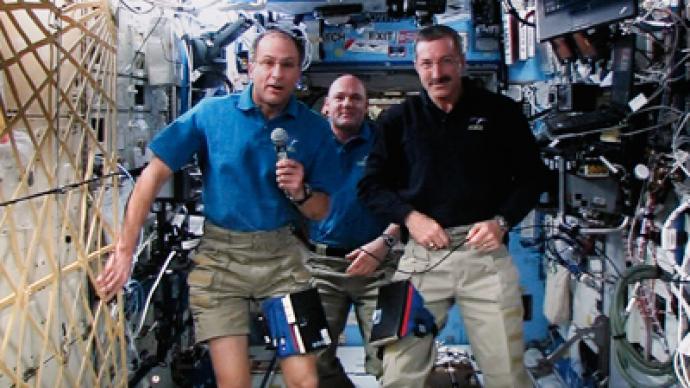
The International Space Station crew (L-R) John Pettit, Andre Kuipers and Dan Burbank, looking blissfully unaware of the bacteria all around them (February 20, 2012, Reuters/Mike Munden)

Seventy-six types of unregulated micro-organisms have been detected on the International Space Station (ISS). Though many are harmless, some are already capable of causing severe damage. And no one knows how they will mutate in space.

­“We had these problems on the old MIR space station, now we have them on the ISS. The microflora is attacking the station. These organisms corrode metals and polymers and can cause equipment to fail,” Anatoly Grigoryev, the vice-president of the Russian Academy of Sciences, told Interfax news agency.

Despite extensive precautions, most of the microbes are accidentally brought to the space station with various cargoes.

One of the early Russian crews also carelessly released a fungus that was later allowed to spread.

Of particular concern is the Zarya – the first ISS module launched into space in 1998.

But the crew is also in potential peril.

“Uncontrolled multiplication of bacteria can cause infectious diseases among the crew,” said Grigoryev.

­

Surprisingly common problem


As stations grow older, microbe contaminations get worse.

On the predecessor of the ISS, the Russian MIR (Peace), there were 90 different micro-organisms in 1990, four years after its launch. By the time it was decommissioned in 2001, the number had risen to 140.

In the relatively sterile and temperature-controlled environs of the station, bacteria were allowed to spread easily.

Micro-organisms also evolved and became highly aggressive. Cosmonauts reported corroded illuminator glass, holes in the metallic casing of the control panel, and exposed leads, the insulation of which had been eaten away.

The ISS is expected to be in operation at least until 2020.

Russian scientists also believe that particularly resilient bacteria can survive for years in extreme conditions on the outside of the station, as several experiments have proved.

Whether their mutations could be dangerous if these are allowed to escape is not clear.

Currently, Russian cosmonauts are wiping down surfaces in their modules with anti-bacterial liquids, but it is not possible to reach all contaminated areas by hand. Russian scientists are planning to deliver a powerful anti-bacterial UV lamp in one of the next shipments to combat the growing problem.


Comments (20)

Dandelion13 26.04.2012 17:16

UselessEater wrote in #9
OK, I have the answer, it came to me while watching a Hollywood movie.

First we send a squad of Space Marines armed whith huge guns. One of them must be tough woman and another must be a whining coward who turns hero. They will land on the Space station and rush in pointing their big guns at at everything. Then the shooting starts, this lasts for about two hours during which most of the Space Marines die. Only one is left, he teams up with the beautiful female scientist, they have great sex and then they find a solution to the Microb problem.

Soun d like a plan?

Is great, Useless Eater! I have only a little thing to add to it: the Microb Problem should get solved by the hero and the scientist having sex.Some kind of "love-radiation" which will help a mankind of tough Space Marines and gorgeous female scientists to conquer, rule and divide the whole of this universe.

0

Undo

A.Smith 26.04.2012 04:56

Ozone generators and UV lamps would seriously deal with any micro organism outbreak on the ISS.

Restorti ng to the possible corrosive gases like Chlorine flooding which would quickly kill off the micro organisms in a ISS Section at a time would also corrode the wiring and electrical connections making that solution not very attractive.

O zone generators in a single ISS section at a time would likely be nearly as effective and bathing incoming ISS cargo with UV rays would seriously limit additional micro organisms being brought in.

+15

Undo

susato 25.04.2012 19:55

The problem with Mir was that the whole station was very humid, the walls continuously glistening with condensate from breath, perspiration, fermenting garbage, and leaks from the ethylene glycol cooling system. An ideal environment for surface-dwelling bacteria and fungi, which need moisture to thrive By contrast ISS is much cleaner and drier. Sure, there are microbes - everywhere humans go there are microbes - but they are far better controlled aboard ISS.  Bottom line: nothing to worry about.

+6

Undo

View all comments (20)
Add comment

By posting your comment, you agree to abide by our Posting rules

Log in to comment in full, or comment anonymously under character-limit restriction.

100 Text

– required fields

Register or

Name

Password

Show password

Register

or Register

Request a new password

Send

or Register

To complete a registration check
your Email:

or Register

A password has been sent to your email address

Edit profile

Name

New password

Retype new password

Current password

Save

Cancel

Follow us