‘Japan playing with fire:' Chinese warships deployed to disputed islands

Published time: September 11, 2012 17:21
Edited time: September 11, 2012 23:50
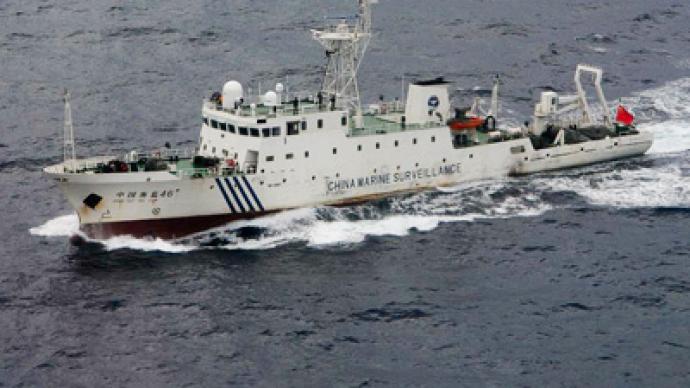
The Chinese patrol ship Haijian 46, one of the two ships which is reportedly sailing near the disputed islands in the East China Sea, known as Senkaku in Japan or Diaoyu in China, in this handout file photo taken by the Japan Coast Guard in December 2008. (REUTERS)

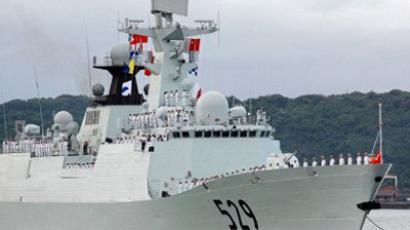
Two Chinese patrol ships have been dispatched to a group of disputed islands following Tokyo’s announcement that it would purchase the isles from private owners. Beijing has vowed “reciprocal measures” should the situation escalate.

Two ships from the China Marine Surveillance (CMS) – a paramilitary maritime law enforcement agency – were dispatched to the tiny archipelago in the South China Sea “to assert the country’s sovereignty,” the official Chinese Xinhua News Agency said Tuesday.

Xinhua said the vessels had reached the waters around the Diaoyu Islands — known in Japan as the Senkaku Islands —and would take the necessary measures to deal with “the development of the situation.”

Chinese Defense Ministry Spokesman Geng Yansheng vowed the “government and armed forces stand firm and are unshakeable in their determination and will safeguard sovereignty over the nation's territories."

"We are watching the evolution of the situation closely and reserve the right to take reciprocal measures," he continued.

However, Japan’s coast guard said no special measures have been taken as a result of the Chinese patrol boats' deployment to the islands, though Tokyo monitoring any possible new developments. Japanese officials say it's unlikely that the Chinese vessels would come within 12 nautical miles of the islands – which would constitute an encroachment on Japanese territorial waters.

Beijing summoned Japan’s ambassador to China late on Monday to protest Japan’s move to buy three of the five islands, which will become the responsibility of the Japanese coast guard if the plan goes through.

The People's Liberation Army Daily also said in a commentary on Tuesday that Japan was playing with fire, calling the purchase the “most blatant challenge to China’s sovereignty since the end of World War II.”

And as the rhetoric heats up, China has started broadcasting a daily weather report for the islands for the first time.

Small demonstrations outside of the Japanese Embassy in Beijing followed the news, with a dozen or so demonstrators chanting “Japan, get out of China.” Similar protests were reported in two other cities in eastern and southern China.

Taiwan, who has also laid claim to the islands, which are on a route to rich fishing grounds and potentially large maritime gas fields, recalled its envoy to Japan on Tuesday in response to Tokyo’s plan to nationalize them.

Taiwan’s envoy was instructed to lodge a formal complaint with Tokyo, and is expected to return to Taipei on Wednesday.

Protesters (front) hold a banner reading "Diaoyu islands belong to China" as people march down a street in Weihai, in eastern China′s Shandong province, to protest against Japan "nationalizing" the Diaoyu islands, also known as the Senkaku Islands in Japanese, on September 11, 2012. (AFP Photo)
Protesters (front) hold a banner reading "Diaoyu islands belong to China" as people march down a street in Weihai, in eastern China's Shandong province, to protest against Japan "nationalizing" the Diaoyu islands, also known as the Senkaku Islands in Japanese, on September 11, 2012. (AFP Photo)

­

Tokyo moves against Japanese nationalists, not Beijing

Japanese Foreign Minister Koichiro Gemba attempted to mitigate the blowback on Tuesday by reiterating the claim that the $26-million purchase served the "peaceful and stable maintenance of the islands."

Gemba urged calm, saying "we cannot damage the stable development of the Japan-China relationship because of that issue.”

Following the announcement to purchase the islands, Japanese Prime Minister Yoshihiko Noda, without specifically mentioning the territorial dispute, admitted that regional dynamics had left Japan in an increasingly precarious position.

"We have North Korea launching missiles under the name of satellites and conducting a nuclear program, China expanding its military might and continuing vigorous activities in regional waters, and Russia also boosting its activities in the Far East," Reuters cites him as saying.

Having found itself in such troubled waters, some experts believe Japan’s bid to purchase the islands is meant to stymie plans by Tokyo’s nationalist governor, Shintaro Ishihara, who had previously announced hopes of developing the islands. The country’s central government maintains that it will not develop the isles.

­Japan incorporated the disputed islands in 1895, but ceded ownership following World War II, when the US took over administrative control. The US returned the islands to Japan in 1972, three after an expert revealed that oil reserves could be located under the sea in close proximity to the isles, reigniting China’s once dormant territorial claims.

“Ishihara put the national government in a very difficult spot. He pushed them into doing this now,” Sheila Smith, a senior fellow at the Council on Foreign Relations in Washington, told AP. Smith says the three parties involved should see the move as an attempt by Tokyo to derail Ishihara’s plans.

Ishihara for his part reiterated calls to develop the islands for use by fisherman.

Chinese authorities, who regularly exaggerate statements regarding Japan for domestic consumption, at least publicly have no intentions of backing down, whatever Japan’s intentions, especially in an area where it might appear that a territorial claim is being solved unilaterally.

But while nationalists on both sides are seen as a potentially destabilizing force, experts believe both sides have no intention of seriously damaging economic times over the issue.


AFP Photo
AFP Photo
Reuters / Bobby Yip
Reuters / Bobby Yip

Comments (49)

mlnw (unregistered) 01.11.2012 12:32

The U.S. created the seeds of this conflict when it transferred "administrative control" of the Daiyou islands to Japan in 1972.  This happened under Kissinger's foreign policy watch at the same time that he was negotiating the Shanghai Accords with the PRC.  While it may have been under the radar with the PRC, it was a public issue for Taiwan since there were strong protests and street demonstrations there over the transfer and by that time, the islands and sea around them were known to contain significant energy reserves.

0

Undo

Tojo 01.10.2012 13:56

Win T Pu:...Japanese negotiators are stubborn negotiators.  They never ever budge an inch even if they know they have a weak hand...   Which is the reason why China is trying to change borders with its neigbors by force. Islands already belonged to Japan for more than 100 years, but hey were managed by private citizen - japanese... Chinese governemnt also offered huge amounts of money to buy the Senkaku, but he didn't accept the offer but sold it to Tokyo government for far less money. Chinese never say anything about this, right? The law is on the side of japanese, maps too, by transfering governance of the island from japanese private person to the government doesn't change anything. Island still stays as part of japanese territory, according to the international law and current official borders. If Chinese side wants to go with "historical" maps from 1880 or 1895 than according to the same maps they need to hand over governance of the occupied Kashmir to the Indians and Tibet to Tibetans. Chinese, are you sure you want to go by those maps?

+1

Undo

Win T Pu (unregistered) 20.09.2012 21:46

When Japan annexed Taiwan 1895after they defeated China's Qing[Ching] Dynasty, they conveniently took the Diaoyu Islands too. and formally took Korea as their colony.  They renamed it Senkaku in 1900.  So this ownership was legal only in that Japan did all these Kabuki theatre themselves.   A 1785 map by a Japanese naval officer writer, Hayashi Shohei of Sendai in which the Daioyu Islands were clearly marked as the red color of Guangdong and Fujian territory, Yellow for Taiwan Province and Olive for Ryukyu outer island so far away from the map that he had to telescope some Ryukyu small islands into a corner of this map.  The Japanese should recognize this map, and Imperial correspondences oof these clear evidence exhibits and not twist history with fiction.  Japanese in trying to drive a hard bargain from a weak position simply uses stonewalling, and present the 1880 no-man's-land arguement they want to side step their aggression of 1895.  After WWII, they were supposed to give up all territories of conquest, Korea, Okinawa, Taiwan and that included the Diaoyu Islands.  But MacArthur being the defacto Ceasar of Japan, did not formally give to Taiwan's Chiang Kai-shek.  They administered Okinawa and these Daioyu Islands until they were ready to step back a little.  It was a mistake based on their trivializing the whole Chinese people that America did not consult China [which was an enemy then due to the Korean war] and Taiwan which was getting handouts from them, a mascot.  This does not negate the rights of China and Taiwan.  So the Daiyu Islands is a leftover loot taken by Japan's aggression that they do not want to give up.  Japanese negotiators are stubborn negotiators.  They never ever budge an inch even if they know they have a weak hand.  I have admired them for this because sometimes our side may be less prepared and will knuckle under.  If we know all our cards and their, they will still not give an inch until they finally capitulate, at the 12th hour. 
That, in my opinion is why Japan started this latest round of kicking China's shin when China did not raise the first move.  There is the 1785 Hayashi map on Wiki and a Taiwan scholar has a good post NYTforum. 

0

Undo

View all comments (49)
Add comment

By posting your comment, you agree to abide by our Posting rules

Log in to comment in full, or comment anonymously under character-limit restriction.

100 Text

– required fields

Register or

Name

Password

Show password

Register

or Register

Request a new password

Send

or Register

To complete a registration check
your Email:

or Register

A password has been sent to your email address

Edit profile

Name

New password

Retype new password

Current password

Save

Cancel

Follow us