Japan to start building world's biggest offshore wind farm this summer

Published time: January 18, 2013 21:46
Edited time: January 19, 2013 01:53
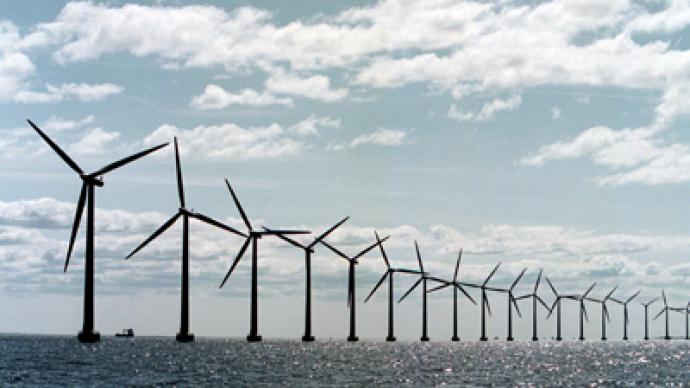
The world's largest offshore windmill farm, Middelgrunden Windmill Farm, located in the Oeresund, three km from Copenhagen harbour. (AFP Photo / Soeren Bidstrup)

Japan is to start building its ambitious wind farm project off the Fukushima coast in July. The farm is expected to become the world’s largest and produce 1GW of power once completed in 2020.

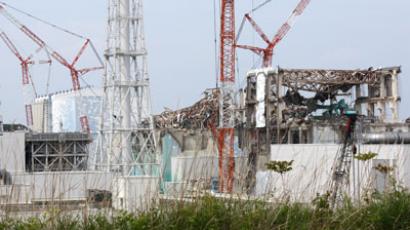
­The power-generating facility will be built 16 kilometers off the coast of the Fukushima Daiichi nuclear power plant, which was critically damaged by an earthquake and tsunami in March 2011.

The 143 wind turbines, which are to be 200 meters in height, will be built on buoyant steel frames stabilized with ballast and anchored to the continental shelf.

Once completed in 2020, the project will generate 1 gigawatt of renewable electrical power. 

The project is part of Japan’s national plan to increase renewable energy resources following the nuclear disaster at Fukushima. After the quake, Japan shut down its 54 nuclear reactors, but due to energy shortages it has had to restart two reactors.

“This project is important. I think it is impossible to use nuclear power in Fukushima again,” project manager Takeshi Ishihara of the University of Tokyo told New Scientist weekly magazine.

Ishihara believes the area's seismic activity won't be a problem for the turbines. His team has carried out lots of computer simulations and water tank tests in order to verify the safety of the turbines in all possible extreme events, such as earthquakes, tsunamis and typhoons.

"All extreme conditions have been taken into consideration in the design," he added.

There were some objections to the project by local people, who expressed concerns, in particular, over possible impact on the fishing industry, which was also hit by the nuclear disaster. But Ishihara is sure it’s possible to turn the farm into a ‘marine pasture’ that would attract fish.

Facility specifications of forward project. (Image from Fukushima Floating Offshore Wind  Farm Demonstration Project, Takeshi Ishihara The University of Tokyo)
Facility specifications of forward project. (Image from Fukushima Floating Offshore Wind Farm Demonstration Project, Takeshi Ishihara The University of Tokyo)

The project is also part of the prefecture’s plan to become completely energy self-sufficient by 2040, using only renewable sources.  

The Fukushima wind farm will produce double the amount of energy of the Greater Gabbard array, currently the world’s biggest, off the coast of Suffolk in the United Kingdom, which generates 504 megawatts from its 140 turbines. Although the title of biggest will soon pass to the London Array in the Thames Estuary, where 175 turbines will produce 630 megawatts of power when it becomes operational later this year.

Scientists and researchers believe Japan’s wind capacity could reach 7.6 gigawatts over the next three years.


Development phases and key success factors. (Image from Fukushima Floating Offshore Wind  Farm Demonstration Project, Takeshi Ishihara The University of Tokyo)
Development phases and key success factors. (Image from Fukushima Floating Offshore Wind Farm Demonstration Project, Takeshi Ishihara The University of Tokyo)

Comments (9)

Max A. H. Hartvigsen 03.03.2013 23:34

Looks like Japan is going to a busy market for Offshore vessels in the future.

0

Undo

Minwoo Kim (unregistered) 27.01.2013 06:10

Obama's energy policy is right. Japan's FiT in July is among the highest in the world. Japan's FiT is shaking the renewable energy market. New solutions will be showed in Japan. This is it! Floating wind turbine is one of the best solutions for USA and UK. UK has more install places around its shores than any other in the world. USA has Atlantic Coast. As you know, Every year Some typhoons arrive Japan. The typhoon has strong wind. Floating wind turbines must have constructed to resist typhoons. So they have to reduce vibration to install floating wind turbines on the sea. Because, it makes many kinds of problems! It's increasing the durability problem of floating wind turbine. Vibration’s caused by wind, waves and external forces. New Floating Body Stabilizer for floating wind turbines has been created in South Korea. The Floating Body Stabilizers generate drag force immediately when floating wind turbines are being rolled, pitched and yawed on the water. Recently, this Floating Body Stabilizers have been used to reduce vibration of floating solar panels in South Korea. You can see New Floating Body Stabilizer videos in YouTube. http://youtu.be/O2oy s_YHhCc, http://www.youtube.c om/watch?v=nA_xFp5kt bU&feature=youtu.be.

0

Undo

Conni (unregistered) 24.01.2013 15:21

It is an example of new environmental technologies. We can only learn from it.

0

Undo

View all comments (9)
Add comment

By posting your comment, you agree to abide by our Posting rules

Log in to comment in full, or comment anonymously under character-limit restriction.

100 Text

– required fields

Register or

Name

Password

Show password

Register

or Register

Request a new password

Send

or Register

To complete a registration check
your Email:

or Register

A password has been sent to your email address

Edit profile

Name

New password

Retype new password

Current password

Save

Cancel

Follow us