Kazakh leader learns lessons from Gaddafi’s experience
Published 15 Jan, 2012 09:45 | Updated 15 Jan, 2012 14:14Early parliamentary election in Kazakhstan comes just a month after the country was shaken by deadly riots in the town of Zhanaozen. And the time seems right for change in a country that does not want to follow in its restive neighbors’ footsteps.
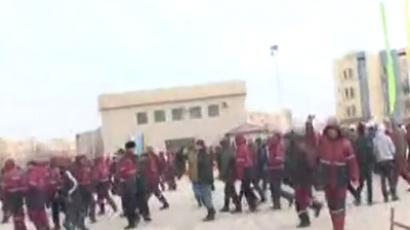
If it was not for the snow and the freezing temperatures, Kazakhstan's capital of Astana could easily be mistaken for one of the gleaming cities of the Persian Gulf. A village just two decades ago, it is now an oasis in the desert, with its architecture having a distinct Arabic flavor.Like many Arab countries, Kazakhstan's primary source of income is oil and gas, and it is these exports that have allowed this country the luxury of building a new capital city from scratch in less than 20 years. In fact, Kazakhstan is now producing about as much oil as Libya used to churn out prior to the civil war, and the similarities between the two countries do not end there.Both Kazakhstan and Libya have predominantly Muslim populations. Both were considered stalwarts of calm in their turbulent neighborhoods. And both have experienced decades of rule by just one man. In terms of style, steadfast Nursultan Nazarbayev is the exact opposite of erratic Muammar Gaddafi, and of course he is still in power.But the Libyan scenario no longer seems improbable in Kazakhstan, even to its leader.“Some young people are fascinated with what's happening in the world right now: in Africa and Europe. But we have to explain to the new generation that blindly believes everything it's told that there are those who envy us and our well-being,” President Nazarbayev once said. “The countries where revolutions took place have gone back 10 to 15 years, economically speaking.”The town Zhanaozen is rightfully called Kazakhstan's oil capital, but it is no match for glistening Astana. Despite producing much of the country's hydrocarbons, for decades it has been poor and neglected.The uprising in western Kazakhstan has smoldered since last spring, but culminated last December in a weekend of clashes with police that left 17 dead and more than 100 injured. As the protests spread to other cities, the authorities were jittery in the wake of the Arab Spring.“What happened in Arab countries definitely scared Kazakh authorities,” says Bolat Abilov, a member of the opposition. “The first thing they did when the uprising began was to switch off mobile networks and the internet connection.”Before the people even demanded it out loud, the Kazakh authorities decided to offer political reforms. The people are now going to the polls to elect a new parliament. Recent constitutional amendments guarantee there will be more than one party, which there has been up until now.“The challenge now is to keep all the good things – stability, prosperity, and at the same time allow the society to evolve,” Ariel Cohen of the Heritage Foundation told RT.Meanwhile, the authorities have approved millions of dollars worth of programs to give the restive city a face-lift and create new job opportunities. The president's close associate, Baurzhan Mukhamedzhanov, who was appointed to oversee the turbulences, says that in a few years, Zhanaozen will make some cities in the gulf pale in comparison.“Come here in a few years… and you won't recognize this city,” he said.While the Arab spring may have sparked protest movements around the world, it has also taught many countries how to deal with them. Kazakhstan is trying to show it has learnt those lessons – and its leaders hope it will remain a stable presence in an unstable world.