Bacteria from Siberia capable of living on Mars – study

Published time: December 25, 2012 20:53
Edited time: April 12, 2013 09:37
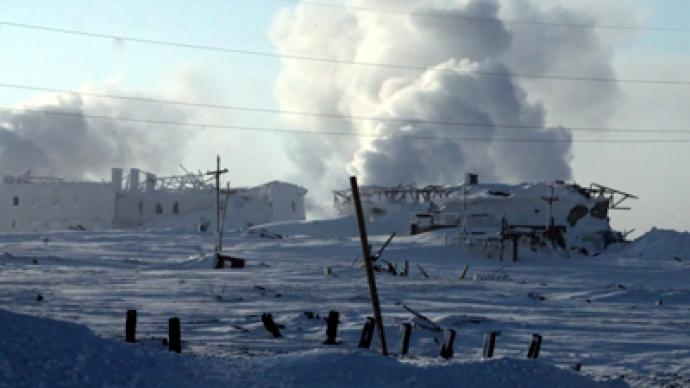
The Taimyr Peninsula, Siberia. (Image from flickr.com user@lvovsky)

A group of American-Russian scientists have found several types of bacteria from Siberian permafrost, which can grow in harsh conditions similar to those on Mars. It could potentially mean that Earth microbes can survive on the Red Planet.

Some of the genus Carnobacterium microbes have already been found to exist in cold climates around the world – such as Alaska and in the oxygen-poor waters of Ace Lake in Antarctica.

Researchers from the Department of Microbiology & Cell Science at the University of Florida took samples of bacteria from the sand deposits, on the bank of the Kolyma River in northeastern Siberia.

After extracting the samples from a depth of 12-20 meters where the soil has an average annual temperature of -7 °C, scientists grew bacterial colonies at 28 °C in normal atmospheric conditions.

The bacteria were then tested in Martian conditions – exposed to a lack of oxygen, extremely negative temperatures, and very low pressure – which hinder the growth of most terrestrial microorganisms.

After the 30-day experiment, only six of the 10,000 isolates were able to grow under these conditions.

All of the surviving isolates were members of the genus Carnobacterium- as reported by the scientific quartet of Wayne L. Nicholson, Kirill Krivushin, David Gilichinsky and Andrew C. Schuerger , in the journal "Proceedings of the National Academy of Sciences."

Scientists say these results are important to assess the possibility of life on Mars.

However, a Russian-American group of physicists recently highlighted a barrier to microbes surviving on Mars.At the 43rd Lunar and Planetary Science Conference in Texas, they found radiation levels on the surface of the Red Planet is so high, that at a depth of around 10 centimeters the existence of organic matter is believed to be impossible.


Comments (11)

Anonymous user 12.05.2013 16:37

i wanted to look up siberian bacteria, and this is what i got

0

Undo

IndianaJohn 06.01.2013 23:16

I just don't know why or how the Martians would want our bugs.

0

Undo

Bob (unregistered) 28.12.2012 10:26

Many scientists have responded to Hoagland's claims and assertions. Professional astronomer Phil Plait described Hoagland as apseudoscientist an d his claims as ridiculous.[9] In 2002, Ralph Greenberg, Professor of Mathematics at the University of Washington, wrote a paper asserting that the logic of Hoagland's deductions from the geometry of Cydonia Mensae is flawed[121] and says that he is not a trained scientist in any sense. The claim that the crashing of the Galileo orbite r into Jupiter caused a "mysterious black spot" on the planet has since been disputed by both NASA and Dr. Plait. There is photographic evidence that a similar "black spot" was present in imagery of Jupiter taken in 1998. A second image referenced by Dr. Plait shows a dark ring which looks similar to the spot Hoagland cited.[122] In 1995, Malin Space Science Systems, NASA prime contractor for planetary imaging, published a paper critiquing claims that the "city" at Cydonia is artificial, the claimed mathematical relationships, and — very specifically — denying any claims about concealing questionable data from the public.[123]In October 1997, Hoagland received the Ig Nobel Prize for Astronomy "for identifying artificial features on the moon and on Mars, including a human face on Mars and ten-mile high buildings on the far side of the moon." The prize is a parody award given for outlandish or "trivial" contributions to science.[124]

0

Undo

View all comments (11)
Add comment

By posting your comment, you agree to abide by our Posting rules

Log in to comment in full, or comment anonymously under character-limit restriction.

100 Text

– required fields

Register or

Name

Password

Show password

Register

or Register

Request a new password

Send

or Register

To complete a registration check
your Email:

or Register

A password has been sent to your email address

Edit profile

Name

New password

Retype new password

Current password

Save

Cancel

Follow us