Unique meteorite hints at Mars’ oxygen-saturated past

Published time: January 04, 2013 00:17
Edited time: April 12, 2013 09:37
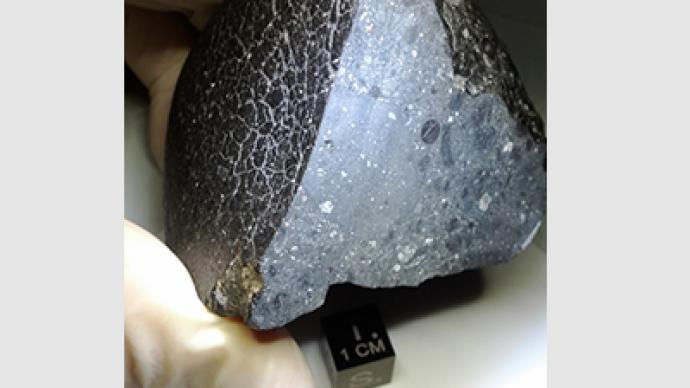
Designated Northwest Africa (NWA) 7034, and nicknamed "Black Beauty," the Martian meteorite. (Image from nasa.gov)

Experts have discovered a unique meteorite from Mars which contains ten times the amount of water and far more oxygen than any other Martian samples found on earth.

­The sample found in the Sahara Desert in 2011 is now called Northwest Africa 7034. Known among the scientific community as a “Black Beauty,” the baseball-size rock is estimated to be 2 billion years old. It's the second-oldest known Martian meteorite that formed from a volcanic eruption. Similar volcanic rocks examined by the NASA Martian rovers Spirit and Opportunity, also found water-bearing minerals.

Around 65 Martian meteorites have been found on our planet. They fell on earth after a large asteroid impact. One of the oldest found, Allan Hills 84001, is more than 4 billion years old, some experts believe it contains traces of ancient bacteria. About half a dozen Martian meteorites are 1.3 billion years old and the rest are 600 million years or younger. The newly discovered specimen scientists believe came from the Gusev crater on Mars.

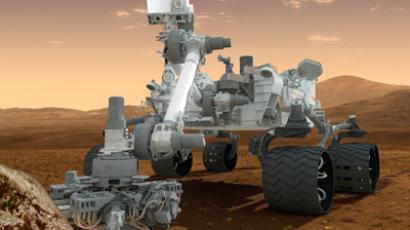
This NASA panorama image released November 26, 2012 shows a mosaic of images taken by the Mast Camera (Mastcam) on the NASA Mars rover Curiosity while the rover was working at a site called "Rocknest" in October and November 2012.(AFP Photo / NASA)

Water saturation analysis, which was published in Science Journal, found that the amount released during heating was small – only 6,000 parts per million – but still ten times more than other Martian meteorites.  Scientists speculate this resulted from interaction with water near the surface during a time when the Red planet was mostly dry and dusty. Tests for oxygen isotopes also came out much higher than other Martian rock. Scientists say this suggests Mars once had reservoirs of oxygen in its crust.

Experts are now trying to determine how long the object floated in space and how long it was sitting in the Sahara. Further discoveries scientists hope will aid their understandings of the geology currently being explored by NASA’s Curiosity rover.


This NASA image released November 26, 2012 shows Martian rock called "Rocknest 3" (AFP Photo / NASA)

Comments (5)

Anonymous user 26.02.2013 16:47

Mars has the biggest known volcano in the system Olympus Mons, also it has large impact craters.

0

Undo

Joshua (unregistered) 09.01.2013 23:26

Take a look at the most bizarre and beautiful picture ever taken of Mars.http://www.educ atinghumanity.com/20 12/12/the-most-bizar re-picture-of-mars-e ver.html

0

Undo

That's very interesting (unregistered) 04.01.2013 23:32

I wonder if the martian's can get a reading on the Barium, Aluminum Oxcide, Strontium 90, Uranium 238, EDB, TMA and Pathogens being sprayed on this planet by psychopaths, sociopaths and narcissists?

+1

Undo

View all comments (5)
Add comment

By posting your comment, you agree to abide by our Posting rules

Log in to comment in full, or comment anonymously under character-limit restriction.

100 Text

– required fields

Register or

Name

Password

Show password

Register

or Register

Request a new password

Send

or Register

To complete a registration check
your Email:

or Register

A password has been sent to your email address

Edit profile

Name

New password

Retype new password

Current password

Save

Cancel

Follow us