‘Supermoon’ to dominate night sky
Published 5 May, 2012 10:16 | Updated 5 May, 2012 16:42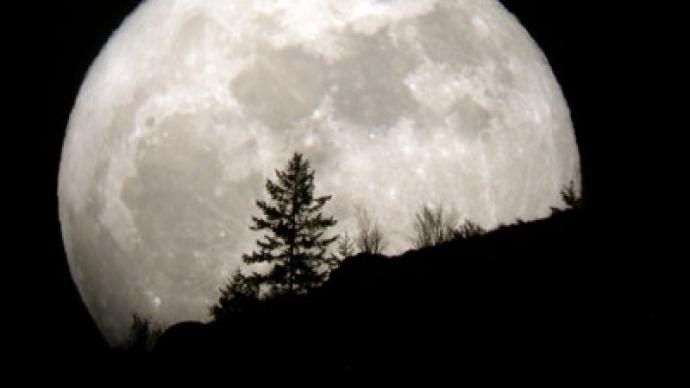
Stargazers will be treated to a rare glimpse of a “Supermoon” this weekend when our celestial neighbor strays closest to Earth. During the annual display, the moon appears to swell larger in size and wax in brightness.
Scientists say that the moon will look 14 per cent bigger and 30 per cent brighter than all the other full moons of 2012 and will be visible at its peak from 03:00 GMT on Sunday for approximately 35 minutes. “Every year there are 13 new moons and 13 full moons, occasionally producing some exceptional spectacles. A Supermoon happens when the moon’s elliptical orbit swings it closest to the Earth,” said senior scientist from the Russian Pulkovo observatory, Sergey Smirnov.Supermoon is a nickname for when the moon reaches the closest point to Earth every month in its orbit. Its scientific name is a “perigee moon” and it occurs because the moon’s orbit is not perfect circle around our planet. According to calculations our celestial neighbor will be about 356,955 kilometers from Earth, about 24 622 kilometers closer than average.For the best views of the Supermoon, astronomers recommend viewing it when it lies closer to the horizon.The giant perigee full moon does bring some side-effects, namely perigean tides, when lunar gravity pulls tidal waters higher than usual. However, scientists assure this is not a cause for concern, as it only raises water levels by an estimated 15 centimeters.The last Supermoon occurred on March 19 of last year, when the moon was recorded at a distance 400km closer than predicted for this weekend’s display.May is set to be an exciting month for stargazing enthusiasts. As well as the Supermoon NASA has said the Eta Aquarid meteor shower will be visible on Saturday night, although astronomers have warned that the unusually bright lunar phenomenon could obscure the display.In addition, on May 20 the moon will pass in front of the sun, creating a partial solar eclipse that should be visible from parts of East Asia and North America.