Energy crisis looms: Japan closes last reactor
Published 4 May, 2012 06:44 | Updated 4 May, 2012 14:52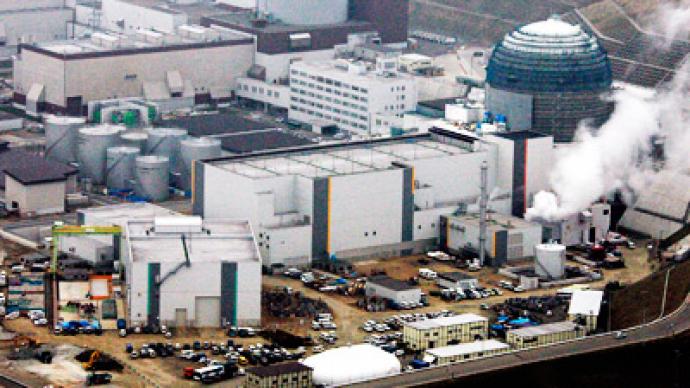
Japan is set to shut down its last operational nuclear plant following last year’s Fukushima meltdown disaster. However, with a giant energy quota to fill and no viable substitute, many predict a nuclear-free future will be short-lived.
The Hokkaido electric company closes down its Tomari plant, the last of Japan’s 53 atomic power stations, on Saturday, leaving a country-already dependent on foreign fuel imports -without nuclear energy.Since the earthquake and tsunami caused a triple meltdown last March at the Fukushima Daiichi plant, the Japanese government has been gradually de-commissioning and closing plants throughout the country. The government has faced increasing pressure from environmental groups to abandon nuclear energy following the Fukushima catastrophe. It forced tens of thousands of Japanese from their homes after dangerous levels of radiation contaminated local food and water supplies.The decision to turn away from nuclear energy is a controversial one in resource-poor Japan. Prior to the March 2011 disaster the country drew approximately 30 per cent of its energy from nuclear power, a figure that was expected to rise to 50 per cent by 2030 to meet exploding energy demands.The energy vacuum is set to incur shortfalls and power cuts this summer, with supplies falling short by 14 per cent in Tokyo and up to 16 per cent in western Japan."I have to say we are facing the risk of a very severe electricity shortage," said Economy, Trade and Industry Minister Yukio Edano in April. He added that rising fuel imports would be felt by the Japanese taxpayer.
Japan bites off more than it can chew?
As it stands the transfer to a non-nuclear energy infrastructure will be very costly as Japan will have no choice but to step-up its fuel imports. Preliminary figures from the international energy agency increase oil-demand to 4.5 barrels a day, costing an additional $100 million, a bleak prospect for an economy that reported its biggest ever trade deficit in 2011.
The Japanese Finance Ministry said its deficit had risen to $50 billion because of the extra fuel imports needed to compensate for the lack of nuclear energy.Environmental groups see the closure of the country’s last operational plant as an opportunity to wean Japan off atomic energy and follow the German model. However, creating the infrastructure for green energy will take time and significant investment. Currently, Japan gets around 8 per cent of its energy from renewable sources and is looking to raise that figure to over 25 per cent by 2030.Many have criticized Japan’s plans as too ambitious and view the reactivation of the country’s power plants as inevitable in spite of public protest.Dr. Howard Hayden, Professor of Physics at Connecticut University, said that Japan “will probably go back to nuclear in due time because money talks.”“It’s costing them very dearly. They haven’t got nearly enough electricity and they have actually called on some factories to cut back their operations quite a bit,” said Hayden.He added that some factories in the North of Japan had been effectively shut down because of power shortages.“Eventually they will probably restart most of their reactors. The ones that are in possible danger of tsunamis, they’ll of course either shut down completely or build some much better protective walls around them,”Hayden concluded.There are experts, however, who believe that in shutting down its reactors, Japan could take an economic hit. “It does present a potential opportunity to Japan to exploit some of its other abilities to generate energy, including geothermal power,”James Corbett, editor of The Corbett Report website told RT. ““It [Japan] is currently only generating 0.5 Gigawatts of power via geothermal power, but it has the potential for up to 23.5 Gigawatts. Obviously a lot of this is in national parks, in hot spring areas which are currently being used for tourism, but could be converted, at least potentially, to more energy generation.”Corbett is convinced that Japan’s proximity to the ocean could be exploited for generating tidal power. Even the temperature difference in ocean currents can be used to generate electricity.“These are experimental technologies at the moment, but Japan could become a leading nation in those types of energy generation techniques,”he added.