Astronomers discover oldest galaxy in Universe

Published time: November 17, 2012 04:32
Edited time: November 17, 2012 08:32
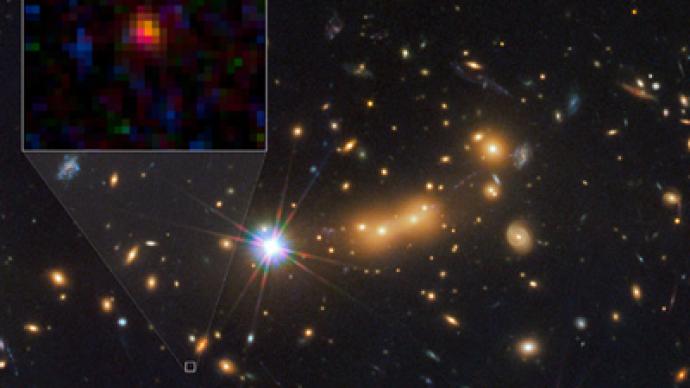
The galaxy MACS0647-JD (Image from nasa.gov)

Scientists have discovered the most distant and apparently the oldest galaxy in the known universe using a unique combination of super man-made and natural telescopes.

The galaxy, MACS0647-JD has been found 13.3 billion light years away from Earth. Scientists believe they are witnessing the cosmic cluster in its infancy, just 420 million years after the Big Bang which created the Universe 13.7 billion years ago, NASA and the European Space Agency announced.

“We see the newly discovered galaxy, named MACS0647-JD, as it was 420 million years after the Big Bang… Its light has travelled 13.3 billion years to reach Earth,” a statement said.

Cluster Lensing and Supernova Survey with Hubble (CLASH), a joint US-European project, has been credited with the discovery. In order to see the galaxy, astronomers combined the magnifying power of the Hubble Space Telescope, the Spitzer Space Telescope and a natural zoom effect called gravitational lensing.

The effect enables astronomers to see galaxies that emit a dim light, undetectable by telescopes on Earth, but through gravitational lensing is made visible as the light from a distant object is bent by the gravity of huge galaxy clusters.

“While one occasionally expects to find an extremely distant galaxy using the tremendous power of gravitational lensing, this latest discovery has outstripped even my expectations of what would be possible with the CLASH program,” said Rychard Bouwens of Leiden University in the Netherlands, a co-author of the study defined the discovery. “The science output in this regard has been incredible.”

The distant galaxy is a miniscule dot in the cosmos, tiny in comparison to our own Milky Way.The new celestial wonder is less than 600 light-years wide as opposed to the Milky Way which is 150,000 light-years across.

Researchers assume that MACS0647-JD may at some point combine with other galaxies to create a larger whole.

“This object may be one of many building blocks of a galaxy,” says Dan Coe from the Space Telescope Institute and lead author of the study.“Over the next 13 billion years, it may have dozens, hundreds, or even thousands of merging events with other galaxies and galaxy fragments.”

Astronomers are awaiting the launch of a new James Webb Space Telescope in 2018. They hope to be able to use its refined capabilities to more accurately measure the distance and composition of the universe’s oldest galaxy.


Comments (17)

Anonymous user 22.03.2013 16:47

That comment is ignorant

0

Undo

@sjbauer via georgio part II (unregistered) 20.12.2012 11:03

(continued)
Why? It just seems like in our mortal oriented minds, we must know.. but really not! Most likely a why, because we humans have a starting time, with an uncertain limit of X number of years. This does not even stand to be agrued as to the start or demise for the existance of the universe. Which reminds me of the typical scientific mental train-of-thought. Back some 40 years ago, a physics mathematics student friend of mine, would not even consider for an instant, entertain the thought, that there could exsist a speed past that of light. Incomprehensible to him, totally. And layman me, would always throw out this possibililty, and likewise receive the same set in concrete response, no way Jose!. This was an example of what restrains our scientific community today, they really fail to truly think, and apply, "outside the box" (brain restraints?). Oh, back to our universal shoe size.. As was suggested in a prior commentor, the universe itself may be a type of a continuation. Of what? Let's speculate further (like any good scientist..), and say, similarly as the oceans on this planet flow, our universe too is in a continuim of flow, but on an insurmoutably immense size scale. I often have a laugh (to myself), whenever I reflect on the question of the universes beginning postulation. My real question is, why are we trying to find this out, rather than to explore ways to expand the knowledge of the remaining 90% or so of our dormain brain capacities. Once we attend to this necessity, questions on the universe, our existance therein, and many more answers to the "why's" will automatically spring forth! Presently, our worldly knowledge comes accross on a universal scale as something akin to a  2nd grade level. And thanks to those brave enough to keep religion and politics out of the mix, we're learning a bit more about both the limitations and the capacities of our species. Gradually,  baby-step by baby-step, but,... very  S  L  O  W  L   Y..

0

Undo

sjbauer 21.11.2012 19:49

Besides the Milkyway galaxy is estimated to be between 13.5 and 13.7 billion years old, which would make it older than this oldest galaxy.

0

Undo

View all comments (17)
Add comment

By posting your comment, you agree to abide by our Posting rules

Log in to comment in full, or comment anonymously under character-limit restriction.

100 Text

– required fields

Register or

Name

Password

Show password

Register

or Register

Request a new password

Send

or Register

To complete a registration check
your Email:

or Register

A password has been sent to your email address

Edit profile

Name

New password

Retype new password

Current password

Save

Cancel

Follow us