Orthodox Patriarch, big politics and the small neighbour
Published 23 Oct, 2008 11:42 | Updated 23 Oct, 2008 15:42
On Thursday Russia’s Patriarch Aleksy II began his three-day visit to Belarus. Amid talks of Belarus turning its back on Russia, it is itself a remarkable thing, but what we saw was an exceptionally warm welcome for the head of the Russian Orthodox Church
The current arrival of Aleksy II is confined to the 1020th anniversary of the Baptism of Russia, when the Orthodoxy was brought to the lands of modern Russia, Belarus and Ukraine. And the Patriarch is received with distinction: in his tight schedule there is time for making speeches together with Belarusian president Aleksandr Lukahsenko and receiving the Medal of Honour for strengthening ties between the three countries and particularly for the Patriarch’s role in spiritual revival of the people of Belarus.
Eyes West!
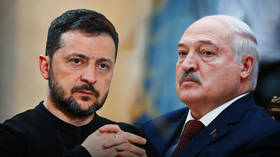
What really makes the visit remarkable is the international background it’s set against. Belarus, Russia’s smaller neighbour and strategic ally within the two countries’ Union State, has recently raised serious concerns over its loyalty to Moscow. Experts both in Russia and in the West are still guessing what is behind the strangely independent steps of Belarus’ irreplaceable leader Aleksandr Lukashenko. And at first glance it seems he really wants to make friends with the EU and the US. After freeing all of the so-called “political prisoners” in the country, he decided not to be led by the nose into recognizing Abkhazia and South Ossetia straight after Russia, and then did everything possible to make the September parliamentary electiona as democratic as it could be in Belarus.
All these moves got high marks in Europe and the United States. The EU has lifted visa restrictions on Belarusian authorities including Aleksandr Lukashenko, while the US has eased economic sanctions and promised more if Belarus takes “some other significant steps” towards democracy.
Russia, in its turn, is on high alert about losing its partner. One of the intrigues in the recent Russia-Belarus dialogue was a stabilisation loan for Minsk. On Tuesday Russia’s Minister of Finance Aleksey Kudrin finally announced that Moscow will provide $2 billion to Belarus. But it seems that it happened only because in a few days the same sum could be offered by the International Monetary Fund. Its delegation arrives to Belarus on October 27.
“Big brother” worries
There are issues that make Russia worry when thinking about Belarus’ ties with the West getting warmer. The first one is whether Belarus will recognise Abkhazia and South Ossetia – something that Lukashenko has not ruled out, but does not want to take responsibility for. The Day of Truth is to become the day of the first session of the newly elected State Parliament on October 27. According to Lukashenko, it is the Parliament that has to decide, not he.
Another issue concerns state security. Very soon Russia and Belarus can sign an agreement on the creation of a United Air Defence System, with the command centre moving to Moscow. The document is on the agenda of the November 3 meeting of the respective presidents at a Higher State Council meeting of the Union State. It is obvious that Belarus in this case is making a serious concession to Russia. The results of the recent meeting of Lukashenko with the Security Council on the issue have been kept secret. But the United Air Defence System is something that Russia wants very much, because it is the simplest and cheapest way to oppose American plans of building parts of their missile defence system in Poland and Czech Republic. If Belarus agrees Russia would not have to spend billions of US dollars to build its own Air Defence System along the Western border.
According to the recent news, Dmitry Medvedev and Aleksandr Lukashenko might sign another important document on November 3 – the Constitutional Act of the Union State. The draft has 8 sections, 68 articles and is based on the principle of sovereignty of the parties. A good chance to leave the European Union behind with its Lisbon Treaty? Maybe, but what it will surely do is stop talks about Belarus being a transit appendix of Russia.
All this makes the Patriarch’s visit similar to that of 2001. It was also an important occasion: seven years ago it was the 60th anniversary of the beginning of the Great Patriotic War of 1941-45. Then, the same issues were on the agenda: security cooperation, constitution of the Union State and Russia-Belarus relations in general. But that time the efforts were not effective to say the least and it was Moscow that restrained the dialogue. It succeeded in making the Higher State Council look like a usual working meeting, and no documents were signed. Moreover, the later cooling of Russia-Belarus relations goes back to that time. It is in 2001 when Russia first raised an issue of tariffs on its crude going through Belarus. The boiling point became the 2007 dispute over gas prices, when Belarus began to reconsider its relations with Russia.
“Calculating mind” or “indecisive bride”?
But the common reasoning that Belarus has just two ways – a democratic one into the West and an authoritarian one into Russia with subsequent inclusion as a province – is too simplistic. Belarus has always been a calculating mind (the point that it only deals with the West to have better bargain positions with Russia has sense). This has been a result of Lukashenko’s long struggle to keep power in this quickly changing world, with Europe and the US introducing sanctions and then lifting them and Russia which can cut gas as easily as give a stabilisation loan.
But the side effects of this struggle seem to be positive for the country – the economy has been growing rapidly in the last ten years, Belarus has preserved its heavy industry, does not depend on food imports and the unemployment level is close to zero. In spite of strained relations with Russia on the one hand and the EU and the US on the other, Belarus has been actively developing economic ties with the rest of the world. But now Lukashenko wants to build “normal” relations in all directions. That is why we can see positive messages sent to both Russia and the West. And it seems that neither will be cheated as soon as the legitimacy of Lukashenko within the country is recognised.
Darya Sologub for RT