OSCE equates Stalinism to Nazism
Published 3 Jul, 2009 13:24 | Updated 3 Aug, 2010 11:50On Friday the OSCE Parliamentary Assembly carried a controversial resolution that equates the Nazi regime with Soviet Stalinism. Many see the document as blatant attack on Russia.
The resolution, titled “Reunification of divided Europe” and put forward by Lithuania and Slovenia, states that Europe has suffered from two totalitarian regimes: the Nazi and the Stalinist. Both brought about genocide and crimes against humanity.
Heated debates
The document itself wasn’t available on the Organization for Security and Cooperation in Europe (OSCE) website by Thursday, but according to Russian news agencies, one of its demands was to stop glorifying the Soviet past and get rid of structures that whitewash history.
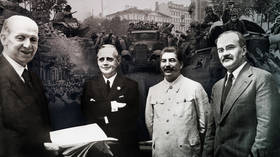
For a final and Europe-wide condemnation of totalitarianism, the OSCE resolution offered to set a Nazism/Stalinism remembrance day on August 23 (the day when the controversial, Europe-dividing Molotov-Ribbentrop pact was signed by Germany and Soviet Union).
“The USSR destroyed more people than Hitler. Russia occupied my country in 1921, and now President Medvedev has created a special commission to glorify criminals,” Georgian MP Georgy Kandelaki said during the discussion, which ended with the adoption of the resolution by a majority of votes.
However, according to Russian Gazeta daily, the decision was far from unanimous.
Greek Communist MP Kostas Alissandrakis noted that the resolution is “not aimed against Stalin, who is long dead, but against Communism in general, and in the times of a crisis, when workers’ discontent is on the rise”.
French MP Michele Billieu suggested that they go all they way and add France to the list of totalitarian regimes for having concentration camps for Spanish refugees in late 1930s, the US for McCarthyism, and the whole Christian world for the religious ideology that inspired persecution based on religion.
Not the first anti-Russian declaration
A similar resolution to condemn the Crimes of Totalitarian Communist Regimes was adopted in early 2006 by PACE. Moscow rushed to slam it as an anti-Russian ploy then, and this time generally followed suit.
“Russia’s parliament has already voiced its assessment of the Molotov-Ribbentrop pact back in 1992, and any new measures would be redundant,” deputy head of Russian Foreign Ministry’s information department Igor Lyakin-Frolov told Kommersant.
The head of Russia’s delegation to the OSCE, Aleksandr Kozlovsky, called the resolution an “insulting anti-Russian attack”.
“Those, who put Stalinism on the same scale as Nazism are forgetting that the Soviet Union suffered the most casualties and made the biggest contribution to Europe’s liberation from Nazism,” Kozlovsky said.
Member of the Public Chamber of Russia, TV and radio host Nikolay Svanidze, however, refuted Kozlovsky’s arguments.
“It was not Stalin’s regime that was victorious over the Nazi Germany, but the Soviet people. Similarly it was not Aleksandr I’s villainous regime that helped rid Europe of Napoleon, but the Russian people,” Svanidze told RT.
Svanidze agreed with the resolution in principal.
“I don’t see any real differences from a humanitarian point of view. One destroyed people based on their ethnicity, the other – based on their social status. But those differences are, alas, minor. The only significant difference is that Nazism was condemned officially, while Stalinism wasn’t. Not that it makes the latter any better,” he added.
“Prior to war anniversaries, people with historical complexes wake up and attempt to lay all the blame on Russia. Using humanist ideas as a cover, they attempt to put Russia and Germany on the same level and blame Russia for all the mistakes of Stalin’s regime,” Chairman of the Federation Council Foreign Affairs Committee, Mikhail Margelov, told Kommersant.
Raising potentially harmful questions
Following the resolution, a number of potentially serious questions may be raised.
Poland will host events commemorating the start of WWII in September, with Russia’s Prime-Minister Vladimir Putin is expected to attend.
With certain points of the resolution openly condemning decisions of Russia’s government, his visit might be jeopardized.
According to Russian media, the call “to stop glorifying the Soviet past” quite clearly alludes to the recent resurrection of massive military parades in Moscow. Meanwhile, many see the call “to get rid of structures that whitewash history” as a reference to the commission to counter attempts to falsify history to the detriment of Russia's interests, which has recently been set up by President Medvedev.
Another potentially harmful question is the issue of compensation for damages from the alleged ‘occupation’, which some former Soviet republics may demand from Russia, who is considered the successor of the Soviet Union.
Svanidze sees the compensation issue as “an entirely separate question”.
“First of all, Russia hasn’t lost a war. Secondly, Russia is not the Soviet Union. If it has to pay reparations, then so do Ukraine, Georgia and Belarus and other former Soviet countries,” he said.
Read also Europe's new chairing state frowns at Russia
Ruben Zarbabyan, RT