All clear! Okinawa police remove anti-Osprey protesters, dismantle barricades (PHOTOS, VIDEO)

Published time: October 01, 2012 01:30
Edited time: October 01, 2012 15:44
Video courtesy YouTube user OfficeChroat
Download video (15.02 MB)
Embed

Japanese police have forcibly removed protesters and dismantled barricades around the US Futemma military base in the city of Ginowan ahead of the of the controversial deployment of American MV-22 Osprey aircraft.

­Police had to use tow cars to remove 12 vehicles that had been parked by the protesters in front of the base over the weekend. Police also dispersed a crowd of demonstrators staging a sit-in near the entrance to the base to restore the vehicle traffic.

Local residents, who are outraged by Monday’s deployment of the aircraft, began barricading one of the base’s gates last Thursday. Over the weekend they were parking their cars near the other two gates as well, effectively stopping all traffic from entering or leaving.

Okinawa residents are worried the aircraft’s safety is not up to standard as the MV-22 has a troubled history of crashes. The latest crash involving a V-22 was in April during the African Lion military exercise in Morocco. The incident prompted the Tokyo to ask the US for guarantees concerning the safety of the deployment in Okinawa.

One of the MV-22’s biggest problems is that there are still bugs to be worked out in the aircraft’s hybrid helicopter-airplane design, human rights activist Ryan Dawson said.

“For them to bringing these MV-22s is very dangerous. It could fall on someone’s head, and that is not an exaggeration,” Dawson told RT. “They don’t work, they are very expensive and very dangerous.”

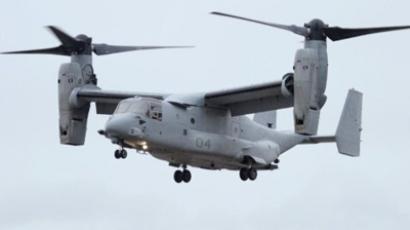
An MV-22 (Osprey) aircraft (Reuters/Yuri Gripas)

The “residents feel they’re being ignored again,” further angering protesters, Dawson said. “When you see tens of thousands of Japanese protesting, that’s a lot of anger. It takes a lot in the culture here to take people out in the streets to protest.”

In September, despite massive protests by locals, Japanese authorities gave a green light to the deployment of 24 MV-22 after “detailed analysis” had shown that the US aircraft does not pose any risk.

US military would have to adhere to strict rules during training flights. Aircraft will be prohibited from flying over nuclear power plants, historical sites and densely populated areas and the minimum flight altitude should be no less than 150 meters, according to the agreement.

In late July, 12 cargo MV-22 Ospreys arrived at the US military base in Iwakuni. They are scheduled to be transferred to Futemma on Monday. By 2014 the US military is planning to send 12 more aircraft.


­

Screenshot from KyodoNews video

­

Screenshot from YouTube user OfficeChroat

­

Screenshot from KyodoNews video

­

Screenshot from KyodoNews video

­

Screenshot from YouTube user OfficeChroat

­

Screenshot from YouTube user stripeschannel

­

Screenshot from YouTube user stripeschannel

­

Screenshot from YouTube user stripeschannel

­

Screenshot from YouTube user stripeschannel

­

Comments (13)

clc (unregistered) 02.10.2012 17:50

Grimm (unregistered) Octo ber 01, 2012, 08:15 quote  +1 

0

Undo

Josh (unregistered) 01.10.2012 13:35

DDD (unregistered) wrote in #11
US deployes so many soldiers worldwide that an attack on US soil  would be easily done ask china their subs go undetected close to the american coasts Honestly I doubt it. The in Early 80s the US Navy piloted a system of coastal defense network in case the Soviets managed to increase their stealth sub capabilities (their current nuclear subs were simply tracked by US tridents). This system included deploying sonobuoys with acoustic sensoring devices and hydrodynamic pressure detection. Now both spread spectrum magnetic and infrared methods are used. Submarines aren't what they were in WW2 and it isn't as if the US doesn't understand the advantages of submarines and how I counter them, after all, most nuclear missiles that are still deployed by the US are on board stealth subs.

0

Undo

DDD (unregistered) 01.10.2012 13:09

US deployes so many soldiers worldwide that an attack on US soil  would be easily done ask china their subs go undetected close to the american coasts

0

Undo

View all comments (13)
Add comment

By posting your comment, you agree to abide by our Posting rules

Log in to comment in full, or comment anonymously under character-limit restriction.

100 Text

– required fields

Register or

Name

Password

Show password

Register

or Register

Request a new password

Send

or Register

To complete a registration check
your Email:

or Register

A password has been sent to your email address

Edit profile

Name

New password

Retype new password

Current password

Save

Cancel

Follow us