US clings onto Gulf with tens of thousands of troops in region
Published 20 Jun, 2012 13:23 | Updated 20 Jun, 2012 17:23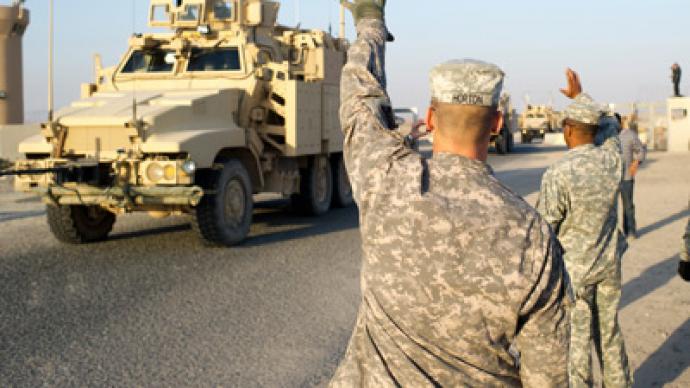
The latest US Senate Foreign Relations Committee report suggests the US will seek to maintain its position as the only superior military power in the Arabian Peninsula and Persian Gulf region for the time being.
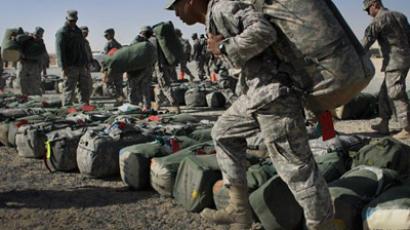
Despite the troop withdrawal from Iraq, the American military presence in the area is set to expand.The seven-point report suggests that working in close cooperation with GCC (Cooperation Council for the Arab States of the Gulf) states, the US intends to maintain military bases or presence in practically all of those countries, namely Bahrain, Kuwait, Oman, Qatar, Saudi Arabia, UAE and Yemen.Americans call this strategy a “lily pad” model. The US military bases scattered here and there enable the US military command to hold the territory under full control, allowing to increase military presence in chosen locations at any given time.In Kuwait alone, where the US has three bases, there are 15,000 troops stationed, including a couple of brigade combat teams and a combat aviation brigade.Overall in the region there are reportedly 40,000 American servicemen ready for action.The build-up of the American contingent in the region is a direct result of Washington withdrawing troops from Iraq in December 2011. The troops and military vehicles did not actually go far: many simply crossed the border with Kuwait and added to the population of the three US bases that serve as logistical hubs, training ranges, and which provide support for regional operations. Besides, the territory of Kuwait is securely covered by Patriot missile batteries stationed there, a vital element of missile defense to be developed in the region, as promised by the US to its allies.If one divides the Persian Gulf lengthwise, it becomes clear that one shore is under tight Washington control, with troops stationed in Bahrain, Kuwait, Qatar and the United Arab Emirates.Despite the fact that the United States withdrew most troops from Saudi Arabia in 2003, the country remains the biggest American arms buyer. Some 3,000 servicemen of the 64th Air Expeditionary Group are still stationed about 20 km southeast of the Saudi Arabian capital Riyadh.
Seven principles of US military policy in the Persian Gulf:1. The US ensures a “security umbrella” to its Arab allies.2. The US remains a central part of the Gulf security framework.3. The US increases trade relations with GCC states to promote economic reform and diversification.4. The US preserves the “lily pad” model of military bases throughout the Gulf region, which permits the rapid escalation of military force in case of emergency.5. The US uses the GCC partners’ capabilities in select defensive missions, though keeping its role as a security guarantor.6. The US provides the Gulf partners with security assistance, supports a comprehensive strategy for regional arms sales and ensures a stable security architecture.7. The US should promote the gradual political reintegration of Iraq into the Arab fold.
The other side of the Gulf belongs to a nation that actually gave its ancient name to it – Iran. Since Iran and its nuclear program remain a major stumbling block in international politics, the correct answer to the question “why does Washington need so many combat-ready troops in the Persian Gulf” is Iran. There is simply no other nation in the region that might pose a threat to Washington’s interests in the Middle East.The Gulf Security Architecture: Partnership with the Gulf Cooperation Council report prepared by the Senate Foreign Relations Committee again stresses the political and economic importance of the region for the US and outlines seven principles for the US military to provide security in the Persian Gulf region.The US continues to expand its combat-capable presence in the unstable region of the Middle East despite a declared shift of interests to the Asia-Pacific region. Heavy financing of the American contingent in the Gulf region is called to stress that America has not forgotten its Arab allies and that Washington intends to play a military superpower role in the foreseeable future.