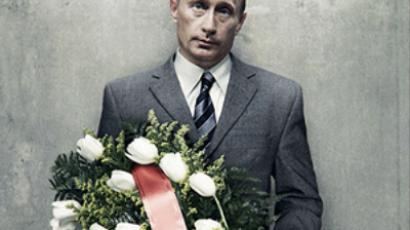
The fall of the Berlin Wall through the eyes of Mr Putin
Published 8 Nov, 2009 18:12 | Updated 27 Mar, 2010 22:02On the 20th anniversary of the fall of the Berlin Wall, Russian Prime Minister Vladimir Putin shared his memories of the historic event with Russia’s NTV TV channel in their documentary film, “The Wall”.
Vladimir Putin was stationed in Dresden, GDR as an intelligence officer from 1985-1990 and personally witnessed the reunification of Germany. Mr. Putin says the Wall made an impression on him when he first saw it.
“What impression? One of unnaturalness and the unreality of what I saw. The history of mankind knows lots of different protective and demarcation lines and construction. One of the most famous is the Great Wall of China. As far as I know, it’s the only man-made construction seen from space. But it’s been standing for centuries. Why? Because it protected the whole nation. But the Berlin Wall divided the nation. And certainly, it was unnatural. I clearly saw then that, in the modern world, it was not possible to maintain that [state of things] and it could not be kept that way.”
So it was the end of GDR?
“More yes than no. It surely depended on the Germans themselves. You may know that many people considered it to be more beneficial – I would like to use that very word – for East Germany to search for some other means of co-operation with West Germany. It was obvious for me that the decision would be made only for direct unification."On the history of Germany’s partition
“The Soviet Union didn’t establish its mission to partition Germany. Even in Stalin’s time. There was no such goal. Soviet diplomacy never had a purpose to divide Germany. Even more, it stated that Germany would by a democratic, unified state, though demilitarised. By the way, this is how it happened in Austria, this very plan was implemented in Austria. But, at that time, our allies chose to declare the establishment of the Federal Republic of Germany. And then those processes began which resulted in partition.”
On sharing responsibility for the German partition
“For a long time, Germany and the German people were hostages in the struggle between two superpowers and occupational forces both in the West and in the East. I would like to emphasise: both in the West and in the East. I know what I’m talking about because when I worked there, we talked with our colleagues from former allied states, and I know the attitudes of our military and the attitudes of the allied countries. And to some extent Germany became loose change, used in the struggle between these two powers. But the division of people had no future. In my opinion it was clear from the very beginning that it should not have been done.”On life in GDR during the mission in Dresden and perestroika years in the USSR
“People lived as if nothing was happening. I felt anxious about them. Yes, they seemed to be living in another world. I had the impression that I had gone into a society which was a piece of the past Soviet system, not even of 70s, but maybe of even earlier years. On the surface everything was restrained and controlled, but at the same time it was clear that inside, in society, some processes existed, processes suppressed but very significant that would lead to sweeping changes. But the GDR leaders of that time opposed any changes.”
On encounter with the ecstatic crowd searching for Stasi offices in Dresden in order to destroy them
“We explained, and I also explained, that the building belonged to the Soviet Army; that according to certain agreements we had the right to be there, that we worked there. And some time later, the people went away.”
On access to detailed information afterwards and his conclusions
“We are always wise after the event. I won’t say what I would have done if I had to make decisions then. The events that happened were destined to happen. I am absolutely sure that the division of Germany had no future, it had no perspective."
As for the protection of our interests during the re-unification of Germany, something possibly could have been done other way. But I think that, during these processes, the main goal was achieved that new relations between Russia and Germany reached a new level as they obtained confidence and gratitude which constitute one of the main cornerstones of our relationships, in supporting our relationships today.”
On relations between Russia and Germany
His personal visits to Germany and understanding of German thinking has contributed to today’s relations between the two countries, Vladimir Putin says.
“But it is only a very small contribution to our relations. Very small indeed. We established our relationships with Schroeder very quickly. Schroeder abandoned political life, Mrs Merkel came in – a politician belonging to an absolutely different political spectrum, another party. But our relationships are remarkable, both personal and business. What does it mean? It means that our involvement in the development of our relationships goes deep. We understand that we need each other."