‘Provocative’ North Korean rocket fails shortly after launch
Published 12 Apr, 2012 23:15 | Updated 13 Apr, 2012 18:23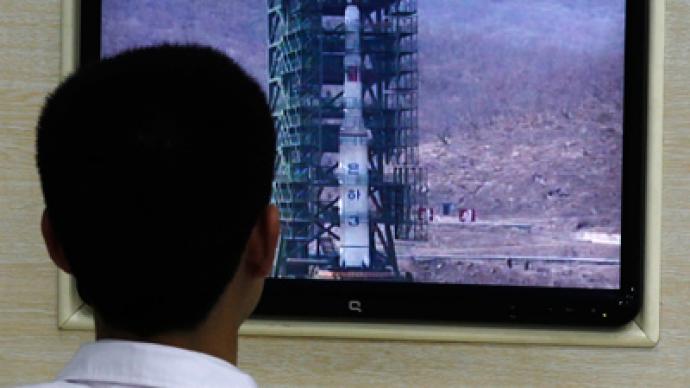
A North-Korean carrier rocket took off at 7:39 am local time on Wednesday. However, the launch has been confirmed to have failed.
The North American Aerospace Defend Command (NORAD) says the first stage of the rocket fell into the sea, while the other two stages failed. And a North Korean news agency has acknowledged that the country's satellite failed to enter orbit, and that scientists and technicians are searching for the cause of failure. Earlier the country's space agency said it had no information on the launch, according to South Korean media.The South Korean army said the rocket debris crashed some 200 kilometers (125 miles) off the western coast of South Korea, Reuters reports. Japanese Defense Minister Naiki Tanaka said the rocket appears to have flown for one minute before collapsing into the Yellow Sea.
International reactions: launch 'provocative,' 'threatening'
The G8 condemns the launch and stresses that it violates three UN Security Council resolutions, a statement of G8 foreign ministers said. The group said the launch undermines regional stability and called on Pyongyang to abstain from such actions.The United States called the launch a provocation, regardless of its failure and has suspended a planned shipment of 240,000 tonnes in food aid to North Korea. The shipment was offered in February, but in return North Korea was required to halt enriching uranium and developing ballistic missiles. “North Korea is only further isolating itself by engaging in provocative acts, and is wasting its money on weapons and propaganda displays while the North Korean people go hungry. North Korea's development of missiles and pursuit of nuclear weapons have not brought it security – and never will,” said White House Press Secretary Jay Carney.Carney did not say if the launch would mean a permanent end to the aid deal.Russia said the UN Security Council should take action following the launch, but called for moderation and balance, keeping the goal of restarting six-party talks in mind. “We don’t believe in further sanctions; they will bring nothing in terms of resolving the situation,” Russian Foreign Minister Sergey Lavrov said.A similar position was voiced by China, whose foreign ministry spokesman Liu Weimin stated: “We hope all parties can maintain calm and restraint and not do anything to harm peace and stability on the Korean peninsula”.The South Korean government condemned the launch in a statement by Foreign Minister Kim Sun-hwan. Kim said his country regards the launch as a provocative act that compromises the security of the region, and called on North Korea to assume full responsibility for any consequences.Japanese Chief Cabinet Secretary Osamu Fujimura called Pyongyang’s move “an extreme provocation” and “a serious violation of UN Security Council resolutions”. He stressed it posed a threat to Japan’s national security.Western governments considered North Korea’s launch of the Unha-3 rocket to be a disguised long-range ballistic missile test. Pyongyang maintained that it was sending a weather satellite into space.
Concerns preceding the launch
Earlier in April, South Korea and Japan stated they would intercept the rocket if it flew over their territory, while the countries’ foreign ministers called on North Korea to abandon its plans for the launch altogether. On Tuesday, the Russian Foreign Ministry stated that the launch would be in violation of UN Security Council 1874, which bars Pyongyang from conducting any launch, either for military or civilian purposes, using ballistic missile technology. However, Russian Foreign Minister Sergey Lavrov noted that North Korea could proceed with its space program after it complies with the resolution. The Russian military said it would bring down the rocket if went off track and headed towards Russia. In March, North Korea announced it will launch an Unha-3 rocket carrying the Bright Star-3 satellite into orbit between April 12 and April 15, corresponding with celebrations of founder Kim Il Sung’s centennial. South Korea called the launch a “grave provocation” aimed at developing a long-range ballistic missile capable of delivering a nuclear warhead.Prior to the botched launch, there was speculation in the South Korean and Japanese media that the North would detonate an atomic device – its third such test. That scenario's quite possible if the North Korean leadership feels too pressured, believes Asia specialist Tim Beal.“If there are fresh sanctions, if the Americans continue to refuse to negotiate properly with Pyongyang, then I suspect we will see another nuclear test,” he told RT.
North Korean military programs: Controversy over the years
North Korea’s rocket and nuclear programs have generated significant controversy in the past. In 1998, the country launched the Paektusan rocket, reportedly carrying the Bright Star-1 satellite into orbit. In 2002-2003, Pyongyang dismissed inspectors from the International Atomic Energy Agency (IAEA) and quit the Nuclear Non-Proliferation Treaty (NPT). Months after publicly declaring it had nuclear weapons in early 2005, North Korea rejoined the NPT and said it would get rid of existing nuclear weapons and nuclear production facilities. However, in 2006 the country detonated a nuclear device and launched seven missiles as part of two tests. In 2009, North Korea launched an Unha-2 rocket carrying what it claims to be a Bright Star-2 satellite into orbit. South Korea and the US stated that it was in fact a ballistic missile test, while international space agencies said they could find no trace of the satellite, concluding that it had fallen into the Pacific Ocean. Later that year, the country launched seven short-range missiles into the Sea of Japan.