Russian Wikipedia protests online censorship with blackout

Published time: July 10, 2012 08:08
Edited time: July 11, 2012 11:00
Screenshot from Russian Wikipedia site
Download video (49.91 MB)
Embed

The Russian version of Wikipedia has declared a 24-hour-long boycott in protest against a child protection bill, which the community says paves the way for internet censorship in Russia.

The front page of the Russian-language branch of the online encyclopedia has been changed on Tuesday. It only carries a notice of the blackout in Russia, while its headline is covered by a black censorship rectangle. Only a handful of some 838,000 articles remain available at the moment, all of which are related to censorship and the cause of the boycott.

The protest move comes as the Russian Parliament discusses a bill which would amend several Russian federal laws related to regulation of information. Sponsors of the bill say they want to provide better protection of children from potentially harmful information on the internet, including web pages advocating substance abuse, suicide and excessively risky behavior, as well as child pornography.

The Russian Wikipedia community has joined critics of the bill, who believe that the blacklist of sites with not-for-children content that the bill introduces will result in internet censorship.

“Lobbyists and activists supporting the amendments claim they are only aimed against content like child pornography and ‘similar things’, but strict adherence to the wording of the bill proposed for consideration will result in the creation in Russia of a system similar to the ‘Great Firewall of China’,” the statement says, adding that if the legislation is approved, access to Wikipedia is likely to be cut all across the country.

The Russian bill currently under discussion in parliament seeks to introduce a non-governmental internet watchdog, which would monitor the web for potentially harmful content and request hosting companies to restrict access to the marked pages. If this is not done, the page would be blacklisted. The bill also has stricter provisions for parental guidance ratings for content.

Several internet giants operating in Russia, including Google, Yandex and Mail.Ru called for a public scrutiny of the bill. Russia’s Information Minister Nikolay Nikiforov also voiced doubt over the legislation, saying it had a dubious enforcement mechanism.

Some rights organizations, including the Presidential Council for Human Rights, have criticized the bill, saying it would lack efficiency in protecting children from inappropriate content and fail to provide necessary safeguards against online censorship.

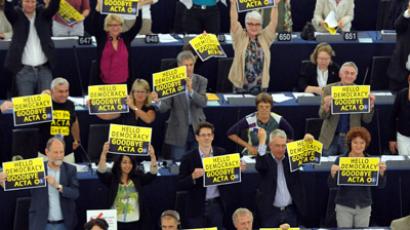
The Russian blackout is similar to what English-language Wikipedia and thousands of other websites did in January in protest of the SOPA/PIPA bills in the US Congress and Senate respectively. The flagships of online business and non-commercial activity moved in an effort to sink down the bills, which they said would empower intellectual property owners and governmental agencies beyond reason and greatly damage the internet in general. Those bills have since been shelved.

In October 2011, the Italian Wikipedia community successfully opposed a restrictive bill in the national parliament by launching a blackout.


Comments (28)

guest (unregistered) 11.07.2012 11:11

Presidential Council for Human Rights: the bill prevents russians from enjoying child pornography and paedophilia.

0

Undo

Count Cash 11.07.2012 06:38

Little Johnny, we live in a complex world, we stepped from the jungle and accepted civilisation as part of a contract, where we gave up some rights in return for order, safety.. You can argue whether you like it or not, you can argue we are not civilised, but that is the way it is, we enacted a whole set of laws and arbitration system to try to make that system work. That law and system is by no means perfect, and is by no means 100% objective, but that is what we have. Everyday the system makes decisions on what is obscene, what is reasonable….. The mechanisms are used all the time under appellate and media scrutiny, there are checks and balances attempted at all stages. Now the internet is just another public space, just like a street a park, but with global reach, and accordingly needs to come under similar regulations, we have today, but of course adapted for the reality of the new medium and space. People do feel a great freedom with the internet, after all it is a view back to the jungle, and I understand that, however, that is not the way ‘we’ have chosen to live in our ‘civilisation’, so naturally the internet has to come in line with society and the way we order it, it is nothing special, in regulatory terms, even though it is special in its ability, as you say to get around established controlled corporate channels. This is the balance that needs striking here, that balance between social responsibility and freedom of expression. The truly simpleton approach is to ignore the social responsibility angle and to propagandise that even the slightest regulation will lead to a total suppression of the useful side of the internet. Yes all regulations and laws tend to get abused, by enforcers, but to believe in your ‘total loss’ propaganda, you would have to believe that giving the power of arrest to one police officer, would lead to the whole population being locked up, to have an obscene publication law, would lead to all magazines being denied publication!

0

Undo

Sergey (unregistered) 11.07.2012 02:08

wesley (unregistered) wrote in #7
If Russia is a beacon of the free world, then why is Wikipedia protesting? You are right Tomasz, these guy are such hypocrites. These spew all these conspiracy theories how the U.S. govt is listening to every word you say and they are almost always wrong. However, when a world renowned organization protests censorship in Russia, it is unjust. Maybe the Russians are too stupid to decide for themselves what is true or not? They need their govt to make decisions for them? Look at Russia during the cold war. They would jam Radio Free Europe to keep the citizens in the dark what is going on in the world.

  Your the stupid one... your the one who goes by all kinds of bs you read on the net. Just about every country sux in one way or another and all have propoganda... However in U.S. this isolation and propoganda wen't over board... At least i USSR people knew that government lied and supressed rights.

0

Undo

View all comments (28)
Add comment

By posting your comment, you agree to abide by our Posting rules

Log in to comment in full, or comment anonymously under character-limit restriction.

100 Text

– required fields

Register or

Name

Password

Show password

Register

or Register

Request a new password

Send

or Register

To complete a registration check
your Email:

or Register

A password has been sent to your email address

Edit profile

Name

New password

Retype new password

Current password

Save

Cancel

Follow us