VERSIONS: روسيا اليوم NOTICIAS FREEVIDEO ИНОТВ RTД FIND US ON: YouTube Twitter
breakingnews
Go to main page   News   Remembering Solzhenitsyn a year after death  
MORE ON THE STORY
16.07.2009, 13:41 1 comment

90 years in the life of Alexander Solzhenitsyn

A collection of the books and photographs of Alexander Solzhenitsyn, the legendary Nobel Prize-winning Russian novelist, opens in the Russian capital in the State Literary Museum.

30.10.2009, 23:36 32 comments

Remembering Stalin’s Great Purge victims

On Friday, Russia marks the Day of Remembrance of the Victims of Political Repressions. Millions suffered from Stalin’s repressions from the 1920s through to the 1950s.

08.01.2010, 15:08 21 comments

Ukrainian president deepens divisions with Russia with new holiday

Ukrainian President Viktor Yushchenko signed a decree on Thursday to establish a holiday dedicated to Ukrainian soldiers who fought during WWI on the side of the Austro-Hungarian Empire against Russia.

18.02.2010, 21:46 17 comments

Cult of Stalin continues to divide and conquer

Moscow City Hall has approved hanging posters of Stalin throughout the city in the run up to Victory Day, but tempers are running high.

12.06.2010, 15:14 16 comments

New Russia celebrates its 20th birthday

June 12 is the Day of Russia, the country’s national holiday. On this day, exactly 20 years ago, the Soviet leadership signed the Declaration on State Sovereignty of Russia, which marked the start of democratic reforms.

Image from freakingnews.com 22.04.2010, 19:14 13 comments

Lessons that Lenin will (probably) never teach America

On the 140th anniversary of the birth of Vladimir Lenin and with much of the world still grappling with the worst economic crisis since the Depression perhaps it is an opportune time to ponder some of his theories.

McDonald's in Moscow, 1990 01.02.2010, 06:30 11 comments

McDonald’s in Russia: 20 years of “loving it”

McDonald’s came to the USSR as a first sign of freedom two decades ago.

Beslan, North Ossetia, 3 September 2004 (AFP Photo /  Getty Images) 02.09.2009, 16:22 9 comments

Beslan school siege five years on

On September 1, 2004, terrorists seized School Number One in Russia’s North Ossetian city of Beslan, taking more than a thousand people hostage: schoolchildren, their parents, relatives and teachers.

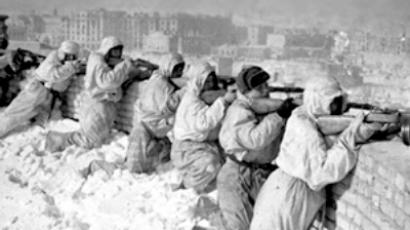
The Battle of Stalingrad 08.05.2009, 22:00 8 comments

The cost of V-Day for Soviet Russia

Most of the world marks the end of the Second World War on the 8th of May. But for Soviet Russia it ended the day after. In modern Russia, May 9th is still celebrated as a major national holiday.

22.06.2009, 07:03 4 comments

Tomorrow was the war: Russia remembers nightmare of Nazi invasion

Exactly 68 years ago, at 4AM on June 22, the German Nazi forces suddenly invaded the Soviet Union without a declaration of war. On Monday, commemorations of victims are to be held throughout Russia.

Remembering Solzhenitsyn a year after death

Published: 03 August, 2009, 09:09

Aleksandr Solzhenitsyn

(11.9Mb) embed video

TAGS: Anniversary, Russia


It’s been a year since the great writer and severe critic of the Soviet regime, Aleksandr Solzhenitsyn, passed away. His life was one of battle - against injustice, intolerance and death.

When, back in the 1950s, Solzhenitsyn served his term in the Soviet GULAG for anti-state propaganda, doctors told him he only had few weeks to live because of a cancerous tumor.

The writer managed to overcome the fatal disease and lived for another 50 years.

“It’s hard to say what it was – a medical miracle or God’s will. But he always said that this was his second chance, another life he was given the gift of. And he tried to do everything to repay it. That gave him motivation to write, and write, and write,” says Solzhenitsyn’s biographer Lyudmila Saraskina.

It was under the influence of life behind the walls of labor camp that Solzhenitsyn wrote arguably his best novels. Including what is still regarded by many as his best-known work, The GULAG Archipelago, which brought the brutality of the Soviet system to the world.

In 1970, he was awarded the Nobel Prize for literature, but with such recognition in the West was seem as a downfall in the Soviet Union. For what was perceived as rigid anti-Soviet views, Solzhenitsyn was stripped of his Soviet citizenship and exiled from the county.

“We always understood he could have been killed in a set-up car crash or something like that. Such practices were quite common at that time. Actually there was an assassination attempt on him in 1971,” the writer’s widow Natalya Solzhenitsyna said.

He found himself in the West – so adoring of him and so much unknown to him. He was greeted as a hero, but what soon came out of his mouth wasn’t quite what was expected. Solzhenitsyn – once an outspoken critic of the Soviet regime – lashed out at Western democracy.

“The Western community was happy to see him. But even there, he acted like a man of independent opinion. He was a prophet, because back then – in the 1970s – he was already warning the Western world of what it is going through now with the global credit crunch,” said poet Olesya Nikolaeva.

Once he even rejected a dinner with American President Ronald Reagan.

“The President invited him, there was a big reception. Solzhenitsyn said, “I’m sorry, Mr. President, but I don’t have time for this. If you want my advice on something, I’ll be glad to come and see you,” stage director and close friend of Aleksandr Solzhenitsyn, Yury Lyubimov, recalls.

Solzhenitsyn came back to a new Russia in 1994, returning to a country he only thought he knew. And yet again his arrival was met by an exultant nation. His close friend, poet Yury Kublanovsky, says that Solzhenitsyn’s first years in Russia were especially hard for him.

“He returned amid what could be best described as a criminal revolution, wrongly judged by many to be a democratic revolution. His address to the State Duma was boycotted by deputies. Boris Berezovsky – who back then controlled state television – denied Solzhenitsyn air-time,” recalls Kublanovsky.

He fought against the regime, against cancer, against prosecution and incarceration, and survived an assassination attempt. Solzhenitsyn lived through chaotic the Nineties to see the country – as he later said – free from things he had criticized before the exile.

Up to his last breath, the legendary writer had his own, strong critical opinion on just about everything.

One of the best-known writers of the 20th Century lost his battle against death on 3rd August, 2008 at the age of 89.


0 (26 votes)
 
Back to top
next MORE NEWS
03.08.2009, 06:48

Saddam Hussein’s ex-minister gets seven years in Kurdish case

Saddam Hussein's former deputy prime minister, Tariq Aziz, has been sentenced to seven years in jail for helping to plan the forced displacement of Kurds from northeastern Iraq in the late 1980s.

03.08.2009, 09:37

Breaking the vicious circle of poverty

Gangs rule the streets of the Brazilian slums. Youngsters are caught in a vicious cycle of crime and poor living conditions. But there are places in the country that give hope to young Brazilians.

Marzipan6 August 04, 2009, 03:05
0

Couldn't agree more, Igor. If Russia honours Solzenitsyn today, let it do so sincerely. Let it also honour what he honoured, honour those who honoured him, and set its face firmly against the deceptions and lies against which he battled.

Igor Jourin August 03, 2009, 18:56
0

Solzhenitsyn has lived a determined life and using his name, or some of the opinions of his modern and past interpreters - is but a tool and a ploy to advance the goals that were not his. Being a life-long admirer of his life, being among the first to have read a samizdat copy of his 'GULag Archipelago' that produced an effect of an exploded shell inside my head, resulting for all of my family life paths so radically different and breathtakingly new - I am raising my voice in support of those who would choose to not to use Solzhenitsyn's name and memory for any personal advancement, right or wrong. Let's remember - he drew the lines for the countless who were scared to death and intimidated into silence and lackeying, he marked the uncharted historical and ethical territories and taught us to think and base our conclusions on the known facts, he insisted on developing the skills of learning and independent information acquisition; he taught those willing to be patient, to be wise, kind, and loving. He taught memory and forgiveness, exactly according to the Russian proverb that states: 'He who will not forgive - may one eye be taken out; he who will forget - may two eyes be taken out.' Severe, true, and fair. He taught me my ethical principals that I am proud to follow as much as I can - Do What Is Right and Fear No Man. His courage, ability to take a punch, his Faith and loyalty to justice - are the life-long inspiration to the countless vulnerable and uniquely singular individuals. Aleksandr Solzhenitsyn was 'dobriy', not 'dobrenkiy'. Memory Eternal!

Marzipan6 August 03, 2009, 09:01
0

Russian commentators determinedly overlook The Gulag Archipelago’s Estonian connection. Solzhenitsyn wrote a large part of its manuscript in Estonia, and the original manuscript was hidden for years in the farmhouse of Estonian friends, to keep it safe from the KGB. The Estonian link was formed by a follow-prisoner, Arnold Susi, who befriended Solzhenitsyn in prison. Susi had been a lawyer in pre-War Estonia and was appointed Minister of Education in the 1944 Estonian government that was established in the brief period between the end of the German occupation and the re-establishment of the Soviet occupation. Soviet “liberators” arrested every one of its members they could find, including Susi. Solzhenitsyn writes the following about Susi in The Gulag Archipelago: “He breathed a completely different sort of air (to Solzhenitsyn’s Soviet orientations), and he talked to me enthusiastically about his own world, and that world was Estonia and democracy. And although it had never occurred to me before to take an interest in Estonia – still less in bourgeois democracy – I listened and listened to his loving stories about the twenty free years of that reticent, hard-working, small nation of big men with their slow, solid ways. I listened to the principles of the Estonian constitution drawn from the best European experience and how it had been worked out by their single chamber parliament of a hundred deputies. And although I didn’t know why, I began to be attracted by it all and to store it all away as part of my experience.” It is ironic that Russia, which latterly proclaims that it agreed with Solzhenitsyn all along, still demonizes the country that provided both the initial inspiration to their latterly-found hero, and which physically preserved the manuscript of his work.