Army of stones: Serb barricades stand firm

Published time: October 18, 2011 08:15
Edited time: October 18, 2011 14:53
Mitrovica: A man walks by a concrete reinforced barricade in front of the main bridge, one of the two bridges built between the south, the ethnic Albanian-dominated part and the north, the Serb-dominated part of Mitrovica. 2011. (AFP Photo)
Download video (29.89 MB)
Embed

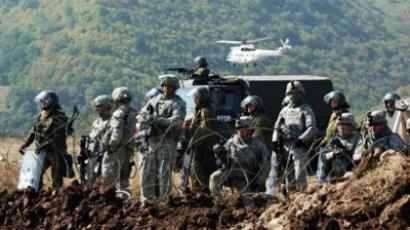
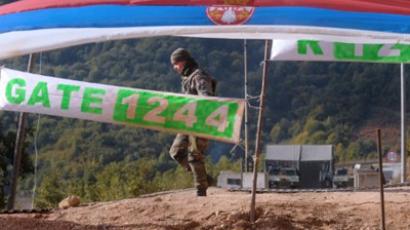
As the deadline for Serbs in northern Kosovo to dismantle their border barricades nears, they remain firm in their protest. The barricades are meant to stop attempts by Kosovan police, and NATO and EU forces to take over border crossings with Serbia.

Stones and sand of the barricades are the only weapons the Serbs living in Kosovo have in their arsenal to make the others listen to them.

The roadblocks they have set up throughout the northern part of the region are making headlines and getting feedback.

Local resident Voityla is reading a leaflet that KFOR, a NATO-led international peacekeeping force in Kosovo, has been distributing here recently: “We ask you not to participate in any event that may threaten your safety or may have negative consequences for you and for your country!“

He comments: “Bastards! They are talking about us! While they are the only negative here.”

“Look at their propaganda! We will not buy it! We don’t want them here, those occupiers; we don’t even want to talk to them!” he adds as he crumbles the leaflet and throws it into a campfire.

Unlike the barricade sentries, the mayor of the Northern Kosovo town of Leposovic is talking to KFOR. Branko Ninic has been among the four delegates from Serbs to negotiate with the peacekeepers on dates and terms for the barricades’ removal.

KFOR announced a Monday deadline, but then postponed it till Tuesday. The Serbs have claimed they need even more time.

Initially designed to prevent Kosovan customs officers from reaching the checkpoints at the northern border with Serbia, rubble on the roads has made trouble for many.

The KFOR complain they have no land access to their troops in the north. They are using helicopters to transport supplies and soldiers.

And the Serbs themselves are suffering too. They are building new alternative roads to reach Serbia from Kosovo, because the main routes have been blocked – by Serbian barricades – in the last several weeks.

The only other alternative is a train, but it runs only once a day and is always packed, so it is not necessarily a viable option.

New bypass roads appear with phenomenal speed. An RT crew has seen at least seven of them.

“This is stupid. We have many roads but we have to make more! But we have no choice – they make us do that! And we’ll not give up. Never,” says Vladimir, a road engineer, who is involved in constructing bypass roads.

Vladimir is one of the volunteers. He is a Kosovan Serbian and says he speaks for all of them.

“This is our state. It’s ridiculous to think we’ll ever recognize an ‘independent’ Kosovo. We’ll never give up,” he vows.

Back at the barricades people are still waiting. All of them have regular jobs as teachers, engineers or miners, but here they call themselves soldiers and use war rhetoric.

“This is our land. We will not surrender!”
they say. “That’s for truth. For the future. For our children and Motherland!”

They say one man cannot win a war, but together people may form a real army. Even if their weapons are just stones and sand.


Comments (16)

that history repeats 01.11.2011 23:04

 In the first Balkan War of 1912 Albania was attacked by Montenegro, Serbia, Bulgaria and Greece. The Albanians were allied with the Ottomans. Serbs joined the army in large numbers to avenge the Serbian defeat by the Turks at the Battle of Kosovo Polje. At this time Kosovo was mostly Albanian. Serbs entered Pristina as Albanians retreated to the mountains. The Serbian army destroyed Turkish and Albanian houses and there was much plundering and killing. Serb peasants followed the army into Kosovo re-occupying the land. The Albanians fought fiercely but lost the war and Kosovo came under Serbian authority. At the Conference of Ambassadors in London in 1912 presided over by Sir Edward Grey, the British Foreign Secretary, Serbia was given sovereignty over Kosovo which it has retained to the present day. Albania, for the first time was internationally recognized and by the Treaty of London in1913 became a fully independent and sovereign state. Within Kosovo not surprisingly there was much anti-Serbian sentiment since the population was still mostly Albanian. In 1913, in the second Balkan War, Bulgaria attacked the Serbian and Greek armies in Macedonia. They miscalculated and were quickly and decisively defeated. Among the outcomes Serbia nearly doubled in size obtaining most of Slavic Macedonia. Koso vo was a Serbian and will remain Serbian. We just have to wait for enough for NATO to go home. Then the eyes can be seen in the eyes again

0

Undo

History will then tell you 01.11.2011 22:50

 Slavs crossed the Danube and moved into the Balkans by the 6th century. These migrations weakened the Byzantium Empire sufficiently that Illyrian speaking people, known to their neighbors as Albanians moved eastward from the Adriatic into the Kosovo region of the Balkans. Their language became known as Albanian and their culture became allied with Byzantium after the breakup of the Catholic Church into Eastern and western branches in 1054. Slavs migrating into the Balkans divided into three groups; Slovenes, Croats and Serbs, as is still true today. By the 12th century almost all arable land in the region now known as Northern Albania and Kosovo was in Slavic hands.

0

Undo

first history of science 01.11.2011 22:45

The earliest known inhabitants of  Kosovo were called Illyrians by both Greeks and Romans. Albanians today claim to be direct descendants of the Illyrians. Serbian scholars claim that Albanians appeared on the scene in the early Middle Ages as a result of intermarriage between nomadic shepherds and unromanized remnants of Illyrians and Dardanians from Thrace. Tracing such descents is difficult but the people living in the region before the arrival of the Serbs from the North are likely to have some genetic relationships to Albanians, but DNA data would be needed to definitively settle the claim, which in any case is hardly germane to the current conflict. The region was conquered by Alexander the Great 300 years before Christ and became part of the Roman province of Dardania in the 4th century A. D.

0

Undo

View all comments (16)
Add comment

By posting your comment, you agree to abide by our Posting rules

Log in to comment in full, or comment anonymously under character-limit restriction.

100 Text

– required fields

Register or

Name

Password

Show password

Register

or Register

Request a new password

Send

or Register

To complete a registration check
your Email:

or Register

A password has been sent to your email address

Edit profile

Name

New password

Retype new password

Current password

Save

Cancel

Follow us