Human error, technical failure or weather conditions behind SuperJet-100 crash - experts
Published 10 May, 2012 15:14 | Updated 10 May, 2012 19:14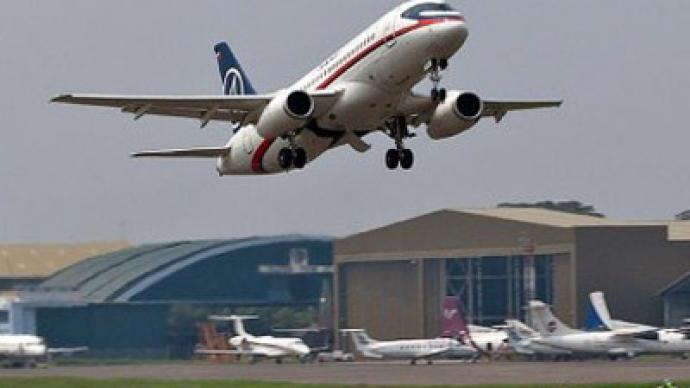
Human error and technical malfunction could be the main causes behind a Russian Superjet 100 coming down in Indonesia, experts believe. The wreckage has been found, but official conclusions on the crash that left 48 people dead are yet to be drawn.
Russia’s acting vice-president Dmitry Rogozin confirmed that human error may have been to blame for Wednesday’s incident. "I hope that the IAC [International Aviation Committee] will hold the necessary work to determine the causes of this tragedy. But the primary expert opinion suggests that the technology worked well and it is possibly the human factor," Rogozin told journalists. However, he said, all versions will be only speculation till the committee gives its final conclusion. Rogozin said he had flown in a plane of this type in February in Novosibirsk and considered it a good, reliable, modern craft. "During the flight from Novosibirsk to Moscow I was in the cockpit and the pilots explained to me the advantages of the jet. The pilots had a high opinion of this plane. The aircraft has a great future, it is promising and competitive," Rogozin said. As pilots come up with their analysis of the tragedy, violation of height clearance requirements is thought to be among possible reasons for the Sukhoi Superjet 100 crash. An Indonesian pilot, who has flown over 33,000 hours, said on Thursday he strongly believes the accident was caused by human error. “I can’t help but wonder myself, why did the pilot ask to descend to 6,000 feet? That’s a violation of the minimum obstacle clearance altitude [MOCA]. In that location, the minimum clearance is around 11,000 feet,” Indonesian media quotes Ronny Rosnadi as saying on Thursday. “The plane was supposed to descend to a lower altitude only when it neared a point south of Pangandaran beach. That’s much safer,” he added. Rosnadi said the Russian pilot might have been in an unstable condition while flying the jet.“He could have been overconfident, or just fatigued,” said the former Merpati Nusantara Airlines pilot. “The pilot was doing a promotional flight and that’s tiring.” Rosnadi said a downdraft, a strong wind that blows during seasonal changes, might have been another possible cause of the plane crash. Or maybe the pilot’s vision was blocked by a thick fog that prevented him from seeing anything coming ahead of him, he suggests.Russian honored pilot and flight security expert Vladimir Gerasimov says he analyzed the facts and came to the same conclusion. “The jet crashed into a mountain in poor weather conditions,” he told Russia’s RBK (RosBusinessConsulting) media company. “It means it descended lower than was safe. There are minimum obstacle clearance altitudes for smooth terrain, hilly terrain and mountainous terrain. If a jet crashes, this means it has broken safety altitude regulations. If the wreckage is located within one-and-a-half kilometers from the last point of communication with air traffic control – this means just seconds of flight. It was a controllable flight. The crew did not report on any possible technical failure. This means we are talking not about the jet, but about the pilots. The pilots’ error.”Vladimir Gerasimov is convinced the investigators should also consider the crew’s qualifications for international flights. Had they studied the terrain, had they been on similar flights before, and were they fluent in English?Russian honored test pilot Anatoly Knyshov, believes that the Sukhoi Superjet 100 was piloted by experienced crew, but they were not informed by the onboard equipment properly. There is a possibly, he says, that the pilots did not get enough information about weather conditions and terrain specificity. To avoid crashing, modern aircraft are equipped with sound and voice alerts, along with color marking of dangerous areas on the weather radar screen. "When they fly over flat countryside – a green light [comes on], over mountains and dangerous areas – a red," explained Knyshov. "Apparently, this system did not work, was not brought to perfection, or something went wrong. In my opinion, thunderstorm activity – static discharge – could lead to failure of the system. This means that the crew had no information about the actual state of things,” he said.Meanwhile, David Learmount, formerly of the aviation news website Flightglobal, believes that the fact that the flight was a demonstration for prospective customers, could be a significant part of the equation. Quite a large number of accidents take place purely because the aircraft are being shown off right up to the edges of their potential, he told RT.“It was a display flight, it was a demonstration flight,” Learmount said. “Sometimes the pilots or the crews deliberately take the aircraft right to their limits. And they do that sometimes when the aircraft is quite close to the ground. That is what a demonstration flight is often like. Sometimes they push the limits just too far. And that might have happened.”The Russian jet carrying 50 passengers disappeared from the radars during a demonstration flight for potential buyers in Indonesia on Wednesday. On Thursday morning rescuers discovered the wreckage and several bodies. No survivors were found at the remote mountain location south of Jakarta. The operation to evacuate remains from the slope is to be started on May 11.