League lock-out: neighbors sanction Syria
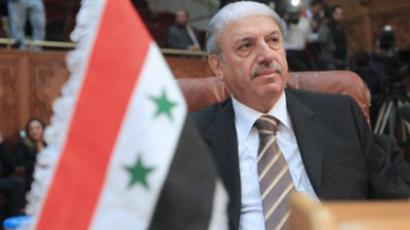
Published 17 Nov, 2011 06:37 | Updated 17 Nov, 2011 22:50Syria’s president has until Saturday to stop the violent crackdown on protesters and allow a monitoring team into the country, demands the Arab League, which threatens to tighten the financial noose around the regime by slapping down heavy sanctions.
And while the drum-beat for international pressure against Bashar al-Assad gets louder, there are fears this may only make a bad situation worse.On Thursday, governmental forces raided the restive Hama province, where Syrian Army defectors attacked an army checkpoint the previous day, protesters reported. The so-called “Free Syria Army” claims to have 25,000 members currently.Earlier Assad’s supporters attacked several embassies in Damascus following country’s suspension by the Arab League. The risky situation prompted France to recall its ambassador from the country.Turkey, which once supported Assad’s government, now says it plans to suspend joint oil exploration and is considering stopping electricity supplies to Syria.As the international pressure on Syria rises, there are growing fears that it may follow the Libyan scenario.London-based human rights group the Syrian Observatory wants both a buffer zone and a Libyan-style no-fly zone in Syria. The call, however, is so far unlikely to gain UN Security Council support. A previous draft resolution on Syria sponsored by Europe had been vetoed by Russia and China.The Chinese Foreign Ministry said Thursday that it is greatly concerned over the situation and the ongoing violence. But ministerial spokesman Liu Weimin stressed that any possible Security Council action regarding Syria would have to help ease tensions and solve the crisis through political means.Russian Foreign Minister Sergey Lavrov called on the Arab League to make it clear that it wants the violence stopped from both sides of the conflict.“The violence in Syria comes not from the governmental structures only. There is an increasing amount of weaponry there smuggled from neighboring countries,” he said on Thursday. The Arab League’s members should “come up with a demand not only for the government, but also to the Syrian opposition to stop violence.”He added that the League’s observers and the media, which Assad’s government agreed to allow into the country, will have to monitor both sides to see how this demand is met.The pressure on Syria from the Arab League is being seen by some as little more than doing the West's bidding, says Russia's envoy to NATO, Dmitry Rogozin.“Many countries that now call the shots in the Arab League are closely connected with top Western powers. Qatar, which actually hosted all the latest Arab League sessions, is a country that fought in Libya; it makes no secret of the fact that its special operations forces were among the rebels,” he pointed out. Likewise, former pentagon official Michael Maloof told RT that foreign attempts to shift the balance of power in the Syria had led to opposition to become increasingly militant. “It’s quite clear that there’s quite an organized effort from outside to arm and to take advantage of what was popular discontent, and now, it has become much more of a militarized form of opposition from within,” he said.
Even in Israel – Syria’s arch enemy – some would rather Assad stayed in power.“The Alawites have been doing us a favor, doing Israel a favor, of course this is not understood this way commonly, but they’ve essentially been going us a favor by keeping this population under control and if they go, it’s going to be an explosion,” said Professor John Myhill from the University of Haifa.While the Arab League has stopped short of calling for Syrian President’s departure, critics say their stance is nothing short of hypocrisy.“They have no democracy or at least, some of them, they don’t have constitution, and at the same time they are asking Syria to modify constitution and to develop the democracy that they are having. It is ironic and paradox [sic] at the same time,” Ali Hamdan points out.What is more, Assad has shown he is willing to conduct reforms. But it is not clear the Arab League has the patience to listen.And neither do Western leaders, who decided a long time ago Assad needs to go. Without the option to do it through the United Nations, the Arab League is their next best option.