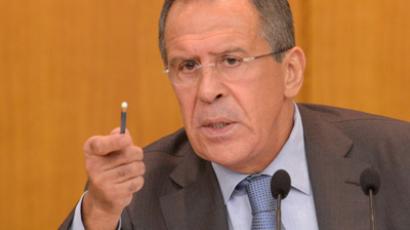
‘Don’t be duped by Western humanitarian rhetoric on Syria’ – Russia's UN ambassador
Russia and China have for the third time vetoed a UN Security Council resolution on Syria which would entail tragic consequences for Damascus. Russia’s ambassador to the UN told RT why a diplomatic solution to the crisis remains the only option.
In an exclusive interview with RT, Vitaly Churkin gave his explanation of what is going on in Syria and why he thinks the conflict has spread beyond that country's borders. RT: Russia's decision to veto this latest resolution has caused consternation and widespread criticism of Moscow's stance – is Russia supporting the Assad regime?Vitaly Churkin: Of course not. It is all about what needs to be done in order to settle the crisis. Unfortunately, the strategy of our Western colleagues seems to be to try to whip up tensions in and around Syria at every opportunity. And this time they took the occasion of the need to extend the mandate of the monitoring mission in Syria and attached a number of unacceptable clauses to their draft resolution. So, we needed to veto together with China that unacceptable draft to allow Kofi Annan more space to work on the document which was adopted by foreign ministers of a number of countries of the so-called “action group”, which calls for setting up transitional national body and that requires of course the dialogue between various parties. So, in this context, to introduce a resolution which would only entail pressure and almost inevitable sanctions on the Syrian government did not look like a good idea to us at all and we blocked the decision, which in our view was counter-productive. RT: So, Moscow is not supporting the Assad regime, but America, Britain and France say Russia's failed the Syrian people – how do you react to that? VC: You know, they are quite good and bad and loud about their propaganda. I think that’s what they have been doing by criticizing Russia and China stridently. Today it was the British and French [UN] perm reps who went out of their way, unfortunately, piling all sorts of falsehoods on the foreign policies of Russia and China. They should focus more on the need to help Kofi Annan. Unfortunately, they have not done anything at all in order to set and train a productive and positive process in Syria. Instead, they have been working with the so-called “Friends of Syria”. In fact, this is a group of countries who are enemies of the Syrian government, I would not call them the enemies of the Syrian people, but certainly those who want to topple the Syrian government, disregarding the consequences which are extremely tragic; such a policy inevitably entails [tragedy] because the government or President Assad is not simply one individual or a group of individuals. They represent a certain segment of the Syrian population, of a certain power structure, which has existed there for decades. To break it would cause and is causing considerable trouble and bloodshed. To reform it through dialogue, this would be a much more reasonable line of action and this is what Russia has been advocating. RT: But dialogue has not achieved anything so far. Isn't there now an overwhelming global sense that something has to be done to stop the killing of innocent people – what about intervention on humanitarian grounds, is that not acceptable to Moscow? I know that Moscow is very concerned about Chapter 7 leading to perhaps military intervention. But what about some form of intervention to stop the killing?VC: In a way, the monitoring group which we are trying to maintain is a way of political intervention – of practical intervention – n trying to deter violence. Unfortunately, it has not happened, it has not been successful. You said the dialogue has not achieved anything. The problem is the dialogue has not started yet. The opposition groups refuse to enter into dialogue with the Syrian government, which says it is prepared for dialogue. They should try that offer of the Syrian government to enter into dialogue. And this is a major missing link, a major impediment in the way of Kofi Annan’s activity. You know, humanitarian intervention unfortunately only sounds humane, but the fact of the matter is that any military intervention for whatever reason is inevitably going to cause more bloodshed. And we know those greatest humanists in the world – US and UK – intervened in Iraq, for instance, citing all sorts of noble pretexts, in that particular case – non-existent weapons of mass destruction. What it caused – 150 thousand civilian deaths alone, to say nothing about millions of refugees, displaced persons and the whole dislocation in the country. So, don’t be duped by humanitarian rhetoric. There is much more geopolitics in their policy in Syria than humanism. Unfortunately, the practical consequences of their policies there is that the conflict and bloodshed is not abating. RT: You've mentioned geopolitics and I understand you mentioned the fact that what's happening in Syria is going to spread to Iran eventually. Can you explain that? That Iran is the eventual goal?VC: I did refer to Iran, but in a slightly different context. I would not rule out that then they would move on to Iran, but I was not referring to that. In my remarks at the [Security] Council of the United Nations earlier today I was referring to their clear interest. And this is a major motivation of their policy and their effort to topple President Assad -in curbing Iranian influence in the Middle East and that entire region. And it is also a major motivation of the other Middle Eastern fighters for democracy – Saudi Arabia and Qatar – who are concerned about what they see as Iranian interest; in Bahrain as well. They claim the Shia protests there is sort of Iranian-sponsored even though some observers – including your colleagues and journalists who have experience on the ground – believe that it happens to be genuine protests against the system which is not entirely democratic, to put it mildly. So, a clear geopolitical dimension is there in the policies of a number of countries, who are extremely aggressive vis-a-vis Syria. And it has nothing to do with the interests of the Syrian people. RT: What is the worry for Moscow, all these geopolitical implications you’ve explained so clearly, why is Moscow so worried about this? In what way could Moscow be affected?VC: We are not worried about geopolitical implications even though we believe that greater confrontation with Iran is hurting, is unnecessary and we are directly involved in efforts to resolve peacefully the problem of the Iranian nuclear program. And this growing tension between Iran, the West and the Saudis is not helpful. Our concern is that the Syrian people have to suffer the consequences of this geopolitical struggle and our concern is that the focus of everybody’s policy must be the benefit of the Syrian people. And the only way they can put an end to this tragic conflict is to get to the negotiating table. And there is a good ground, there is a document which was a consensus document adopted by the “group of action” -foreign ministers in Geneva- two and a half weeks ago which says that a transitional national body needs to be set up and it can not be set up by sanctions, it can not be set up by more pressure on just one side – the Syrian government which is claiming that it is ready for such dialogue, it designated its representative for such a dialogue. But so far the interest from the opposition is not there and we see extreme opposition groups; armed opposition groups resorting to more and more violence and even terrorist attacks like the one we saw yesterday in Damascus. This is not to say that the Syrian government has not resorted to excessive violence at times, they made very serious mistakes and blunders over the months but the time to end it is now. Unless we want to continue it for years, [we need to] enter into a dialogue. RT: Russia is really stuck by its principles of non-intervention. Is there not a danger of being isolated, bearing in mind the continual vetoing of the sanctions of the UN Security Council and the supplying of military hardware to Syria. Of course Moscow says it is not being used against civilians, but what is it to do for Russia’s reputation and, indeed, its relations after this crisis is over? VC: We’ll see. I think doing the right thing and not simply following somebody’s catastrophic policy is something which makes me proud and something which eventually will be born out as the right course of action and the right policy under these very difficult circumstances. And about vetoes – if I am not mistaken, the US has cast 60 vetoes on the Palestinian issue alone. So, why don’t you question my American colleagues about the impact of the image of the US in the Middle East of those continuous vetoes? Sometimes even vetoing their own presidential and secretary of state’s public statements. So, the veto is a part of the UN Charter and there is nothing wrong about casting it when you feel the need to do so. RT: Can we talk about what happens next now? No agreement in the UN Security Council, but Russia has said that it would like to see the extension of the UN observer mission to Syria. But the monitors haven't made any visible impact on the mission so far. So what's the point in keeping the mission alive when so far it has failed?VC: What would be the point of their departure? We think that we have at least more chances to get objective information if it is there If the situation were to improve, they would be on the ground already, so, they would be able to participate more actively in political process and also in dealing with the humanitarian situation. Pulling them out is going to entail negative consequences. Unfortunately, now and again we seem to be entering another diplomatic battle. Now we are going to have a discussion about really making it technically rollover without loading it with political conditions and implications.