Syria: Ground zero for geopolitical machismo (Op-Ed)
Published 1 Sep, 2012 10:19 | Updated 1 Sep, 2012 14:46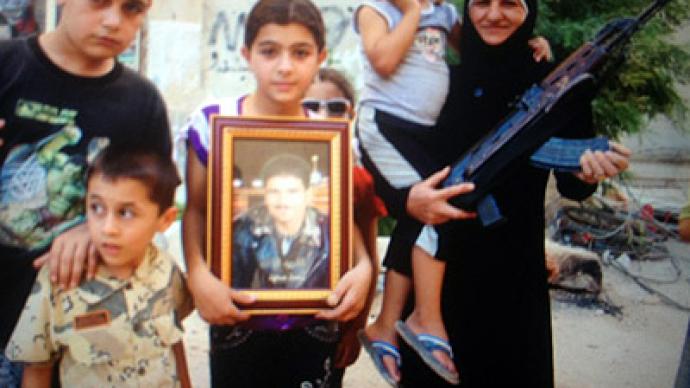
The war in Syria is divisive on many levels, especially so in gender. It's a men's war, where decisions are executed by men, and where women are the faceless victims of massacres. Men are the leading actors, while women only play a supporting role.
Ostensibly presented as a democratic struggle, by its very existence, this war discriminates against at least half of Syria's population. It was in the comfort of my own home, in between ironing and cooking, that the jeering bravado of the Syrian war finally caught up with me. I had just returned from a month-long trip to Syria, where death is celebrated and therefore spreads faster than a pandemic disease. It's a place where rebels thank the Assad regime for giving them so many martyrs, and army soldiers say going home in a coffin is the ultimate honor. I've seen this kind of patriotic machismo in previous conflicts, and thought it was just part of war's self-perpetuating dynamics – men glorifying death, to make it easier and more meaningful to die and kill for a cause. And then I saw her: A middle-aged Syrian woman in an abaya, smiling, holding a cute pot-bellied toddler and an AK-47 in the same hands. Her picture was taken by an opposition activist who claimed she joined the FSA after her son was killed. While I don't believe that – the other kids looked way too neat and well taken care of to have a warrior-mother – the unnatural composition of the photo cut to the heart of the Syrian war. It's long been established by social psychologists that valor and honor are predominantly male values, especially among the young. Giving your last breath for a noble cause; sacrificing your life for freedom; choosing dignity in death over injustice in life. You hear this from men on both sides of the Syrian conflict, many of them in their early 20s. In all of these slogans, death is the common denominator.The same research shows that women are far more concerned with the realities of life – all the more so the older they are. Giving up your honor to feed a child; sacrificing your ambitions for the well-being of your family; choosing humiliation for the sake of loved ones. There is nothing heroic about it, yet this is typical behavior for women all around the world. And the common denominator here is life – or rather, the desperate attempt to save it.In a dispatch from Darya – an epicenter of the Syrian conflict, and the site of one of its bloodiest massacres, whose perpetrators are still unknown – Robert Fisk of The Independent was one of the very few Western reporters who actually talked to the locals. One woman told him how armed men broke into her home, and how she, despite having no idea who they were, kissed them in a fearful attempt to prevent them from shooting her family. That's what ultimately differentiates men from women in warfare. Women are ready to forgo lofty ideals of freedom and dignity to save their children, while men are ready to sacrifice their children for freedom and dignity. And it's why all the stops are pulled out in the Syrian war. It's a glorified, Allah-sanctified, internationally-backed battle for a noble cause that couldn't be bothered with trifles like human life. Of course, I don't mean to say that human rights and civil liberties are not important to women, and to Syrian women in particular. Up until the protest movement was hijacked by armed gangs, many of those demonstrating peacefully were women. One such rally in Damascus in April brought together elderly Kurdish women in baggy village skirts and artsy, sunglasses-wearing intellectuals with Western university degrees. They were campaigning for different things, stood together under the banner of 'Stop the Killing.' "We think that Bashar al-Assad has to step down," Amina Osse, a representative of Syria's National Coordination Committee told me. "But we are totally convinced it can be achieved through non-violent means. The only way for this democratic revolution to proceed is peacefully."About 20 minutes after this rally began, the women were forced to flee by a mob of 20 Assad supporters, all men. But they were protesting again a few days later. And then again. Until it became too dangerous to even walk the streets. One of the primary differences between male and female reasoning is their directness in achieving goals. Men tend to focus their attention on the ultimate prize, ignoring anything that stands in their way. Women, on the contrary, usually take a longer and more nuanced path, but they are also far less likely to throw the baby out with the bathwater. That's why, historically, men are warriors and women lead reconciliation efforts. One may argue that war has always been and always will be men's prerogative, but that's just as discriminatory as saying that a societal group will never vote. There is absolutely nothing that affects people's lives in such a profound way as war, and having women to be able to influence this process is far more important, in terms of the value of human lives, than being able to elect a president every five years. Every major societal institution, from family to religion, has evolved to become more inclusive and egalitarian towards women. In fact, gender equality is the most hard-won of all liberties, as it took longest to accomplish. But there is no place for it in Syria, not now at least. Here, war is still justified by democracy, regime change, the caliphate or whatever other goal that some men – in Syria and abroad – set their sights on. And even the women who agree with them on those goals have absolutely no say on the means of this utterly undemocratic, yet very macho, struggle.
Oksana Boyko, RT