Turkey’s backing of Syrian rebels leads to danger of Kurdish autonomy
Published 7 Aug, 2012 23:28 | Updated 12 Oct, 2012 16:44When it comes to Turkey’s policy towards Syria, Ankara might be cutting off its nose to spite its face. As Turkey pushes for Assad’s ouster, chaos on its southern border has seen the possibility of a Kurdish-controlled region grow by the day.
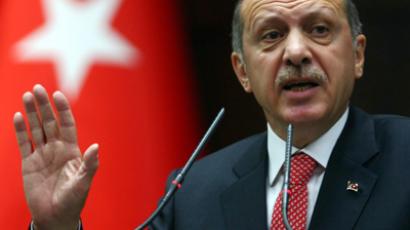
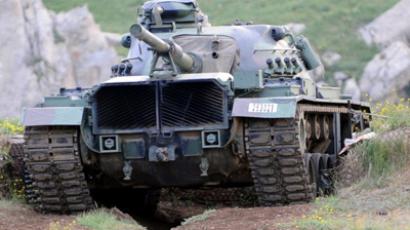
Turkish foreign minister Ahmet Davutoglu’s “zero problems policy” to build strong economic, political and social ties with the country’s neighbors was almost an invitation for disaster. Once the country moved to provide political support – and reportedly covert aid – to the Syrian opposition that is seeking regime change in Damascus, the blowback was almost immediate. With millions of ethnic Kurds in Turkey, Syria, Iraq and Iran, destabilization in northern Syria has provided another base for the PKK (Kurdistan Workers’ Party) to launch military operations against Turkey in its struggle to establish an autonomous Kurdish state. The situation rapidly escalated, with clashes between the Turkish military and PKK fighters intensifying in recent weeks.Turkey’s prime minister, Recep Tayyip Erdogan, vowed that Turkey would “not allow a terrorist group to establish camps in northern Syria and threaten Turkey" during a July 26 news conference. He further implied potential cross border incursions into Syria, saying "if there is a step which needs to be taken against the terrorist group, we will definitely take this step."Sinan Ulgen, a former Turkish diplomat now at the Carnegie Endowment for International Peace in Brussels, told Reuters that Turkey could “carry out the kind of surgical strikes that it did in northern Iraq in past years if the government has intelligence that northern Syria is being used by Kurdish terrorists.”
But Gokhan Bacik, an editor of the Turkey-based newspaper Today's Zaman, believes Ankara's calls for regime change in Syria will not serve as a solution for the Kurdish problem. “Turkey for the first time demands a regime change in the neighboring country, but this strategy is producing some counter-productive outcomes – that is, the autonomy of Kurdish groups. So Turkey is unclear of what to do with these Kurdish groups in Northern Syria. Pushing the Turkish army into Syria will not be a solution for the Kurdish problem and will not help the humanitarian crisis in Syria.”
Mark Almond, a professor of international relations at Bilkent University in Turkey, told RT that Ankara’s position was riddled with contradictions.“It [Ankara] wants to see the overthrow of Assad’s government, it is supporting the destabilization of that regime, but it seems to expect that the mosaic of Syrian society, its ethnic make-up, will remain stable. When you shake the kaleidoscope, you cannot be certain where the pieces will fall down.”Almond says that despite Turkey’s antagonistic relationship with Syria, Ankara cannot have its cake and eat it too when it comes to toppling the Assad government and maintaining regional stability. “We’ve seen television pictures of places in northern Syria where people are waving pictures of Ocalan, the leader of the PKK, the Kurdistan Workers’ Party, who of course is held in regard as the arch anti-Turkish terrorist. And so the Turkish government does face the problem that so long as it had good relations with Bashar al-Assad’s regime, he kept the border closed and kept the PKK forces out of operation in Turkey. With the growing hostility between Ankara and Damascus and the fact that the Turkish and Syrian authorities have lost control of large parts of the border with Turkey, then of course the PKK can operate in Turkey and of course Assad’s regime can say we have ‘other things on our mind’ instead of trying to stop them.”Almond says that threatening Syria with reprisals will only fuel the Kurdish rebellion, just as cracking down on Kurdish resistance does not change the fact that “now you have two quasi-autonomous areas on the Turkish border, in northern Iraq and increasingly in Syria.”As the potential ‘Lebanonization’ of Syria will only lead to further chaos, Almond says Turkey has to make a choice. “The Turkish government seems to want to have it both ways. It wants to see the implosion of the Syrian regime, but it doesn’t want to see the collapse of public order and control of the borders. That to me seems to be a logical contradiction. And unfortunately for many Turkish soldiers, police and civilians, this contradiction is coming home to haunt them.”