Cholera immunity: UN denies compensation to Haiti disease victims
Published 23 Feb, 2013 05:36 | Updated 22 Apr, 2020 11:48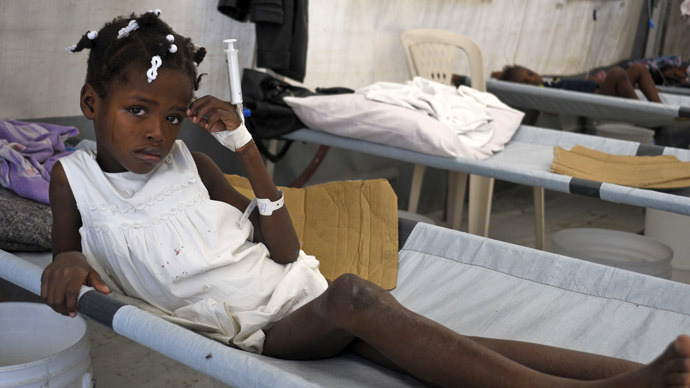
The United Nations has announced it rejects a damage claim for victims of a cholera epidemic in Haiti, believed to have been caused by UN forces. Since its outbreak in October 2010, the disease has claimed over 7,750 lives.
A relief mission, which helped restore Haiti from earthquake-caused devastation, set off yet
another crisis in the region – the health one. A study by a UN-appointed panel
offers evidence the cholera bacteria were brought to Haiti by a United Nations
battalion sent over from disease-stricken Nepal.
Poor sanitation, provided by a local contractor at the Haitian UN base allegedly led to
contaminated waste getting into a tributary of one of Haiti's biggest rivers.
The disease quickly spread across the country, which lacks decent water and sewage
facilities. Over half a million people fell ill.
The claim for compensation from the UN was filed in November 2011 by the Institute for
Justice and Democracy in Haiti, which believes the international body owes
hundreds of millions of dollars in compensation for sparking off the
still-ravaging epidemic.
The UN thinks otherwise. Its February 21 statement describes Haiti cholera victims’
compensation claim as “not receivable”, citing immunity granted to the
organization by its own 1946 convention.
"We're disappointed because the UN is passing up a chance to stop cholera's killing,
and to show leadership in promoting the rule of law," said Brian
Concannon, the institute's director in an interview to The Associated Press.
He has also promised to carry on the legal battle for compensation, pledging to take the
case to a national court in Haiti, the United States or Europe.
The Institute for Justice and Democracy in Haiti, which legally represents 5,000 Haitians,
thinks each death should be compensated for by a minimum of $100,000, and half
that sum should go to each cholera survivor.
A Washington think-tank, the Center for Economic and Policy Research (CEPR), has condemned
the UN’s claim of immunity in the case of Haitian cholera epidemic as “another
unfortunate abdication of responsibility.”
“They have the resources to put an end to cholera in Haiti for less money than they are going
to spend in the next year or two on keeping UN troops there. But they're in no
rush to right the wrongs that they have done," said Mark Weisbrot, CEPR’s
co-director.
The disappointment with the UN decision expressed by the human rights activists is
shared by Haitians.
"I think every victim should get compensation,” said Maximilien Saint Juste, 29, in an
interview to The Guardian. Though his disease is gone, Saint Juste complains
those who recovered “suffer discrimination.”
“A lot of people think that cholera cannot be treated entirely; they believe that cholera always
sticks in your blood cells."
Although the UN is not going to pay compensations, it still pledges a commitment to help Haiti
eradicate cholera.
In December, UN Secretary-General Ban Ki-Moon came up with a 10-year $2.27-billion plan to help
put an end to cholera in Haiti and the neighboring Dominican Republic. The
projects remains largely underfunded so far, with only 10 per cent of the total
sum having been secured.
The epidemic in Haiti continues to claim lives. One hundred and ninety-three people died of
cholera in December 2012. More than 11,000 cases were reported that same month,
a significant increase from 8,000 reported in December 2011.