Guns for buddies: US weapons sales surge overseas

Published time: June 15, 2012 19:22
Edited time: June 15, 2012 23:22
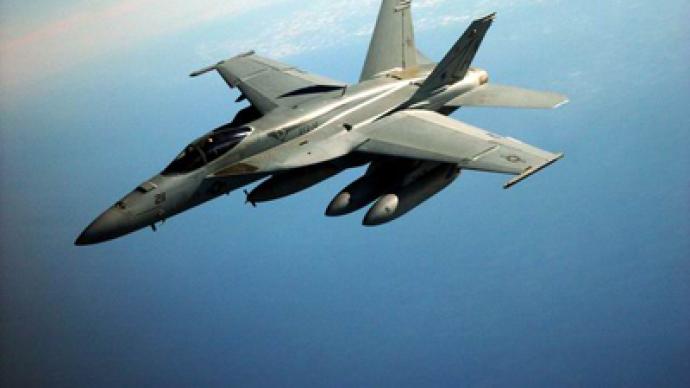
F-18 RC Jet (AFP Photo / Getty Images)

US foreign military sales have shot over $50 billion. Another record-breaking year is expected thanks to US ally Saudi Arabia, which accounts for three-fifths of the sum.

­"We have already surpassed $50 billion in sales in the fiscal year 2012," Andrew Shapiro, assistant secretary of state for political-military affairs, told journalists on Thursday.

Though it is three months till the end of the fiscal year, the figure already shows a 70 per cent increase over government-to-government military deals in 2011. Last year also set a record for the US with sales at some $30 billion.

The sale to Saudi Arabia was very significant,” said Shapiro. The $29.4 billion deal finalized in December included 84 new fighter jets and the modernization of 70 old jets.

Former Canadian diplomat Peter Dale Scott told RT that Saudi’s big contribution to Washington’s revenues may be explained by the long standing “arms for petrol” relations between the two countries.

During the oil price hikes of 1971 and 1973 the US negotiated an agreement to pay Saudi Arabia higher prices for crude, on the understanding that Saudi Arabia would recycle the petrodollars, many of them through arms deals,” said Professor Scott. “So recently the imports of American hardware to Saudi Arabia have grown significantly.”

The record-breaking figure also includes the sale of the Joint Strike Fighter to Japan, which is valued at approximately $10 billion, according to the State Department.

As for direct commercial sales, whereby companies sell directly to foreign governments as opposed to government-to-government sales, an official report released the previous week only accounts for 2011. That year brought US contractors some $44 billion with top customers including Jordan, Japan, Israel, Afghanistan and Pakistan.

How to join the US gun club

Shapiro also pointed out that weapons sales are licensed “to serve foreign policy interests” and brought up the trend of tying defense contracts to diplomacy. Countries willing to buy from the US have to be sure “about the nature of the relationship” with Washington.

When a country buys an advanced US defense system through our foreign military sales, direct commercial sales or foreign military financing programs, they aren’t simply buying a product. They are also seeking a partnership with the United States. These programs both reinforce our diplomatic relations and establish a long-term security relationship,” said the official.

Can this mean that a country importing US weapons may fall under America’s influence?

Yes, this link may be correct,” observed Professor Scott. “Hosni Mubarak’s Egypt, for instance, was the third-largest recipient of the US aid, which arrived in the shape of finances and arms. In return, Cairo granted security in the region, which first meant acceptance of Israel.

Whether 2013 see a further increase in foreign military sales is “too early to predict,” says the US State Department

The US is expected to continue expanding into key markets, including India, which is considering a $1.4 billion deal for 22 Apache helicopters. The US Defense Security Cooperation Agency is also eyeing military sales of more than $1.1 billion to Qatar and Oman, reports ArabianBusiness.com. Qatar is considering purchase of Black hawk helicopters and missile-warning systems, while Oman might be buying missiles and military training kits.

Free weapons for Russia’s backyard?

However, it appears that some Asian countries can get US weapons for free, a report in the Russian daily Kommersant reveals. The Pentagon is engaged in talks with Kyrgyzstan, Uzbekistan and Tajikistan to hand over some of their military hardware after NATO troops quit Afghanistan in 2014.

This would mean distributing armored vehicles, tank trailers, tankers, medical equipment and communication tools – everything which is not worth sending back home due to high transport costs. Pakistan, affronted by continuous drone strikes, has pushed up fees from $250 per container to $5,000.

The US reportedly intends to give away some of its equipment for free, while some of it is to be left behind for secure storage, as it may prove to be of need later – for new operations in Afghanistan or Pakistan or other Central Asian countries.

Kyrgyzstan has confirmed negotiations are under way, but officials do not believe they will get anything valuable.
This is done to study the three countries leaders’ reactions as well as the reaction of the Shanghai Cooperation Organization and Collective Security Treaty Organization,” an unnamed official in the Kyrgyz Defense Ministry told Interfax news agency.

Meanwhile, the prospects of finding US military hardware in neighboring countries have reportedly thrust Moscow into “utter bewilderment.

This kind of scenario is totally unacceptable for Russia. It would contradict our arrangements with Central Asian partners and violate our agreement within the Collective Security Treaty Organization,” a diplomat told Kommersant.


Comments (53)

White Horse (unregistered) 19.06.2012 05:11

If I were Russia, I wouldn't worry about the US weapons left behind for later use too much......Russian troops can use them just as well as anybody else....or eliminate anybody else who comes in possession of them. If I were Russia, If I were Russia, I would welcome all these weapons left behind as I could be the one most likely to be in possession of them.....and if not.....Strategic Rocket Forces can see to it that those in possession will get no use from them. Unlike USA rocket forces (intercontinental ballistic missiles, sea launched ballistic missiles, etc.), Russian rocket forces are far more mobile and not entirely tied to land based rocket silos or ballistic missile submarines. As U.S. General George S. Patton stated,  "Fixed fortifications are a monument to man's stupidity." If he were alive, he would have promoted a far more mobile use of land based rocket forces, as Russia has done. A country that has great interest in sea launched ballistic missiles probably has "first strike" firmly entrenched in its mind as it greatly reduces reaction time by the enemy to a preemptive strike. The weapons left behind for later use are based on the belief that Russian Strategic Rocket Forces or Russian Special Forces will not eliminate those in possession of the weapons. Once again, the resolve of Russia has been vastly underestimated as far as I see it. Germany once made this mistake, and the USA seems determined to repeat that mistake. When the Soviet Union fell, most Russian military forces were greatly cut back in order to develop a competitive commercial economy. That did not apply to Strategic Rocket Forces, and it remains to be seen just how effective they really are....... I think it has been presumed they will not fight, and that could be a big miscalculation. They most certainly can launch degensive strike in their own "backyard" because a retaliation by the West would be seen as highly arrogant in nature. The USA has no ability to launch a successful conventional war against Russia, just as Russia has no ablity to launch a successful conventional war against the USA. This means that either one could launch a tactical nuclear strike in their own sphere of influence with little likelihood of direct interference by the other.

+1

Undo

Michael Levy (unregistered) 17.06.2012 23:11

The only country with the type of mentallity that spreads democracy out of the barrels of weapons! The good ol United States of A**holes.

+23

Undo

MrCoto (unregistered) 17.06.2012 19:23

 We are fighting WWIII. It's not been declared, but the world already is at war. In the Middle-East alone we're currently involved in 4-hot conflicts, and not so covertly engaged in several more. Attacks on Syria, Iran and Yemen seem certain. Drone attacks are taking place in several countries, and are in effect in some African.

Reportedly we have slipped forces into North Korea. Since WWII we've swelled military bases around the world to 800, in 130 countries. Domestically formerly closed military bases have been reopened as concentration camps.

With the CIA openly engaging in black-ops, with their own black-budgets, who really knows how many dirty little wars we're fighting?

A perpetual state of war is the end-game. And a plan like that takes more than one man, one party, or even one country. A plan such as this knows no boarders, nor has any alliance to any Nation. A plan such as this takes a certain breed of people. A people that have a sickness for power, and perversions not shared by normal human-beings. And they do exist.

They go by many names, Illuminati, Bilderbergers, Globalists and belong to many clubs, Bohemia Groove, Trilateral Commission, CFR, but its all the same members, it's always the same families and fortunes. And it all ends the same. They enslave and kill us.

We're at war. And it's the same war man has been fighting since the being of time. Do we want to be ruled by a small group of elites, or does man wish to rule himself?

Exce pt this time the end-game has reached the end-time. Man has reached a point in history where the very survival of not just our species, but life itself can be flipped-off. Where one ignorant or rash judgment can trigger extinction. And to think that, that power is being concentrated into the hands of a few, inbreed, sociopaths should be the only thing we should be concerned about.

There are no choices here. We face certain death or freedom. Whatever pain we have to go through must be endured crush this system. It's the system we must end, or the system will end us.

It's world peace, or world war.

+39

Undo

View all comments (53)
Add comment

By posting your comment, you agree to abide by our Posting rules

Log in to comment in full, or comment anonymously under character-limit restriction.

100 Text

– required fields

Register or

Name

Password

Show password

Register

or Register

Request a new password

Send

or Register

To complete a registration check
your Email:

or Register

A password has been sent to your email address

Edit profile

Name

New password

Retype new password

Current password

Save

Cancel

Follow us