A sign of things to come
Published 13 Sep, 2011 17:04 | Updated 13 Sep, 2011 23:37The United States and Romania have signed off on the first stage of the European anti-missile defense shield. Russia continues to demand guarantees of the shield not being aimed at its strategic forces.
Secretary of State Hillary Clinton and her Romanian counterpart signed the first bilateral agreement for the placement of AMD shield elements in the country. Elements of the anti-missile shield will be located at an unused military base, deemed to be the best out of several locations for the 24 interception missiles, which will be operational in 2015. The plan calls for deploying increasingly sophisticated land- and sea-based assets around the continent to identify and destroy enemy missiles from nations such as Iran. Originally the US wanted to deploy the shield in Poland and the Czech Republic, but that fell through when the Czechs pulled out, frustrated at what they saw as “too small a role” in the program. Amid intensifying pressure from Russia, which received no definite guarantees that the system is not aimed at its territory, US President Barack Obama made a statement in September 2009 saying his country "no longer planned to move forward" with the project. Soon a new, scaled-down version of the shield was introduced, with Romania and Turkey as the only confirmed participants – but rumors have circulated of two other Central European countries also coming onboard. The plan to erect the shield to protect American interests from a perceived threat from what the White House deems “rogue nations,” such as Iran, has not been well received in Moscow. Russian political and military officials have flat-out stated the AMD system is just shy of a national threat – and that they are prepared to employ “not diplomatic, but military-technical methods." Russia wanted to build a joint system which would use NATO and Russian capabilities to defend against a possible attack, but would not be out of Moscow's control. However, the revised AMD plans failed to address Russia's concerns, with Moscow continuing to view the current plan for the European anti-missile system with suspicion. Its concerns have been largely dismissed as “over the top,” but a recent visit by French Foreign Minister Alain Juppe seems to have been aimed at not only verbally placating Russia’s fears, but actually backing up words with actions. Following the visit, NATO’s assistant secretary general, Dirk Brengelmann, said: "We can give political reassurances that the missile defense system is not aimed against Russia. These will be political wordings. Then they will be set out on paper." But so far, the only thing that is being put to paper is the pens of US Secretary of State Hillary Clinton and Romanian Foreign Affairs Minister Teodor Baconschi. And Moscow has been forced to remind Washington once more that a legal agreement with Romania must be met with a legal agreement with Russia. "The situation's development simply intensifies the need for definitive, legally binding guarantees from NATO and the United States that the European defense shield will not be aimed at Russian strategic forces", said an official statement released by the Foreign Affairs Ministry late on Tuesday.
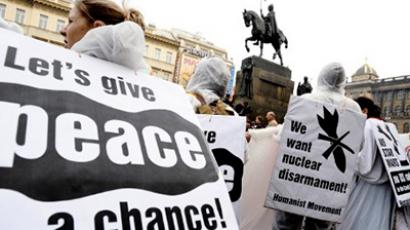
An activist from the Humanist movement, Jan Tamas, believes that what we are seeing now is a dangerous move away from an arms-free future.“It goes again in the way of armament, in the way of using force not only in the countries where there are armed conflicts, like Iraq, like Afghanistan, in other countires in northern Africa and around the Mediterranean, but also in Europe,” he told RT. “And that I see as a very dangerous development. Because if we build up more military equipment in Europe, we are moving closer to a conflict.”“There are many more dangerous weapons of mass destruction around the world,” he continued. “The nuclear weapons. There are thousands of nuclear warheads in the world. And they are just a ticking bomb waiting for a disaster – either one that is planned – or one that is caused by an accident. So, that is a much bigger threat than some potential hypothetical threat like North Korea or Iran.” “What we need to talk about is fundamental threats, the most important threats, and reassess the threats based on their importance,” he stated.