Flames of foul play
Published 15 Sep, 2009 10:18 | Updated 15 Sep, 2009 18:30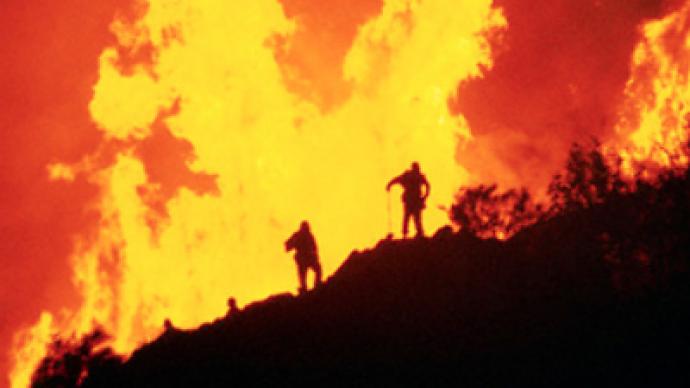
As the number of wildfires amplify each year, so too does the evidence proving global warming is responsible for the foray of ferocious flames, as the planet seeks revenge for man’s gluttony.
Climate change is causing wildfires to become more rife, rampant and increasingly destructive with devastating consequences. As the globe warms up, so too does the number of spontaneous fires, terrorizing landscapes, and scientists are quickly gathering evidence that these two facts are intrinsically linked.
The journal Science admitted that premature snowmelts, spring arriving early, and higher summer temperatures are resulting in longer and fiercer wildfire seasons, and this summer’s firestorm wreckage certainly conforms to their testimonies.
In California, as uncontrollable flames swept through the landscapes last month, lives were lost, homes destroyed. and a financial toll reached almost $45 million. In Spain, many homes, property and businesses were also ravaged by wildfires in July.
According to reports from the State Meteorological Agency, Spain endured its third hottest August this year in fifty years with rainfall being a lot lower than average and humidity extremely high. Angel Rivera, the Met. Office spokesperson, described this summer’s temperatures in Spain to the Europa Press as being “extremely warm”. Whilst admitting that one summer is not enough to substantiate climate change, Rivera asserted that the higher temperatures and lower rainfall are in line with what is expected under climate change. This sentiment stretches thousands of kilometers to the West, to California, who have also experienced abnormally high temperatures and single-digit humidity.
Two years ago, blazes similar to the ones California has recently suffered roared through Southern California, causing analysts to then assert that the fires are consistent with climate change. Ronald Neilson, a professor at Oregon State University and bioclimatologist with the USDA Forest Service, believes patterns in the behavior of catastrophic fires can be directly linked to global warming. Neilson commented on Science Daily:
“You can’t look at one event and say with certainty that it was caused by a changing climate. But things like this are consistent with what the latest modeling shows, and may be another piece of evidence that climate change is a reality, one with serious effects.”
A study carried out by Neilson and other researchers led them to predict that the rising temperatures combined with increasing carbon dioxide levels would result in larger and more frequent catastrophic fires in the west of America. Explaining how global warming can initiate these tragedies, the professor continued:
“As the planet warms, more water is getting evaporated from the oceans and all that water has to come down somewhere as precipitation. That can lead, at times, to heavier vegetation loads popping up and the creation of a tremendous fuel load. But the warmth and other climatic forces are also going to create periodic droughts. If you get an ignition source during these periods, the fires can just become explosive.”
With dense vegetation sprouting from the parched and arid terrain, the Almeria Sierras in mid-July were the perfect location for two different fires, nine days apart, to rip across the countryside, destroying anything that stood in their way.
Perched high on an isolated shelf in Spain’s Sierra de Cabrera, the trinkets and treasures hung upon every quirky cranny in Finca Listonero made the 300-year-old converted farmhouse every bit as beautiful on the inside as it was on the outside. But this “jewel amongst the desert” has been reduced to a heart-rending heap of rubble, whose charms have been replaced by charcoal.
Fact box
Climate change is expected to increase areas burnt by wildfires by 175% by 2050.
Wildfire seasons in Western America have been extended by 78 days.
The length of the burns has increased from 7.5 days per 1000 hectares to 37.1 days and is a response to a 0.87 degrees Celsius rise in temperature.
(Statistics taken from Gist.org)
Suffering from a prolonged period of drought, Matthew Edwards and his partner Carol Vanmosel, the proprietors of Finca Listonero, welcomed the heavy grey sky that hung unusually overhead, backed up by an equally favorable weather forecast that predicted rain. But when the thunder storm finally arrived, it took just an instant for a bolt of lightning to strike the land and ignite it into flames, with devastating consequences. The rain never came, albeit a few drops, which were not enough to rescue the couple’s livelihood from ruin.
Prioritizing the larger urbanizations and having to cover an area of 4,000 hectares, it took the firemen five hours before they finally arrived at the secluded hotel, by which time the damage had already been done. Although many other residents and local authorities believe the fire was started maliciously, Matt Edwards is doubtful that arsonists caused the blaze and believes it was ignited by a bolt of lightning. Mr. Edwards told RT:
“There are accusations flying around about how the fire began, like the flames were seen two hours before the bolt of lightning struck, but to be honest there are just too many discrepancies to these stories. With how hot it is been here this summer, the weather has to be the only offender.”
According to the newspaper, The Reader, at the time of the fires it was generally accepted that they were started deliberately. There was even suspicion that the area damaged happened to “conveniently” be a piece of land caught up in a clash between landowners, town halls and ecologists. Despite a specialist arsonist team being flown in from Madrid and the possible “crime scenes” being sealed off, a lack of evidence meant that any beliefs that the flames were a result of foul play remain speculation. Whilst the cause of both fires continue to be disputed with many yearning for a more “dramatic” answer than a bolt of lightning, a spokesperson for the Emergency Military Unit announced that is was highly likely that the underground roots of the trees and shrub land put out in the first fire continued to burn, and the hot, dry winds caused them to explode into a second wildfire.
Judging by the summer’s shattering blazes, Neilson’s remarks to sciencedaily.com two years ago that, “In the future, catastrophic fire such as those in California may simply be a normal part of the landscape,” seem to bare some truth, not only in America, but in Europe as well. Whilst more research has been carried out and literature written examining the effects global warming is having on wildfires in California, the same life-devastating experiences in countries like Spain are less well-documented. Whilst the actual starting of a wildfire is often an ambiguous guess, ranging from a naïve tourist throwing a cigarette out of the window, to a malicious arsonist out for revenge, the spread and impact of the blazes are less disputable. As the warming climate encourages wildfires to thrive by aiding ignition and spurring them to spread, it is the likes of Matt Edwards and Carol Vanmosel, who describe this summer’s experiences as “a form of grief”, who are the real victims of a tragedy that could have arguably been prevented, if it were not for man’s destructive footprint on the planet.
Gabrielle Pickard for RT