VERSIONS: روسيا اليوم NOTICIAS FREEVIDEO ИНОТВ RTД FIND US ON: YouTube Twitter
breakingnews
Go to main page   Politics   “Britain became hard target for the KGB after 1971”  
MORE ON THE STORY
25.03.2009, 09:32 1 comment

MI5 intimates ‘Russian spies threat’

The British counter-intelligence agency MI-5 warns that foreign spies still present a risk to national security alongside the likes of Al-Qaeda.

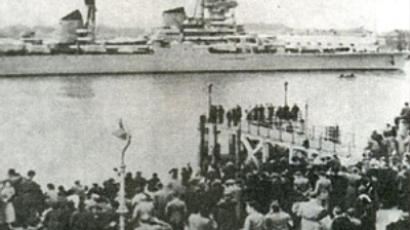
Cruiser ‘Ordzhenikidze’ at anchorage at Portsmouth Harbor 17.04.2009, 13:41 3 comments

Death of MI6 agent during Khrushchev visit still unclear

The British National Archives has declassified documents relating to the visit of Soviet leader Nikita Khrushchev to Great Britain in 1956 and the disappearance of a British special agent connected with the event.

Guantanamo Bay (AFP Photo / Pool / Brennan Linsley ) 06.05.2009, 17:44 1 comment

MI5 made secret deals in Guantanamo – newspaper

The British secret service, MI5, tried to hire British nationals held in Guantanamo Bay and various other US prison camps, reports 'The Independent' newspaper.

Ehud Barak (RIA Novosti  / POOL) 06.09.2010, 17:10 6 comments

Israel Defense Minister in Moscow for talks

Ehud Barak, the Israeli Defense Minister, met with his Russian counterpart Anatoly Serdyukov on Monday to strengthen bilateral security agreements, as well as pay tribute to Russia's sacrifices in World War II.

Slovenian President Danilo Turk (AFP Photo / Hrvoje Polan) 08.05.2010, 13:09 15 comments

The Soviet Union’s input in the liberation of Europe is unforgettable – Slovenia

As countries around the world mark VE-Day, it seems that some of those who once fought side by side, have these days turned on each other.

The Official White House Photostream 10.07.2009, 03:33

"Russia and US mended a totally abnormal state of affairs"

During his regular Thursday media briefing, Russian Foreign Ministry spokesman Andrey Nesterenko discussed the recent visit of U.S. President Obama to Moscow, among other pressing issues in Russian foreign policy.

Russian Foreign Minister Sergey Lavrov 29.04.2010, 19:57 6 comments

Russia knows solution for European problem - Lavrov

The equal, indivisible and guaranteed security of all states should become a real thing instead of being just an attractive motto, Russia’s foreign minister told a PACE plenary session.

21.12.2009, 19:28 10 comments

Consequences of attack on Iran would be unpredictable – Mid-East expert

An attempt to solve Iran’s nuclear issue by an attack on its facilities would lead to "horrible and unpredictable consequences," former Russian Prime Minister Yevgeny Primakov has said.

The final flight stage of a ballistic nuclear missile 30.12.2009, 01:09 13 comments

“Russians are making a tactical mistake” – US expert

The change Barack Obama proposed for the ABM systems in Europe is much more tailored for the Middle Eastern missile threat, says policy analyst Ivan Oelrich, the president of the American Federation of Scientists.

Nuclear ballistic missile SS-18 Satan launched 13.06.2009, 05:31 9 comments

Return of Satan

The Russian military plans to introduce a up-to-date analogue of the most powerful ballistic missile of all time - the RS-20, or SS-18 Satan by NATO classification.

“Britain became hard target for the KGB after 1971”

Published: 14 October, 2009, 11:10

(54.6Mb) embed video

TAGS: Military, Nuclear, Russia, UK, Politics, Terrorism, History


The KGB, unlike MI5, had no limits in growth, so it simply tried to overflow Great Britain with its spies, tells former MI5 member and the organization’s historiographer, Professor Christopher Andrew.

Over the past hundred years, Britain's MI5 intelligence agency has worked through two World Wars, the Cold War and the fight against terrorism – all in as much secrecy as possible.

“Today, only 3.5% of MI5 resources are spent on counter-espionage. Most of the rest is spent on counter-terrorism,” acknowledged Christopher Andrew.

“At the beginning of the Cold War, Cambridge was producing the best agents for both sides. MI5 did not do very well in tracking down the magnificent Cambridge Five, largely because the defector named Anatoly Golitsyn, who defected in the beginning of 1960s to the CIA, knew certain amount of real intelligence, but he added on fabrications [including on the Cambridge Five]”, he said.

“The KGB was huge. There were never any constraints ever on its growth in size, and the same is true of [Russia’s] intelligence services. MI5 is a tiny fraction of the size of the KGB, so the simplest method that the KGB could use for defeating MI5 was simply to flood London with KGB and military intelligence GRU officers, who could run more agents than MI5 could possibly track on,” revealed Andrew. “In the end, the British government in 1971 sent back to Russia 105 Soviet intelligence officers. No other country in the West, the US included, ever came close to that, but it turned Britain from being a soft target for Russian intelligence, which it had been up to 1971, to a very hard target. It remained that way to the end of the Cold War.”

Christopher Andrew admitted that in the 1960s some British MPs worked either for KGB or for Czechoslovak intelligence that was a part of the Soviet bloc, though they did not have significant influence in the Cabinet.

“If [Soviet defector] Oleg Penkovsky had not told the given information to the West on the part that Soviet missile bases were being constructed, the Americans would not have been able to tell at the time of the Cuban missile crisis whether or not the bases constructed there were operational. If they had seen that they were operational – we might not be sitting here having an interesting discussion,” he noted.

Christopher Andrew also mentioned that MI5 never tortured terror suspects because it is a big mistake, as a tortured man could say anything against himself.

During a seven year period Christopher Andrew has had an unprecedented, phenomenal and virtually unrestricted access to 400,000 files, many of which are multivolume, of MI5 archives. He has also recently published a book to mark the 100th anniversary of the agency founded in 1909 (five years ahead of the First World War) to deal with the chief security problems of Great Britain.


+5 (10 votes)
 
Back to top
next MORE NEWS
State Duma, Moscow (AFP Photo / Alexey Sazonov) 14.10.2009, 04:04

Opposition protests local election results

All three opposition parties have walked out of Russia's lower house of parliament, the State Duma, in protest over local elections that took place on October 11 throughout the country.

Vladimir Kremlev for RT 14.10.2009, 14:06 2 comments

ROAR: Russia and China depend on each other

Analysts are wary of the new program of economic cooperation between Russian and Chinese boundary regions.