Eastern partnership summit: better to be an onlooker?
Published 7 May, 2009 20:20 | Updated 8 May, 2009 00:20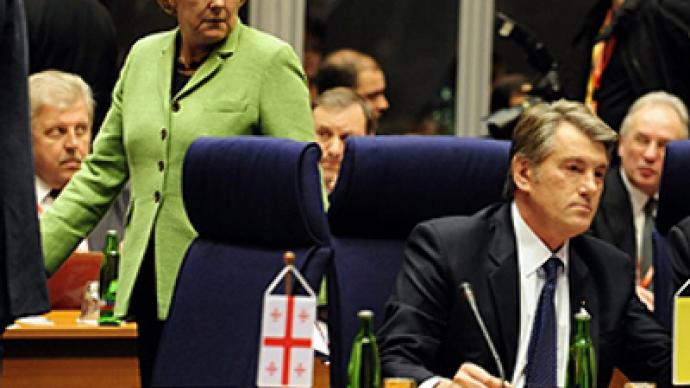
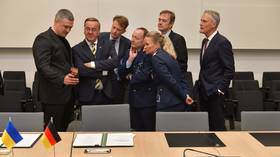
Based upon the number of missing invitees, the Eastern Partnership summit in Prague has been comparable to a dull university lection. Almost all major EU leaders thought they’d better stay at home.
Moldovan president Vladimir Voronin also did not come to Prague, but that is not a surprise considering his shaky position after April’s parliamentory election. But what did Belarusian president Aleksandr Lukashenko want to say by ignoring the summit?
Empty seats
There was no chance to see French President Nicolas Sarkozy, British premier Gordon Brown and his Italian and Spanish counterparts, Silvio Berlusconi and Jose Luis Zapatero, in Prague on Thursday. Similarly, there was no sign of the leaders of Austria, Portugal, Luxembourg, Malta and Cyprus. Was this due to the poor organization (Czech officials were, undoubtedly, distracted by another EU summit – on employment – held on the same day) or were there other reasons for the EU leaders to stay away from the summit? Anyway, their absence considerably deflated the entire event and, as an EU spokesman said, made some people believe that the program is not a very serious initiative.
However, there is another view of the issue from Minsk, where the Eastern Partnership is seen as a serious breakthrough in relations with the EU following years of a cooling-down. There is no doubt that Aleksandr Lukashenko wanted to go to Prague. However, he could not stand being treated as an “inconvenient” person there. The Belarusian president wanted to be “equal to the best”, so from January to May 2009 he has met with Javier Solana, Silvio Berlusconi and even with Pope Benedict XVI, all in an attempt to make the Europeans treat him as a peer. However, EU leaders who have just recently begun getting out of the habit of calling him “the last dictator in Europe” cannot catch up with the pace at which Lukashenko is moving towards gaining a reputation as a mainstream European policymaker. So, the result of his efforts was only a European dispute on the “issue of Belarus”, which threatened to grow into an EU-wide political split. However, that cannot fully explain why Alexander Lukashenko stayed in Minsk, sending instead first Deputy Prime-Minister Vladimir Semashko and the FA minister, Sergey Martynov.
Onlooker sees most of the game
Even without Aleksandr Lukashenko at the summit, Belarus was awarded the prize of the day – the country was accepted as a full participant in the Eastern Partnership program. Thus, Belarus has received access to all the expertise and negotiating opportunities the program can provide. The obstacle to Belarus’ access to the bilateral track of the Eastern Partnership, mentioned by EU commissioner Benita Ferrero-Waldner a couple of weeks ago, is a purely formal question. This was proven at a meeting of the commissioner with Belarusian FA minister Sergey Martynov on the day of the summit, where the parties exchanged texts of declarations on cooperating in the energy field and discussed some EU-Belarus infrastructure projects, among them the integration of Belarusian and Polish electrical networks.
As Belarusian analyst Yury Shevtsov notes, the participation of Belarus in the program also means that Brussels actually made the decision to ultimately lift the diplomatic sanctions against Belarus and will soon have to lift the economic ones, also.
The fact that Belarus was represented in Prague by a governmental delegation means that Lukashenko placed the task of supervising the Eastern Partnership program under the competence of the Belarusian Government, rather than the Presidential Administration. Besides, Belarus sent to Prague the lowest level delegation among all participants of the Summit. All this makes an impression that the Eastern Partnership is just a “technical” question for Belarus. That would help ease possible tensions with Russia, which considers the program to be an encroachment on its traditional partner-countries. By sending a governmental delegation to Prague, Lukashenko has also avoided a more serious split on the “Belarusian question” within the EU, which would be appreciated by its leaders.
There is no doubt that Alexander Lukashenko’s decision to stay in Minsk has helped him to maintain discipline within his “team”. According to an anonymous source within the Presidential Administration, the Belarusian leader’s visit to the Vatican and Rome last week was “a 100% PR project having no economic or political meaning, intended only to demonstrate the effectiveness of a pro-Western party in the President’s Executive Office”. Lukashenko’s decision to skip the visit to Prague, in its turn, has shown who is ‘the Man’ in Belarus. Inevitably, this step will slow the process of Belarus-EU rapprochement and have the effect of throwing cold-water on those who longed for “leapfrogging” to Europe.
Centre joint
Meanwhile, everyone in Europe understands that not a single important decision could be made in Belarus without the President’s consent. At the same time, there are reasons to claim that without Belarus the Eastern partnership program would be pointless. As Yury Shevtsov emphasized, without Belarusian territory it will be impossible to change the economic infrastructure of the region in the way Brussels intends to. We can also expect rapid progress on EU-Belarus relations in the political area, because Brussels already has all necessary agreements from the participants of the Eastern Partnership, except Belarus. This point of view is also shared by the Italian expert, Tiberio Graziani. “If a program of the European partnership excluded the presence of Belarus, it would not be a real European program, but most likely a transatlantic one. The exclusion of Belarus would appear as an imposition of the euroatlantic policy, that being the US policy”, he says. In Graziani’s opinion, within the Eastern Partnership “Minsk could act as a counterbalance against the pro-Atlantic ambitions of hegemonizing the whole of Eastern Europe”.
And the summit has shown that this idea of a creative, non-confrontational Eastern Partnership is quite in line with the views of at least one major EU member – Germany. German Chancellor Angela Merkel, who was practically the only major national EU politician at the event, underlined the constructive perspective of the program saying that “this Eastern Partnership is not against anyone, not against Russia." The German leader urged the new partners to intensify their cooperation not only with each other, but also among themselves. So it looks as though Berlin is eager to shape a new macroregional market for its industry suffering from a severe over-production crisis. And from this point of view, Belarus with its heavy industry, could be an attractive market for innovation.
However, if Belarus – at the moment technologically tied to Russia’s machine-building – adopts European technological standards, its industrial ties with Russia will erode. In this regard, we must admit that to some extent the Eastern Partnership does undermine Russia’s long-term interests, unless Moscow itself is going to become part of the “Greater Europe."
Darya Sologub for RT