European lawmakers ‘meddling in Russia’s internal affairs’ – Foreign Ministry

Published time: September 14, 2012 15:48
Edited time: September 14, 2012 19:48
AFP Photo/Frederick Florin

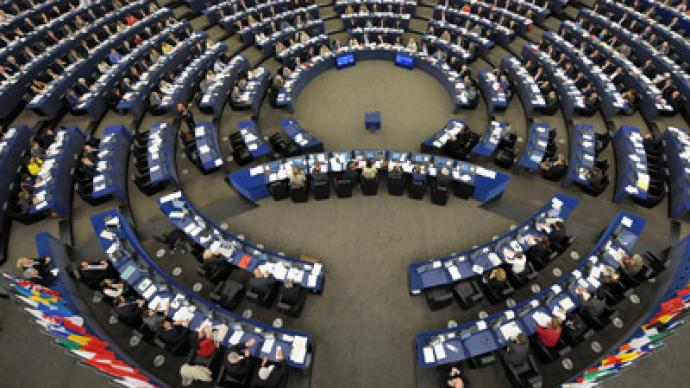
Moscow has responded harshly to a European parliament resolution entitled, ‘On Use of Justice for Political Purposes in Russia,’ saying the document is an example of meddling in the country’s affairs.

­The European Parliament's resolution has been derided by the Russian Foreign Ministry as the latest attempt by European lawmakers to make unfair conclusions on the internal situation in the country. 

“We have read through the European Parliament’s latest resolution on Russia and unfortunately we have to say that the MEPs have once again failed to provide a balanced analysis of the situation in our country,” the Foreign Ministry said in a statement released Friday. “The resolution seems to be based on unconfirmed and biased reports, which is further compounded by unfair ‘analysis.’” 

The EU resolution mentions several high-profile cases in Russia, including the murders of lawyer Stanislav Markelov and journalist Anastasia Baburova, who were gunned down together in January 2009 in Moscow. Following a thorough investigation, the killer – identified as a Russian nationalist with a grudge against Markelov due to his “anti-fascist work” – was sentenced to life in prison.

The investigation also determined that Baburova had the misfortune of being with Markelov at the time of the attack.

The EU report labels the solved case as slow progress. 

As to the complaints concerning Russia’s legal system, Russia’s envoy to the EU Vladimir Chizhov reminded that every country “has its own laws, and legislation even differs inside of the European Union."

Chizhov questioned why the EU parliament never consulted Russia on the developments of the court cases it mentions in the report.

"I understand that this debate was dominated by a speech delivered by EU High Representative for Foreign Affairs and Security Policy Catherine Ashton,” the Russian envoy said. "The wording of this resolution is regrettable and gives a biased picture of the events. Some of them raise questions even from a factual point of view." 

If Ashton wanted to get Russia's viewpoint, she could have done so, Chizhov added.

The Foreign Ministry also mentioned human rights violations in the EU itself, including the issue of not providing citizenship to Russians living in Latvia and Estonia.

Earlier, President Putin’s press secretary Dmitry Peskov told reporters the EU document was ‘unacceptable’.


Comments (46)

Marzipan6 (unregistered) 17.09.2012 13:34

To "JoinedMyTriptoEU" who asks, "Since no statehood traditions (in Estonia before 1920) how can you say about the nation?" Simple. I said it. Estonia existed as a people and as a self-aware culture for around 4,000 years. In the 1300s, it was finally unable to resist the combined attacks of stronger nations, and succumbed to a 600-year night of slavery, from which it emerged again in 1918 through a declaration of independence. Its Russian and German foes immediately mounted a joint attack against it, but because both had already been weakened in WW1, Estonia was able to beat the armies of each, and secured its freedom.

A modern nation-state is just one expression of peoples. German, French and Russian people existed long before their modern nationhood. So did Estonian people.

The logic of your musings on monoculture and multiculture is lost on me, I'm afraid. But you can research Estonia's centuries of recorded history at any relevant historical source anywhere. The very first mention of Estonians in history was by the Roman historian Tacitus in 98AD.

Regardi ng Nazi Germany, it was no less an oppressor and enemy of Estonia than Soviet Russia, and Estonians have no love of either. Each occupied the country, savaged it hugely and sought to destroy it permanently. The only difference between the two is, that Russia came closer to succeeding.

R egarding people of Russian origin in Estonia, most arrived illegally as colonists under Soviet occupation. They never sought and never had Estonian citizenship. Those who haven't gained citizenship by naturalization still don't have it, regardless of how many of them there might be.  As I pointed out in my  post of September 15, their number isn't particularly great in any case. Others who have acquired Russian citizenship are clearly foreigners, quite appropriately have no citizenship rights in Estonia and have nothing to complain about in that regard, while more than 150,000 who have become naturalized Estonian citizens have the same full rights as all Estonian citizens of whatever ethnic origin.

I partly agree with you when you say that Russia is much greater than Europe. Geographically this is true. But by many, many objective economic, social and civic indices, Russia is also much less than Europe.

Any more questions?

0

Undo

Sandy (unregistered) 17.09.2012 13:31

The EU wants to control all countries. Putin and the Russian people are too proud of their country to let Russia be taken over by them. The EU is greedy and should not be trusted.

0

Undo

joind my trip to EU Falls (unregistered) 17.09.2012 12:12

@Marzepan6
let me joint interesting discussion:
===== =======
Question: "When did Estonia have statehood before 1918?"

Answer : Estonia won its freedom through its victorious 1918-20 War of Independence against Soviet Russia and Germany,

Hmmm so actually there were no statehood  traditions in Estonia before 1920. Since no statehood traditions, multiculti so how can you say about nation? Monucultural nation is not nation, especially that has no common history, heroes language. Point.

A  nation without history based on what? fairy-tales fo dominating tribe about SS Estalnd heroes ?mourning and hatery towards Russia? cooooooool


Of course you recall that Estonia was one of very few areas in the Reich that were Judenfrei? and Estonians still hailing SS Estalnd herose even being part of EU. Nobody in Bxl sees it ha ha ha they are busy with foerign agent NGOs
 
====== =======


A nswer: Estonia indeed is multicultural. Ethnic Estonians make up 69% of its population, and the remaining 31% comprise people of 192 different nationalities.


Of which you forgot to add: 25% are ethnic Russians who do not have equal rights. In multicultural country everybody is on the same rights so Estonia is xenophobic.  So so


BTW No yo uare not correct Russia in not EUrope, is European country by geography but no EU colony. Russia is much Greater then EUrope and unlike EU has something to offer not civilization of death.

0

Undo

View all comments (46)
Add comment

By posting your comment, you agree to abide by our Posting rules

Log in to comment in full, or comment anonymously under character-limit restriction.

100 Text

– required fields

Register or

Name

Password

Show password

Register

or Register

Request a new password

Send

or Register

To complete a registration check
your Email:

or Register

A password has been sent to your email address

Edit profile

Name

New password

Retype new password

Current password

Save

Cancel

Follow us