Did Georgia get a US green light to attack South Ossetia?
Published 5 Aug, 2011 13:30 | Updated 5 Aug, 2011 18:17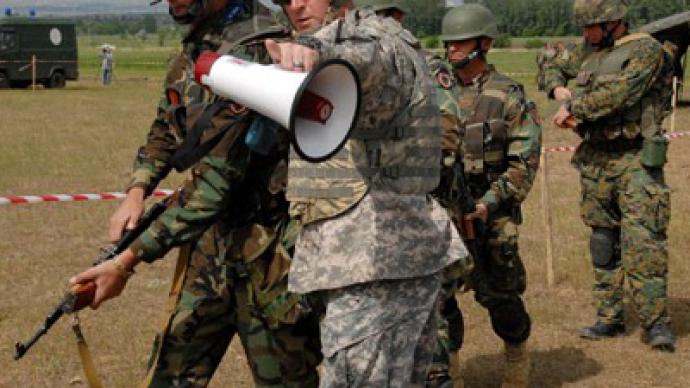
President Medvedev, in an interview on Friday, provided some insight into Georgia's military offensive against South Ossetia in 2008, noting how the Georgia-Russia relationship took a turn for the worst once Tbilisi stepped up talks with Washington.
In the early morning of August 8, 2008, Georgian forces did what had previously been considered unthinkable: they launched a large-scale military attack against the sleeping town of Tshkinval, the South Ossetia capital, in a brash effort to capture the territory. If that move was not bad enough, the surprise offensive, which involved some 11,000 Georgian troops, also killed about a dozen Russian peacekeepers who had been stationed in the contested region since 1993.Ever since then, the world has been left wondering: What would persuade this small, Caucasian country to launch an attack against territories that it knew were being protected by Russian peacekeepers? For many observers, the only possible explanation is that President Mikhail Saakashvili believed that the United States, and possibly even NATO, would rush to his rescue in the event of a Russian counterattack. Of course, such a scenario did not play out, and Georgia went on to suffer severe consequences at the hands of the Russian military for its presumptuous. Is it possible that America’s keen interest in training the Georgian army helped fortify President Saakashvili’s delusions of grandeur to the point that even hulking Russia to the north could be attacked with impunity?In early 2002, the United States launched a two-year, $65 million program called "Train and Equip," which was designed to give Georgia three battalions and one motorized company that would meet NATO standards. Following the successful implementation of that program in 2004, another initiative was launched to train another 4,000 Georgian soldiers. Although such a force would seem adequate for a country the size of Georgia, Tbilisi seemed obsessed with increasing troop strength.“Georgia launched an ambitious program in the fall of 2004 to train 15,000-20,000 reservists,” reported GlobalSecurity.org. “By late October 2004, three battalions of reservists had been established. These battalions underwent intensive basic training over a period of several weeks.”The security website added that “plans called for a total of 15 battalions to be trained by the end of 2005.” Meanwhile, in addition to this relatively robust increase in military expenditures, US and Georgian troops were jointly conducting military exercises on Georgian soil. In fact, just one month before Saakashvili gave the command for his ill-conceived military folly in South Ossetia, Georgian troops were training alongside their US counterparts in Georgia. And what was the name of that military exercise? “Immediate Response 2008.”If Saakashvili needed any additional encouragement that the US would rush to his aid in his hour of need, this was certainly it. "The main purpose of these exercises is to increase the cooperation and partnership between U.S. and Georgian forces," Brigadier General William B. Garrett, commander of the U.S. military's Southern European Task Force, told reporters.The war games, which took place at the Vaziani military base near the capital Tbilisi (a former Russian air force base until Russian forces withdrew in 2000 under a European arms reduction agreement) involved 600 Georgian troops.Georgia had also deployed a 2,000-strong contingent in the U.S.-led coalition in Iraq. Perhaps Saakashvili believed that the United States would feel obliged to defend the interests of a fellow combatant no matter how excessive its actions may be. Meanwhile, Georgia’s lavish spending on military items seemed to know no limit.In addition to increasing troop strength, Georgia significantly increased its defense spending, from 79 million laris ($43 million) in 2004 to 317 million laris ($172 million) in 2005. The jump in military expenditures was consistent with the requirement that countries aspiring to NATO membership spend at least 2 percent of GDP on defense.Here is GlobalSecurity’s report on Georgia’s military increase, and its connection to the imminent invasion of South Ossetia: “The weaponry purchased reportedly included armored personnel carriers, self-propelled artillery, helicopters, and T-72 tanks. The latter three items called into question earlier statements that Georgia had no aggressive intentions and plans to strengthen its armed forces exclusively for defensive purposes, to repel any external invasion. These weapons were well suited for an offensive against the Ossetians."From mid-June to mid-July 2005, some 800 Georgian troops conducted large-scale tank exercises using some 170 battle tanks, the report added. One year earlier, Georgia had only 76 T-55 and T-72 tanks. Incidentally, Ukraine, which at the time was also a NATO hopeful, supplied many of the new T-72 tanks.According to President Dmitry Medvedev, however, those five days that shook the world could have been easily avoided. Although the Georgia-Russia relationship had always been tense since the collapse of the Soviet Union, progress was being made on the diplomatic front.“We met in the Constantine Palace (in St. Petersburg, Russia), and as Mr. Saakashvili arrived, I told him, literally: 'You know, there are many problems in the region at the moment. Georgia is at odds with these unrecognized states. But I can assure you as the newly elected President of Russia that I shall do everything in my capacity to help you find some compromise solutions that would accommodate everyone, and would eventually facilitate the reintegration of Georgian territory. That is, if it is acceptable for all the parties engaged in the negotiations, naturally.'” “That is what I told him, word for word,” Medvedev said. “His response was, 'But of course, we are ready to co-operate.'” The Russian leader said after his meeting with Saakashvili he was “checking regularly for any feedback from our Georgian counterpart. There was nothing.” Meanwhile, Medvedev revealed, “Georgia was getting more and more visits from ‘envoys from across the ocean.'” Medvedev described this as his “moment of truth.”“The moment of truth for me…came with the visit (to Tbilisi on July 10, 2008, less than a month before Georgia launched its attack on South Ossetia) by US Secretary of State Condoleezza Rice,” Medvedev said. “Following that visit, my Georgian counterpart simply dropped all communication with us. He simply stopped talking to us, he stopped writing letters and making phone calls. It was apparent that he had some new plans now. And those plans were implemented later.” When asked if he thought the United States was deliberately encouraging Georgia to pursue a conflict with Russia, Medvedev said no, while stressing the importance of “connotations and nuances” in politics.“No, I don’t think so,” he said. “The United States is a very large country headed by pragmatic people. But in politics, connotations and nuances are very important.”“I do believe that there were certain subtleties and certain hints made – statements like 'It’s time to restore constitutional order,' or 'It’s time to be more assertive' – which could effectively feed Saakashvili’s apparent hopes that the Americans would back him in any conflict, that they would stand up for Georgia and even go to war with the Russians.”Medvedev added that he discerns “a relation between Ms. Rice’s visit to Georgia and the events that followed.” When asked if Georgia received a ‘green light’ from the White House, the Russian leader said he had no official information to back such a claim. However, he once again made a connection between an official visit to Georgia (on July 10, 2008) by then US Secretary of State Condoleezza Rice and the breakdown of communication between Moscow and Tbilisi. “Well, I would have to at least have some official information or intelligence reports to be able to make such a statement. I don’t have them,” he admitted. Medvedev then provides an analysis of the situation: “My Georgian counterpart ceased all communication with us following a visit by Condoleezza Rice. Maybe that was just a coincidence. But I’m almost absolutely sure that that was when they came up with a plan for the military gamble, which ensued in August 2008.”Robert Bridge, RT