Georgian aggression: chronology of war
Published 14 Sep, 2008 06:29 | Updated 2 Oct, 2010 22:33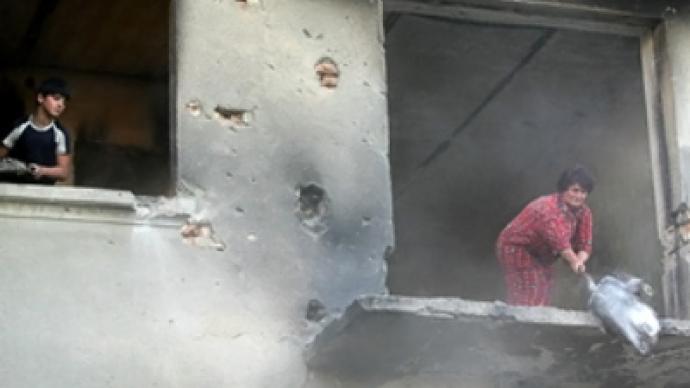
About 7 PM on August 7, 2008 Georgian President Mikhail Saakashvili said live on TV: “Let's stop the escalation and begin negotiations – direct, multilateral, what else. Let us give peace and dialogue a chance”.
The statement calmed the citizens of South Ossetian capital, Tskhinval, who were living in anticipation of escalating conflict. The people believed that there were ways out of crisis and that the Georgian leadership would do all everything necessary for a peaceful settlement.
But within the next few hours tons of hot lead from artillery, howitzers and “Grad” rocket systems were hurled on the peacefully sleeping and defenseless city. Tskhinval plunged into chaos. People died in their beds, on the streets, and in the basements of the houses where they tried to escape the ruthless bombing.
“The Georgian side has virtually declared war on South Ossetia”, – said the commander of the peacekeeping contingent in South Ossetia, Marat Kulahmetov, after the firing commenced.
The operation conducted by Georgian troops aimed “to establish constitutional order in the Tskhinvali region” and received the code name of “Clear Field”. There are no doubts about what should have been a result of these actions. There are no buildings, infrastructure, human beings in the clear field. Following the logic, none of this should stay in the zone where the Georgian army was firing. The carpet bombing of civilian building were labeled “the destruction of a criminal regime” by Georgian Minister Temur Yakobashvili. But he didn’t specify how he suspected the residents of Tskhinval of being criminals.
Early in the morning of August 8, another massive wave of shelling from all kinds of weapons commenced, hitting the town. Georgian artillery was aiming at the Tshinval Republican hospital, where the wounded were brought throughout the night. In the middle of the day there were 270 people with gunshot and shrapnel wounds. Medical Personnel were unable to take new patients and had to evacuate the injured to the building basement.
Georgian tank columns entered Tskhinval. The Russian peacekeepers didn’t return fire, but the Georgian tanks, and artillery, attacked their positions. The first tank shot destroyed the observation post on the roof of the barracks of the Russian peacekeeping battalion, located in Tskhinval. As a result, Russian soldier, Sergey Kononov, was killed. The next series of bursts destroyed the battalion’s equipment, including hospital vehicles, which were clearly marked with Red Cross signs.
After this began a massive offensive on the battalion position, by infantry backed with tanks and artillery. In the first hours of battle, Russian peacekeepers suffered serious casualties – ten people were killed, and 25 wounded.
The shelling of South Ossetia was accompanied by an attack from the air. Five Georgian Su-25 aircraft attacked the village Tkverneti. In addition, planes were dropping bombs on the village of Kvernet and bombed a convoy with humanitarian aid, which was going into Tskhinval by the Zarskaya road.
In Tskhinval, now cut from the outside world, Georgian punishers were restoring “the constitutional order” with fire and sword. Saakashvili’s soldiers were opening fire at all moving targets: men, women, elderly people and children. Georgian tanks were shooting at vehicles stuffed with panic-stricken people trying to escape the burning city. Heavy vehicles ran over burning cars with people inside them. Basements, which sheltered those who could not run away, were bombarded with grenades. Georgian snipers occupied the key heights, showering the city with bullets from all the sides.
The essential priority in the protection of human rights is the right to life. Killing for the sake of a national idea cannot be justified. In South Ossetia, the key legal and human values, worked out by the world community over the course of centuries were crossed out by barbarity, by absurd and blind aggression, in one night.
The war in South Ossetia, Georgia unleashed on the opening day of the Olympic Games in Beijing, only produced the concern of the international community. The UN Secretary General Ban Ki-moon stated that he was extremely concerned by the outbreak of violence in South Ossetia. Meanwhile, the United Nations Security Council, called for an emergency session on South Ossetia, was unable, not only to stop Georgia’s aggression but even come up with a joint resolution on the situation in South Ossetia. EU Foreign Policy Chief Javier Solana had a telephone conversation with Georgian President Mikhail Saakashvili, urging him to take all necessary measures to stop violence in South Ossetia.
The reaction of the international community did not stop the Georgian military machine. On August 8, fighting went on for the whole day. A small group of Ossetian militia and police resisted the Georgian army – trained by American and Israeli instructors and equipped with brand new arms. Georgia’s Prime Minister Vladimir Gurgenidze stated that “government troops must establish guaranteed peace” and that the military operation would continue until the population is in security.
While exterminating the residents of Tskhinval and South Ossetian villages, the Georgian leadership made repeated statements insisting on a peaceful settlement of the conflict. By 3 p.m. on August 8 the Georgian authorities announced a shooting moratorium for the organisation of a refugee corridor. However, peacekeepers who stayed in the area refuted these statements, saying that the city was under constant shelling.
Could Russia not give an adequate response to the unprovoked, barbaric actions of the Georgian leadership? Thousands of Russian citizens live in South Ossetia, Russian peacekeepers with international status have been ensuring security in the region over the course of 15 years. All earlier agreements reached between Georgia and South Ossetia, with the participation of Russia, the European Union, and OSCE, were cancelled by war crimes which could not be left unpunished. The residents of South Ossetia wanted to survive at all costs while the Georgian authorities were doing their best to keep their grip on the occupied territory.
Taking into account the indistinct stance of the U.S. and the EU, the extermination of the South Ossetians could only be stopped by the tough and proportionate use of force. Russian President Dmitry Medvedev took the decision about a “peace enforcement operation”. On August 8, units of Russia’s 58th army entered the territory of South Ossetia.
In the evening of August 9 the Russian army started pushing Georgian forces out of Tskhinval. By this time, the peacekeeping camp was almost destroyed. At seized observation points Georgian soldiers were shooting at peacekeepers and local residents, preventing medical services from evacuating the wounded from the combat area. Hundreds of refugees were seeking rescue at the Zarsk road. Noticing tanks, people would rush to soldiers for help and protection. However, taking advantage of the similar look of the military equipment being used by both sides, the Georgian military coolly shot and burned defenseless people in their cars.
Supported by the South Ossetian militia, the Russian army was able to push the Georgian aggressors to the outskirts of the city, and a part of Georgian army was encircled. The Russian air force struck Georgian air bases from where Georgian planes were carrying out regular air strikes on Tskhinval. The fighting continued on August 10 and 11. On these days the Georgian military continued shelling the capital and villages of South Ossetia. On August 12 Georgian military bases near the city of Gori were destroyed. It was not until August 13 that the first columns with the humanitarian aid could make their way to Tskhinval and affected villages.
Georgian aggression claimed the lives of hundreds of South Ossetian civilians. Hundreds of injured filled the hospitals of Vladikavkas, in Russia’s republic of North Ossetia. In the first days of the war thousands of refugees crossed the border to North Ossetia. People were forced to leave their houses and belongings. They had to flee, leaving the bodies of their killed relatives unburied. By August 14 there were 34,000 people in refugee camps in Russia’s republics of North Ossetia, Kabardino-Balkaria and its Stavropol, Krasnodar and Rostov regions.
The Georgian military blew up the water pipeline in Tskhinval, which severely exacerbated the humanitarian disaster. People who stayed in the city during the military operation and the following week had no fresh water and food. Emergencies workers set up hospitals in Tskhinval and the village of Java, and started providing assistance. They also organised water supply and distribution of food.
The investigation of crimes in South Ossetia shows that the shelling residential areas by Georgia’s military used cluster bombs as well as various multiple artillery rocket systems; notably the GradLAR-160, and the 262 mm Orkan. A 46-kilogramme rocket launcher contains 104 dual purpose M85 cluster bombs produced in the U.S. One shell can cover a massive area. These are exactly the shells in service with the Georgian army.
From August 7 to 8, 18 Grad units, each containing 40 rocket missiles, were shelling Tskhinval. 720 missiles were fired in 30 seconds. The large coverage area of the shells coupled with the non-specific targeting resulted in multiple civilian casualties and victims in Tskhinval, and other cities and villages in South Ossetia.
According to the specialists’ assessment, 70 per cent of the South Ossetian capital was ruined. A calm and cozy city turned into Stalingrad, destroyed by the Nazi in 1942-1943. As a result of Georgia’s aggression, industrial facilities and government buildings are destroyed. Cultural and historic monuments suffered particularly, as they were deliberately targeted by the artillery and tanks. This shows that the Georgian military aimed to annihilate not only the people but their cultural heritage.
The historical part of the city, considered to be an architectural conservation area, has been completely wiped out. During the war of 1991-92 it was severely damaged, and this time it has been completely burnt down. After Grad shelling no joist has been left which would allow an assessment or determination of the age of the buildings, many of which having a thousand-year history. The city’s synagogue survived the bombing but was severely ravaged. Blast waves have caused deep cracks in the walls of the orthodox church of Georgy Kavtinsky, which dates back to the 9th century. The foundations of the Church of the Nativity of the Most Holy Mother of God, built in 1718, have been shaken.
The memorial house museum of prominent Iran researcher Vasily Abayev has been burned down, while his monument, in Teatralnya square in central Tskhinval, was beheaded. Georgian tanks virtually wiped off the face of the earth a memorial cemetery, in the courtyard of school #5, where those perished in the war of the 1990s are buried. All cultural institutions in Tskhinval suffered. The local history museum, “Chermen” and cinema are ruined, the Culture Ministry building with documents concerning South Ossetia’s more than 700 historical and cultural monuments, is burnt down. The Parliament building of South Ossetia, which is an architectural monument constructed in 1937, has also been reduced to ashes.